Most boards now ask the same question in different words: "How mature is our cybersecurity, and is it getting better?" NIST Cybersecurity Framework (CSF) 2.0 is the obvious yardstick, but the framework itself does not hand you a maturity score. It gives you outcomes, Tiers and Profiles, and leaves the measuring to you. That gap is why so many CSF assessments end up as a colourful heat map that nobody can explain or repeat a year later.
This guide shows how to run a NIST CSF maturity assessment that holds up: what CSF 2.0 actually provides, how Tiers differ from maturity levels, a five-level scoring scale you can apply to each subcategory, a seven-step method, an illustrative worked example and the mistakes that make results meaningless. It is written for CISOs, GRC leads, internal auditors and consultants who need a baseline they can defend and track.
What is a NIST CSF maturity assessment? (Quick answer)
A NIST CSF maturity assessment measures how well an organisation achieves each outcome in the NIST Cybersecurity Framework, usually by scoring every subcategory against a defined maturity scale for its current state and its target state. The gaps between the two become a prioritised improvement roadmap. NIST provides the outcomes, Tiers and Profiles; the maturity scale is chosen by the organisation.
What NIST CSF 2.0 gives you, and what it does not
NIST published CSF 2.0 as NIST CSWP 29 in February 2024. It has three main parts that matter for an assessment:
The CSF Core: a set of cybersecurity outcomes organised into 6 Functions (Govern, Identify, Protect, Detect, Respond, Recover), 22 Categories and 106 Subcategories. Govern (GV) is new in 2.0 and covers strategy, roles, policy, risk management strategy, oversight and supply chain risk.
Organizational Profiles: a way to describe your Current Profile (the outcomes you achieve today) and Target Profile (the outcomes you want to achieve). Comparing them shows the gaps.
Tiers: four levels (Tier 1 Partial, Tier 2 Risk Informed, Tier 3 Repeatable, Tier 4 Adaptive) that characterise the rigour of your cybersecurity risk governance and risk management practices.
What CSF 2.0 does not include is a scoring method. There is no official NIST maturity score, no "CSF certification" and no required level. The framework is voluntary and outcome-based, so two organisations can both "use CSF" and measure themselves in completely different ways. That is fine, as long as you define your scale before you start and apply it consistently.
If you are building the governance side for the first time, our guide to the layers of a governance framework explains how strategy, policy and oversight fit together, which is exactly what the new Govern function asks for.
NIST CSF tiers vs maturity levels
This is the most common point of confusion. Tiers and maturity levels look similar because both run from "informal" to "optimised", but they answer different questions.
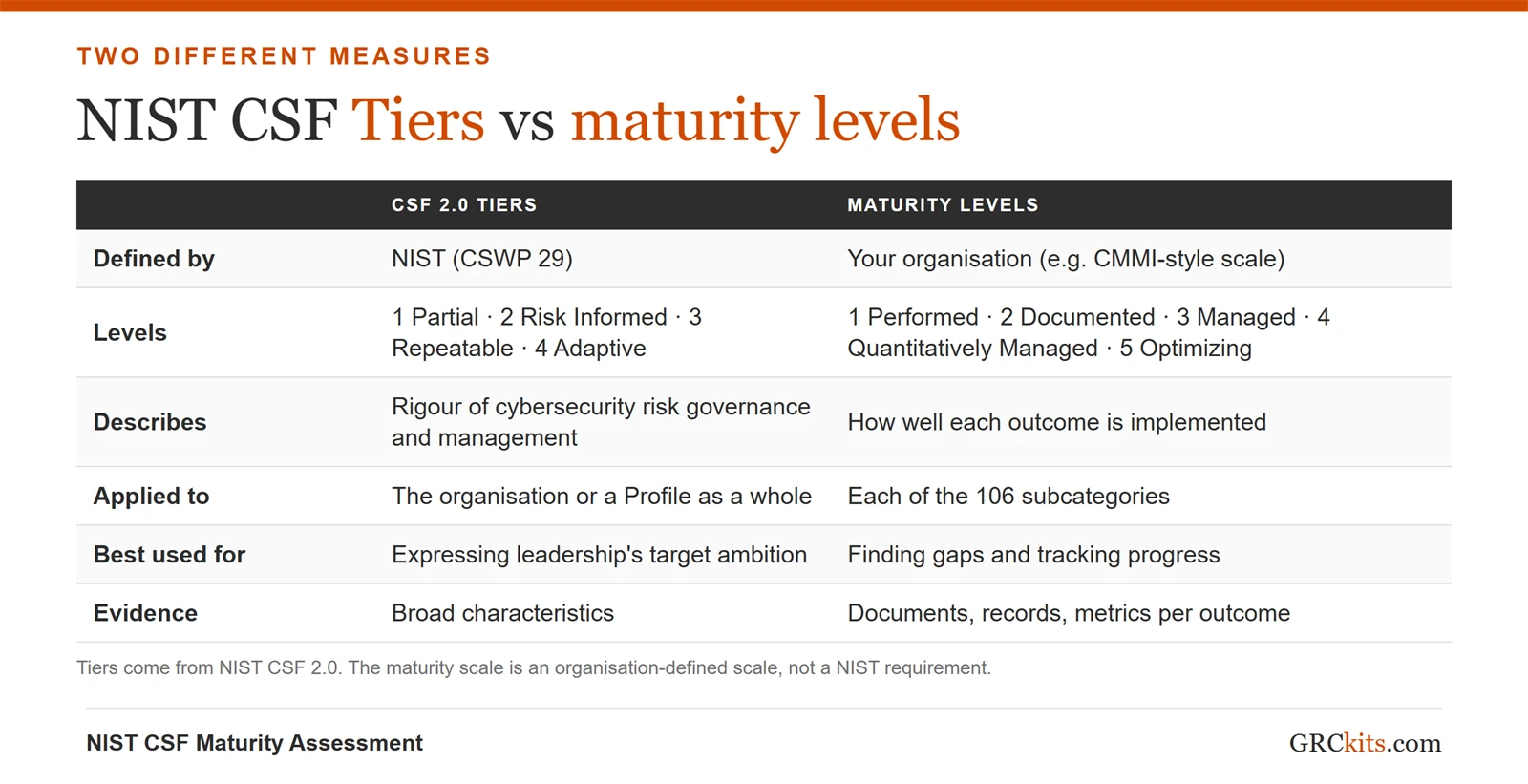
Tiers are a high-level description of how cybersecurity risk is governed and managed: whether practices are ad hoc or formally approved, whether risk information flows across the organisation, and whether the organisation adapts based on lessons learned and threat intelligence. NIST's quick-start guide on using CSF Tiers (NIST SP 1302) suggests selecting Tiers to inform your Current and Target Profiles.
Maturity levels are an internal scoring scale applied subcategory by subcategory. They tell you, for example, that asset inventory (ID.AM-01) is documented but not measured, while incident escalation (RS.MA-04) is performed informally with no documented procedure.
NIST does not present Tiers as a maturity model, and a single Tier cannot show you where the weaknesses are. In practice, many organisations use both: a target Tier to express leadership's ambition, and a maturity scale to measure progress at subcategory level. Just do not report one as if it were the other.
The five maturity levels used in a CSF maturity assessment
Most CSF maturity scales borrow from capability maturity models such as CMMI. The scale below is the one used in the GRCkits workbook. It is a practical internal scale, not a NIST requirement, and you can adapt the wording to your organisation.
Level | Name | What it looks like for one subcategory | Typical evidence |
|---|---|---|---|
1 | Performed | The outcome is achieved, but informally and inconsistently. It depends on individuals. | Interviews, ad hoc emails or tickets |
2 | Documented | A policy, standard or procedure exists, is approved and is followed in most cases. | Approved documents, records of use |
3 | Managed | The process is owned, applied consistently across the scope, reviewed and corrected when it fails. | Owner assigned, review records, exceptions tracked |
4 | Quantitatively Managed | Performance is measured with metrics and targets, and the results drive decisions. | KPIs/KRIs, dashboards, management reports |
5 | Optimizing | The process improves continuously based on metrics, incidents, threat intelligence and lessons learned. | Improvement log, post-incident changes, trend data |
Two rules keep the scale honest. First, a level counts only if the levels below it are also true: a process cannot be "Quantitatively Managed" if it is not documented. Second, the score reflects what you can evidence, not what the process owner believes. Some teams also use a level 0 (Not performed) for outcomes that are missing entirely.
How to run a NIST CSF maturity assessment in 7 steps
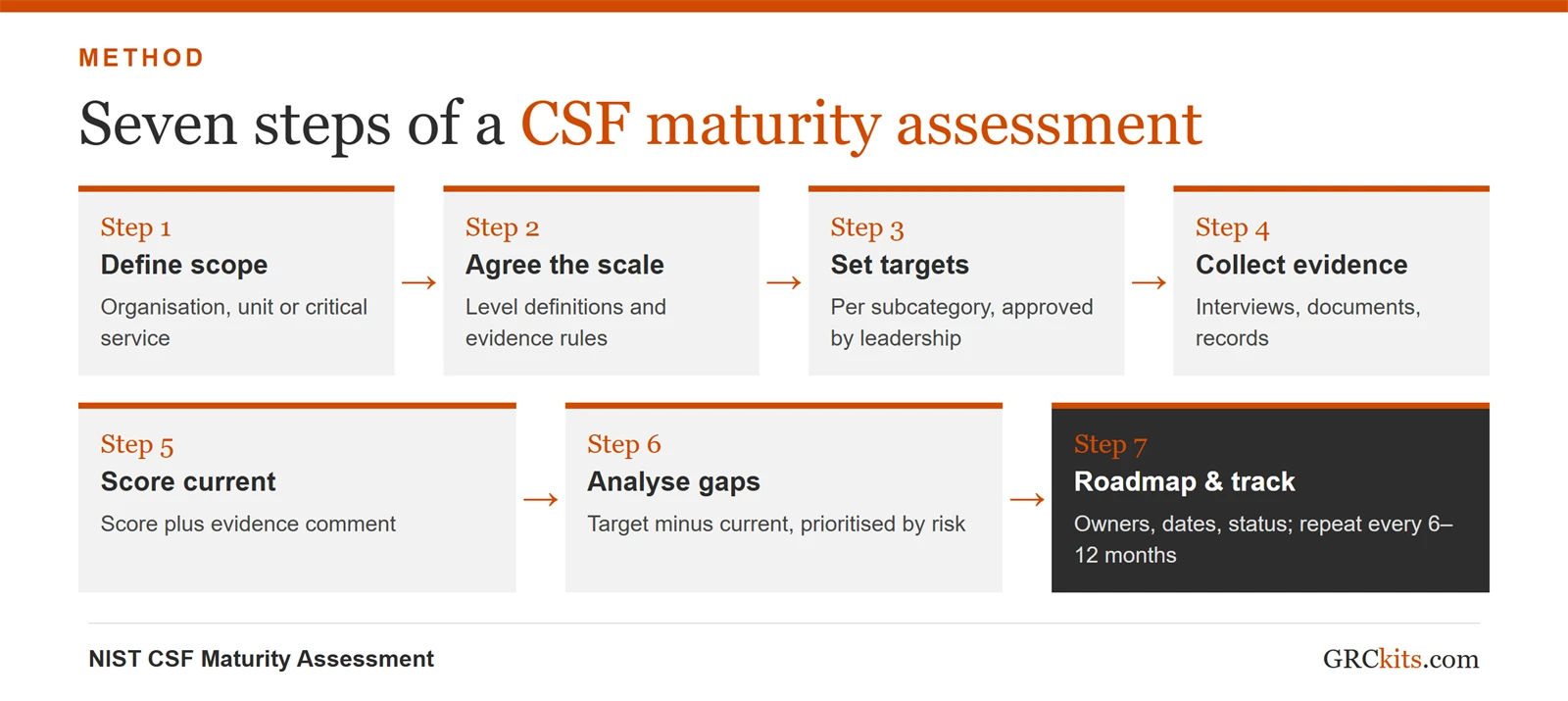
Step 1: Define the scope
Decide what you are assessing: the whole organisation, a business unit, a critical service or a subsidiary. Write the scope down, including what is excluded. A score for "the group" and a score for "the payments platform" are not comparable, and mixing them is the fastest way to lose credibility with the board.
Step 2: Agree the maturity scale and the evidence rules
Fix the level definitions before scoring. Agree what evidence is enough for each level, who can score, and how disagreements are settled. If several people assess different functions, run a short calibration session where everyone scores the same three subcategories and compares results.
Step 3: Set target maturity per subcategory
Not every outcome needs level 5. Set targets based on risk, regulatory obligations, customer requirements and budget. A target of level 3 across the board with level 4 for the outcomes that protect your most critical services is a realistic starting point for many mid-sized organisations. Your target Tier, if you use one, should be consistent with these targets. Targets are leadership decisions, so get them approved, ideally as part of your cybersecurity strategy and implementation plan.
Step 4: Collect evidence
Interview process owners, review documents and sample records. The CSF 2.0 informative references (published through NIST's Online Informative References program) help here: each subcategory maps to controls in frameworks such as NIST SP 800-53 and the CIS Controls, which tell you what evidence to look for. NIST also publishes implementation examples for each subcategory in the CSF 2.0 resource centre.
Step 5: Score current maturity
Score each of the 106 subcategories (or those in scope) and record the evidence and comments next to the score. A score without a comment is an opinion; a score with "Asset register exists in CMDB, last reviewed March, 12% of servers missing owner" is a finding someone can act on.
Step 6: Analyse the gaps
For each subcategory, gap = target level minus current level. Then prioritise. A gap of two levels on an outcome that protects a critical service matters more than a gap of three on a low-risk outcome. Roll the results up by category and function to see patterns: a weak Govern function often explains weaknesses everywhere else.
Step 7: Build the roadmap and track it
Turn priority gaps into actions with an owner, a target date and a status, and report progress monthly or quarterly. Treat the largest gaps as risks: record them in your risk register with an owner and a treatment decision, so leadership formally accepts whatever cannot be fixed this year. Then repeat the assessment, usually every 6 to 12 months, using the same scale and scope so the trend is real.
Worked example: scoring five subcategories
The example below is illustrative, not data from a real organisation. It shows how a mid-sized company might record part of its assessment.
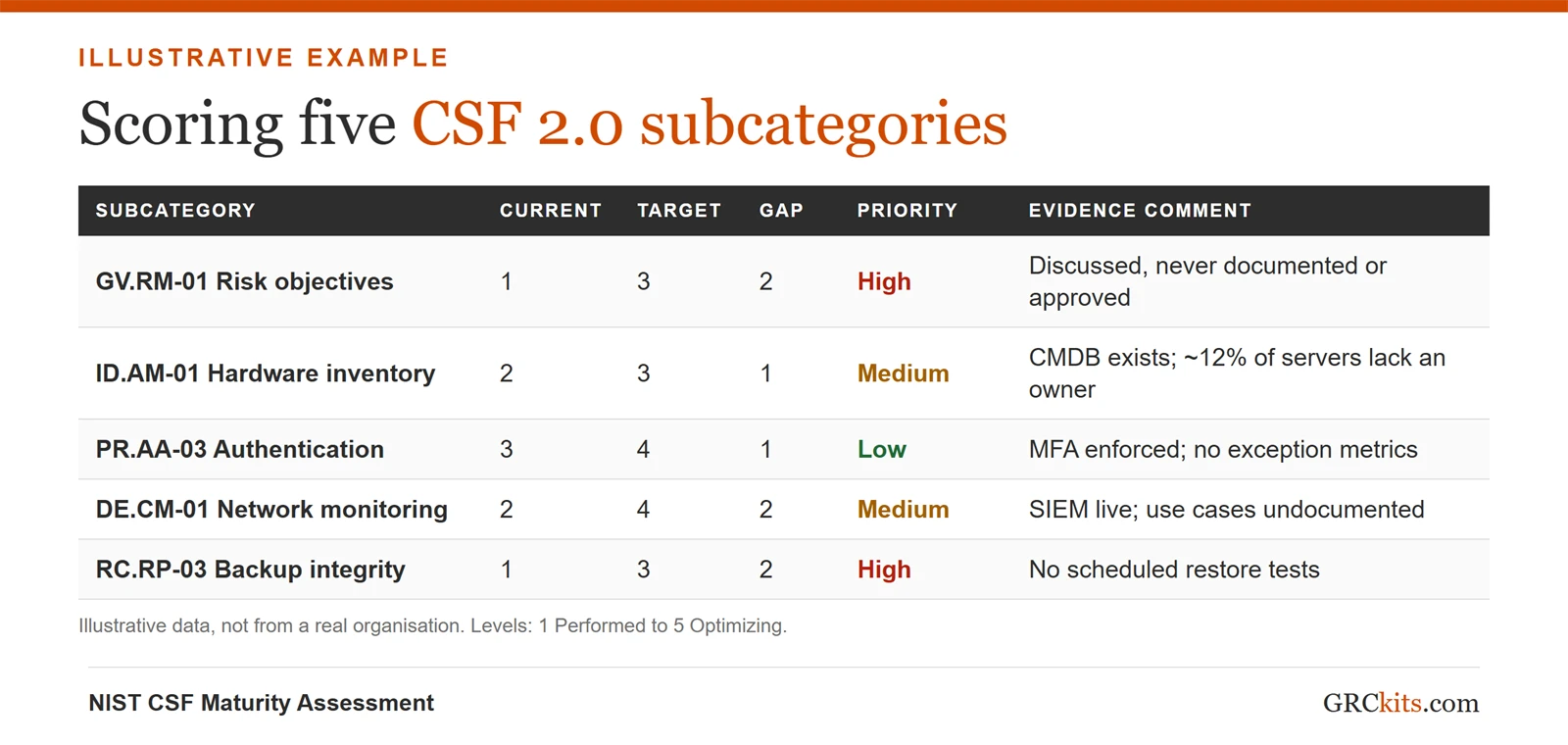
Subcategory | Current | Target | Gap | Comment |
|---|---|---|---|---|
GV.RM-01 Risk management objectives are established and agreed | 1 | 3 | 2 | Objectives discussed in leadership meetings but never documented or approved |
ID.AM-01 Inventories of hardware are maintained | 2 | 3 | 1 | CMDB exists; no owner review; around 12% of servers lack an owner |
PR.AA-03 Users, services and hardware are authenticated | 3 | 4 | 1 | MFA enforced for staff; no metrics on exceptions or service accounts |
DE.CM-01 Networks are monitored for adverse events | 2 | 4 | 2 | SIEM in place; use cases undocumented; no alert quality metrics |
RC.RP-03 Integrity of backups is verified before use | 1 | 3 | 2 | Restores done when needed; no scheduled restore tests |
Three of the five gaps are two levels, but they are not equal. The backup gap (RC.RP-03) and the governance gap (GV.RM-01) would usually go first: untested backups turn a ransomware incident into a crisis, and without agreed risk objectives every other target is just someone's opinion.
Common mistakes in CSF maturity assessments
Reporting Tiers as maturity scores. "We are Tier 2.7" mixes two different measures and cannot be traced to evidence.
Averaging everything into one number. An overall score of 2.6 hides the one outcome at level 1 that could sink you. Show function and category scores, and list the top gaps by name.
Setting level 5 as the target for everything. It is expensive, rarely justified and makes every result look like failure.
Self-assessment without evidence. Process owners almost always score themselves one level higher than the evidence supports.
Changing the scale between assessments. If the definitions change, the trend line means nothing.
Ignoring Govern. Teams used to CSF 1.1 often skip the new GV function. It has 31 subcategories, more than any other function, and it is where boards and regulators look first.
No owners for the gaps. A gap without an owner and a date is a finding that will appear again next year.
Tools for a NIST CSF maturity assessment
You can run an assessment in many ways: NIST's own Organizational Profile templates, a GRC platform, or a structured spreadsheet. Sector-specific maturity models also exist, such as the U.S. Department of Energy's Cybersecurity Capability Maturity Model (C2M2), which maps to the CSF.
A spreadsheet works well for a first baseline or for consultants who assess several clients, as long as it fixes the scale and calculates gaps for you. The GRCkits NIST CSF 2.0 Maturity Assessment Tool is an Excel workbook built for exactly this: all 106 subcategories with informative references, current and target scoring on the five levels above, automatic gap calculation, a dashboard with a radar chart and the top 10 priority gaps, and a remediation tracker with owners, dates and status. It is formula-driven with no macros.
If your organisation is also certified to ISO 27001, keep the two aligned rather than running parallel programmes. Our ISO 27001 implementation guide explains the ISMS side, and our comparison of compliance software vs spreadsheets helps you decide when a spreadsheet stops being enough. Remember that CSF-to-ISO mappings are partial: a good score in one framework does not prove compliance with the other.
Reporting the results to the board
Boards do not need 106 scores. A one-page summary usually works best:
Scope and method: what was assessed, when, and the scale used.
Function view: current vs target for the six functions, often as a radar chart.
Top five to ten gaps: in plain language, with the business risk each one creates.
The plan: owners, dates and budget for closing the priority gaps.
Decisions needed: targets to approve, risks to accept, investments to fund.
Trend: from the second assessment onwards, what improved and what did not.
If you are a new security leader, the first assessment is also a strong day-90 deliverable; our CISO first 90 days plan shows where it fits.
Frequently asked questions
Does NIST CSF have a maturity model?
No. CSF 2.0 provides outcomes (the Core), Organizational Profiles and Tiers, but no official maturity model or scoring method. Organisations choose their own maturity scale, often based on CMMI-style levels, and apply it to the CSF subcategories.
What are the four NIST CSF tiers?
Tier 1 Partial, Tier 2 Risk Informed, Tier 3 Repeatable and Tier 4 Adaptive. They characterise the rigour of an organisation's cybersecurity risk governance and risk management practices, and can be used to inform Current and Target Profiles.
How many subcategories are in NIST CSF 2.0?
CSF 2.0 has 106 subcategories in 22 categories across 6 functions: Govern (31), Identify (21), Protect (22), Detect (11), Respond (13) and Recover (8).
How long does a NIST CSF maturity assessment take?
It depends on scope and evidence depth. A focused baseline for a mid-sized organisation often takes a few weeks of elapsed time, mostly spent on interviews and evidence collection. Repeat assessments are faster because the scale, scope and evidence sources are already agreed.
What maturity level should we target?
There is no required level. Many organisations target level 3 (Managed) for most outcomes and level 4 for outcomes that protect critical services or are under regulatory scrutiny. Set targets based on risk and get leadership to approve them.
Can we get certified against NIST CSF?
No. NIST does not certify organisations against the CSF. You can have an independent assessment or audit, but the result is an attestation of your status, not a NIST certification.
Key takeaways
NIST CSF 2.0 gives you outcomes, Profiles and Tiers, but the maturity scale is yours to define.
Tiers describe how rigorously you govern and manage cybersecurity risk; maturity levels score each subcategory. Use both, but do not mix them.
Agree scope, scale, evidence rules and targets before scoring anything.
Prioritise gaps by risk, give each one an owner and a date, and repeat the assessment on the same basis.
Ready to run your own baseline? Start with the NIST CSF 2.0 Maturity Assessment Tool, or read our guide to building a risk register in Excel to track the gaps you find.

Written by
Shahidul Shubo
Cybersecurity GRC Consultant
Shahidul Shubo is a Cybersecurity GRC Consultant with 10+ years of experience in information security governance, risk management, regulatory compliance and IT audit, and has audited more than 120 organisations. He is CISA and CISM certified, an ISO/IEC 27001 Lead Auditor and Lead Implementer, and a Lead Auditor for ISO/IEC 27701, ISO/IEC 42001, ISO 22301 and ISO 9001. His technical credentials include AWS Solutions Architect, AWS Security Specialty, Red Hat RHCA and RHCE, Fortinet NSE and CCEP. He works hands-on with ISO 27001, NIST CSF and NCA ECC, and builds the practical templates and assessment tools published on GRCkits.
Connect on LinkedInNeed hands-on help?
Governance, Risk & Compliance (GRC)
Meet regulatory requirements, manage risk and maintain strong governance frameworks.
Talk to a GRC expert