A cybersecurity strategy has become a business requirement for any organization that runs on digital services, cloud platforms, and data. Even so, many security programs still grow reactively. A firewall gets replaced after an audit finding. An EDR tool arrives after a ransomware headline, and phishing training starts after an incident. Each decision may be sensible on its own, but together they rarely form a coherent defense. The cost of getting this wrong keeps rising: IBM's Cost of a Data Breach Report 2026 puts the global average cost of a breach at USD 4.99 million, up 12% on the previous year and the highest figure the study has recorded.
Tools solve technical problems. They don't decide which risks matter most, who owns them, how much risk leadership will accept, or where a limited budget should go. That is the job of strategy.
This guide explains three things:
what a cyber security strategist uses as the foundation for strategy
how that strategy becomes a documented cyber security plan
how a cybersecurity implementation plan turns both into measurable progress
What Is a Cybersecurity Strategy?
A cybersecurity strategy is a leadership-approved, multi-year direction that defines how an organization will protect its critical business services, information, and technology to an acceptable level of risk. It answers three questions:
Where are we today? Current risk exposure and security maturity.
Where do we need to be? A target state based on business priorities, risk appetite, and legal obligations.
How will we get there? Prioritized initiatives, governance, resources, and measures of success.
How cybersecurity supports business objectives
A good strategy treats security as an enabler. Suppose the business plans to launch online payments, move core applications to the cloud, or acquire a competitor. The strategy should explain how security will make those moves safe, compliant, and fast, rather than simply listing technical controls.
Strategic vs. operational cybersecurity
Strategic cybersecurity sets direction: priorities, target maturity, governance, investment themes, and risk tolerance. It usually covers three to five years.
Operational cybersecurity runs the daily work: patching, monitoring alerts, managing access requests, and handling incidents.
Operations without strategy leads to constant firefighting. Strategy without operations is a document nobody follows.
Why strategy must be risk-driven and business-aligned
No organization can protect everything equally. A risk-driven strategy puts investment where a failure would hurt the business most. Examples include an outage of a revenue-generating platform, a breach of regulated customer data, or a compromise through a critical supplier.
Leadership, governance, and accountability
A strategy needs executive sponsorship and clear ownership:
The board or executive committee sets risk appetite.
The CISO or security leader designs and drives the strategy.
Business leaders own the risks in their areas.
Without this accountability, cybersecurity becomes an IT-only exercise.
Strategy vs. policy vs. plan vs. implementation plan
Term | What it is |
|---|---|
Cybersecurity strategy | The long-term direction and priorities |
Cybersecurity policy | Mandatory rules and expectations, such as an access control policy |
Cyber security plan | The documented program that turns strategy into scoped controls, owners, and activities |
Cybersecurity implementation plan | The detailed schedule of projects, tasks, deadlines, and deliverables |
What Do Professionals Utilize as the Basis for Cybersecurity Strategies?
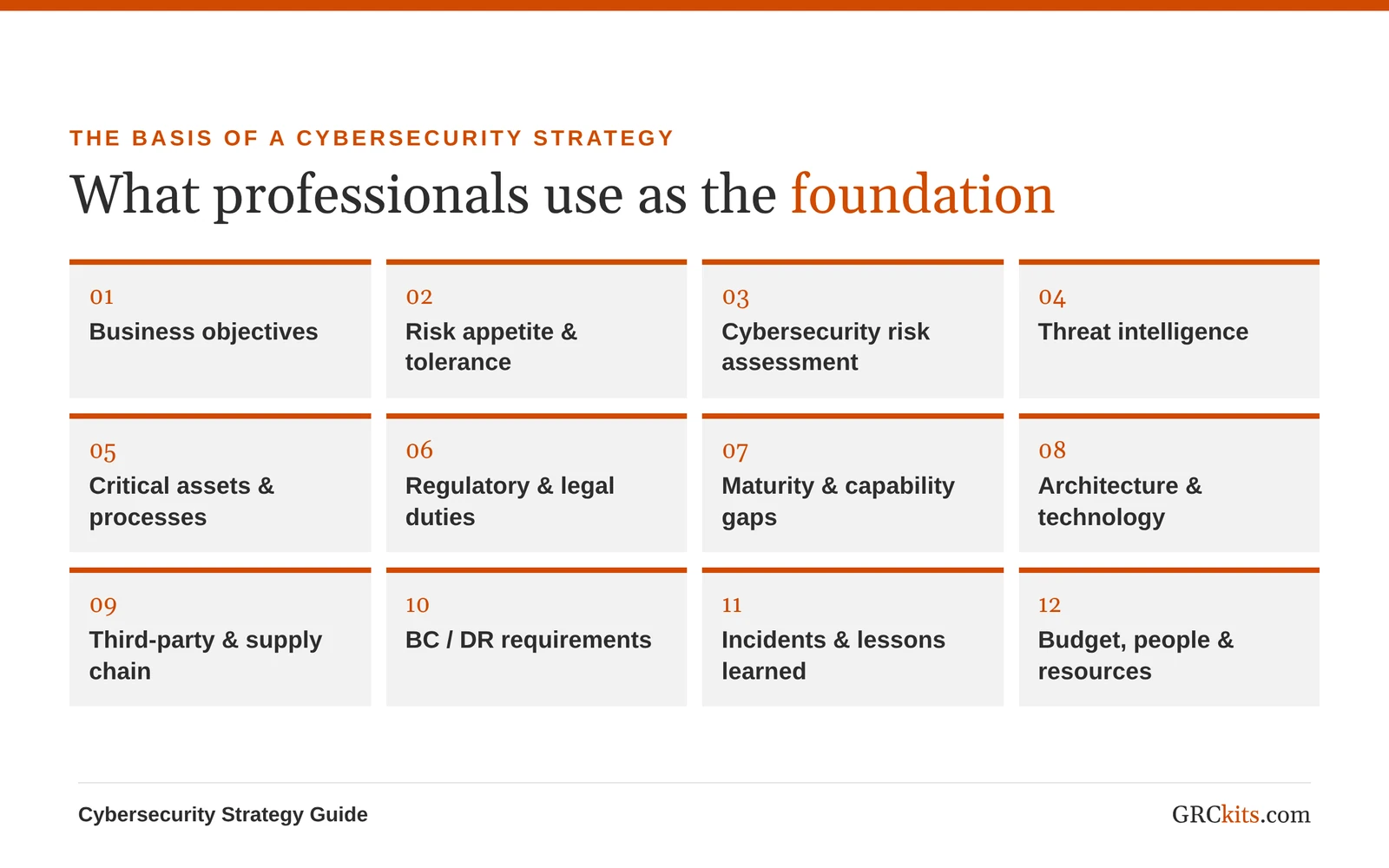
Cybersecurity professionals base their strategies on business context and risk, not on a single framework or product. An experienced cyber security strategist combines several sources of evidence:
Business objectives and strategic priorities. Growth plans, new products, digital transformation, mergers, and market expansion.
Risk appetite and risk tolerance. How much loss, downtime, or regulatory exposure leadership will accept.
Enterprise and cybersecurity risk assessments. Identified risk scenarios, their likelihood and impact, and how each is being treated.
Threat landscape and threat intelligence. The threat actors, techniques, and campaigns relevant to your sector, region, and technology.
Critical business assets and processes. The services, systems, and data whose compromise would do the most damage.
Regulatory and legal requirements. Data protection laws, sector regulations, and security obligations in contracts.
Industry-specific compliance obligations. For example, payment card, healthcare, financial services, or critical infrastructure requirements.
Current maturity and capability gaps. The results of a cybersecurity maturity assessment against a chosen framework.
Security architecture and technology environment. On-premises, cloud, SaaS, OT, remote work, and legacy constraints.
Third-party and supply chain risk. Dependence on vendors, managed service providers, and software suppliers.
Business continuity and disaster recovery requirements. Recovery time and recovery point objectives for critical services.
Previous incidents and lessons learned. Internal incidents, near-misses, audit findings, and penetration test results.
Stakeholder expectations. The board, regulators, customers, auditors, insurers, and employees.
Budget, workforce, and resources. What can realistically be delivered and sustained.
Frameworks provide the structure, but the content of a strategy comes from combining business context, risk analysis, regulatory requirements, maturity, threat intelligence, and organizational priorities. Two organizations using the same framework should still end up with different strategies.
Practitioner tip: Start with a one-page "strategy inputs" summary signed off by the business: the top five business priorities, the stated risk appetite, the regulations in scope, and the top ten risks. Every later initiative should trace back to something on that page.
Frameworks Professionals Use to Develop Cybersecurity Strategies
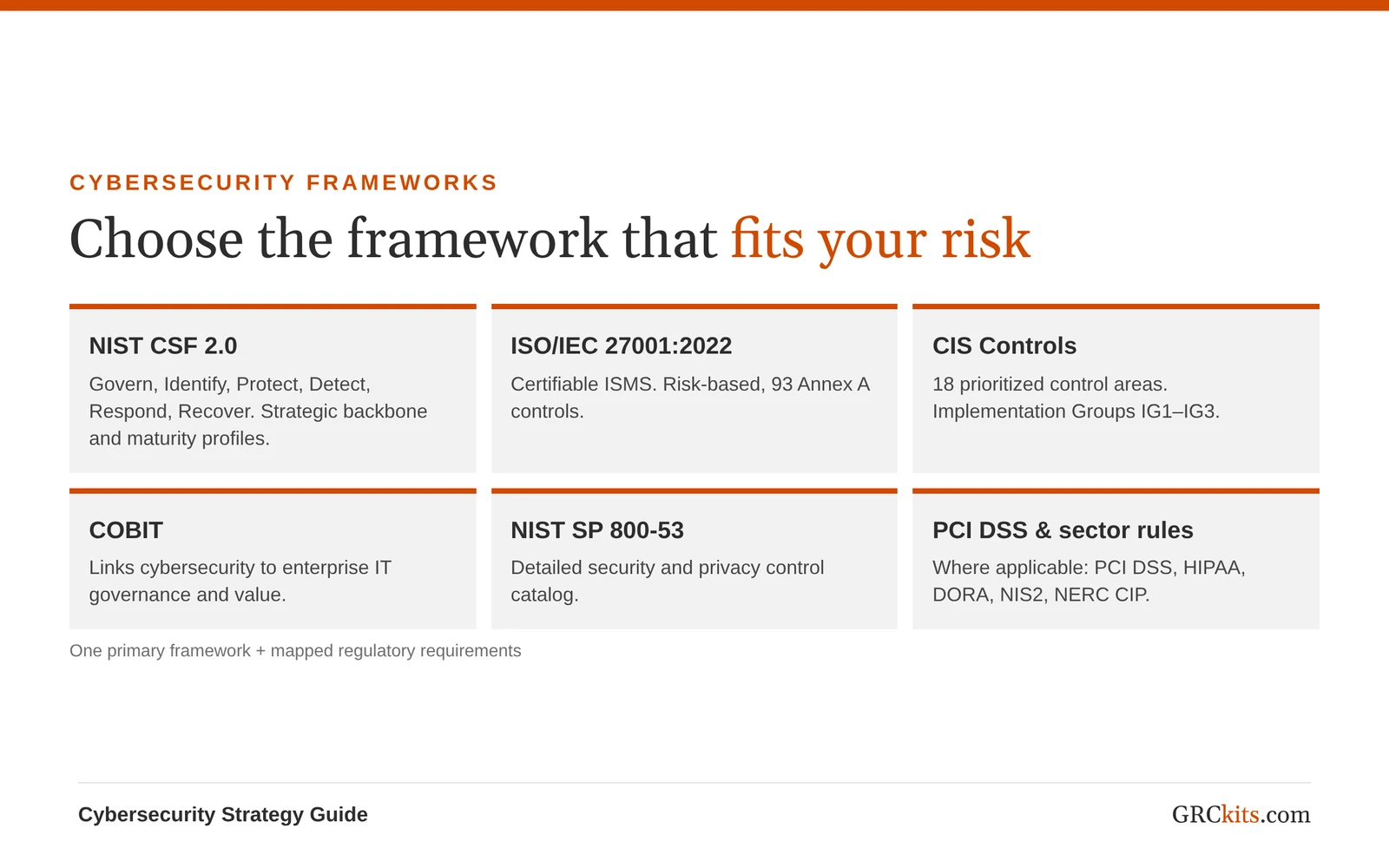
A cybersecurity framework provides a common language and a structured way to measure capability. Professionals choose one based on the organization's industry, size, regulatory environment, risk profile, and maturity.
NIST Cybersecurity Framework (CSF) 2.0
NIST released CSF 2.0 in February 2024. It groups outcomes into six functions: Govern, Identify, Protect, Detect, Respond, and Recover. The new Govern function covers risk management strategy, roles, policy, oversight, and supply chain risk, which makes CSF 2.0 especially useful for strategy work. The framework is voluntary and outcome-based, and it is widely used to set maturity baselines and target profiles.
ISO/IEC 27001:2022
ISO/IEC 27001 is the international standard for an information security management system (ISMS). It requires a risk-based approach, leadership commitment, and continual improvement. Its Annex A lists 93 controls in four themes: organizational, people, physical, and technological. Organizations often choose it when customers or partners expect certifiable assurance.
CIS Critical Security Controls
The CIS Critical Security Controls are a prioritized set of 18 control areas. Their safeguards are grouped into three Implementation Groups (IG1–IG3), and IG1 is often described as essential cyber hygiene. The controls give smaller or less mature organizations a clear, defensible starting point.
COBIT
COBIT is ISACA's framework for governing and managing enterprise IT. It ties cybersecurity to enterprise governance, stakeholder value, and performance management. It is common where IT governance and audit functions are already mature.
NIST SP 800-53
NIST SP 800-53 Revision 5 is a detailed catalog of security and privacy controls. U.S. federal agencies and their contractors use it widely, as do organizations that need precise control definitions.
PCI DSS (where applicable)
PCI DSS is mandatory for any organization that stores, processes, or transmits payment card data. It applies to the cardholder data environment, not the whole enterprise. Treat it as one input to the strategy, not as the strategy itself.
Industry-specific frameworks and regulations
Depending on sector and jurisdiction, organizations may also need to meet requirements such as:
HIPAA for U.S. healthcare
DORA for EU financial services (see our DORA compliance dashboard)
NIS2 for EU essential and important entities
NERC CIP for North American bulk electric systems
national frameworks such as Saudi Arabia's NCA ECC
Practical guidance: no organization needs to implement every framework. A common enterprise pattern is to:
Use one primary framework as the strategic backbone, often NIST CSF 2.0 or ISO/IEC 27001.
Map the mandatory regulatory requirements to that framework.
That way, one set of controls meets several obligations.
How to Develop a Cybersecurity Strategy: Step-by-Step
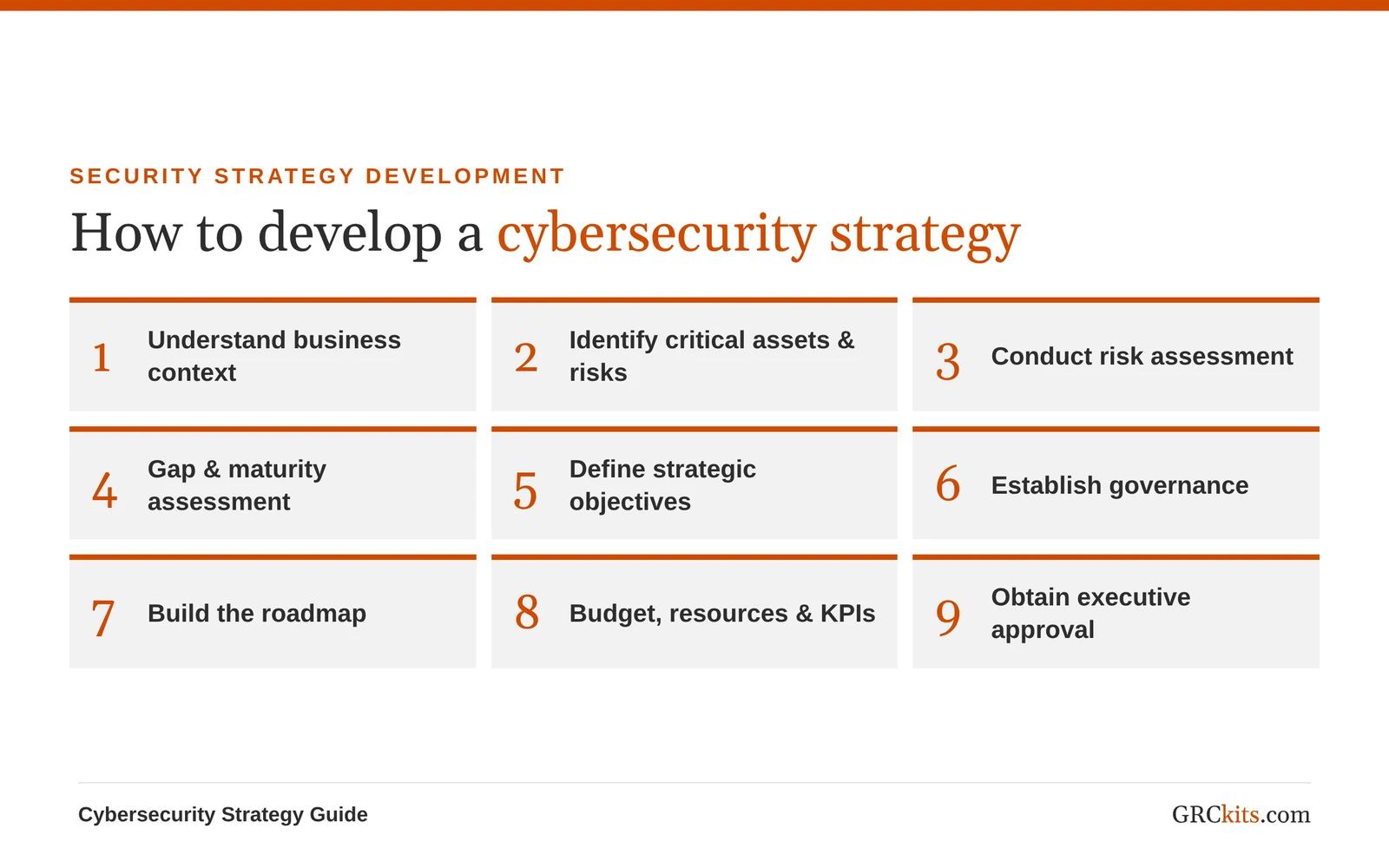
Step 1: Understand Business Objectives and Organizational Context
Interview executives and business owners. Document the organization's goals, critical business services, key processes, stakeholders, technology dependencies, and planned changes. Example: a retailer launching a mobile app and loyalty program faces new risks to data, payments, and availability.
Step 2: Identify Critical Assets and Business Risks
Build or validate an inventory that covers:
critical systems, applications, and databases
infrastructure and cloud platforms
sensitive data
identities, including privileged and service accounts
third parties
the business services each of these supports
Then rank these assets by the threats most likely to reach them. Verizon's 2026 Data Breach Investigations Report found that 48% of breaches involved ransomware, so business services that depend on recoverable systems and data usually belong near the top of the list.
Step 3: Conduct a Cybersecurity Risk Assessment
For each critical asset or service, evaluate threats, vulnerabilities, likelihood, and impact. Then:
Determine the inherent risk.
Assess the existing controls.
Estimate the residual risk.
Choose a treatment: mitigate, transfer, avoid, or accept within appetite.
Step 4: Perform a Cybersecurity Gap and Maturity Assessment
Compare current capabilities against the selected framework, regulatory requirements, and industry practice. A control implementation tracker keeps this evidence in one place. Set current and target maturity levels for each domain. Base the targets on risk, not ambition. Not every domain needs the highest maturity.
From the field: In the maturity assessments I've run, access control is the area clients most often score higher than the evidence supports. The policy calls for MFA and periodic access reviews, so the self-assessment says "managed". When we ask for proof, review records are missing or incomplete, and MFA has gaps on some privileged or remote accounts. Score against evidence, not policy, or the roadmap will start from a target you have only reached on paper.
Step 5: Define Cybersecurity Strategic Objectives
Write measurable objectives across domains such as governance, identity and access management, network security, data protection, vulnerability management, security monitoring, incident response, business continuity, third-party risk, and security awareness. Example: "Enforce phishing-resistant MFA for all privileged and remote access within 12 months."
Step 6: Establish Cybersecurity Governance
Define:
accountability and reporting lines
roles and responsibilities
a security steering committee and executive oversight
risk ownership
who has authority to accept risks and approve exceptions
Step 7: Develop the Cybersecurity Roadmap
Prioritize initiatives by risk reduction, business impact, compliance deadlines, cost, dependencies, available resources, and implementation complexity. Group them into realistic phases over the strategy horizon.
Step 8: Define Budget, Resources, and KPIs
Estimate the costs of:
personnel
technology investment
implementation
training
managed services
ongoing operations
Then define the KPIs and key risk indicators (KRIs) that will show progress.
Step 9: Obtain Executive Approval
Present the strategy in business language: the risks it addresses, the investment it needs, and the outcomes leadership can expect. Formal approval brings sponsorship, funding, and the authority to make changes across departments.
From the field: I have seen roadmaps sent back by leadership not because of cost, but because the initiatives had no named owners and no realistic timelines. Directors could see what was proposed, but not who would deliver it or when. Before you present, give every initiative an accountable owner and a target quarter.
Practitioner tip: Present no more than three or four funding options to the board, for example "minimum compliance", "risk-aligned" and "accelerated". For each option, show which top risks stay above appetite. Leaders find it easier to choose between trade-offs than to approve one large number.
What Is a Cyber Security Plan?
A cyber security plan is the documented program that turns strategic objectives into defined controls, responsibilities, and activities. The strategy explains why and what. The plan explains how and who.
A comprehensive cyber security plan should include:
Objectives and scope: business units, locations, and systems
Governance structure and ownership
A summary of risk assessment results and risk treatment decisions
Security controls and planned initiatives
Roles and responsibilities (a RACI matrix works well)
Implementation activities
Timeline and milestones
Budget and resource requirements
KPIs, reporting, and the monitoring approach
Incident response arrangements
Business continuity and disaster recovery arrangements
Applicable compliance requirements and control mappings
Maintaining the plan
Review the cyber security plan at least once a year, and again after any significant change, such as:
a major incident
a new regulation
an acquisition
a large cloud migration
a major shift in the threat landscape
Assign a document owner, keep version control, and report the plan's status to the security steering committee.
Cybersecurity Implementation Plan: Turning Strategy Into Action
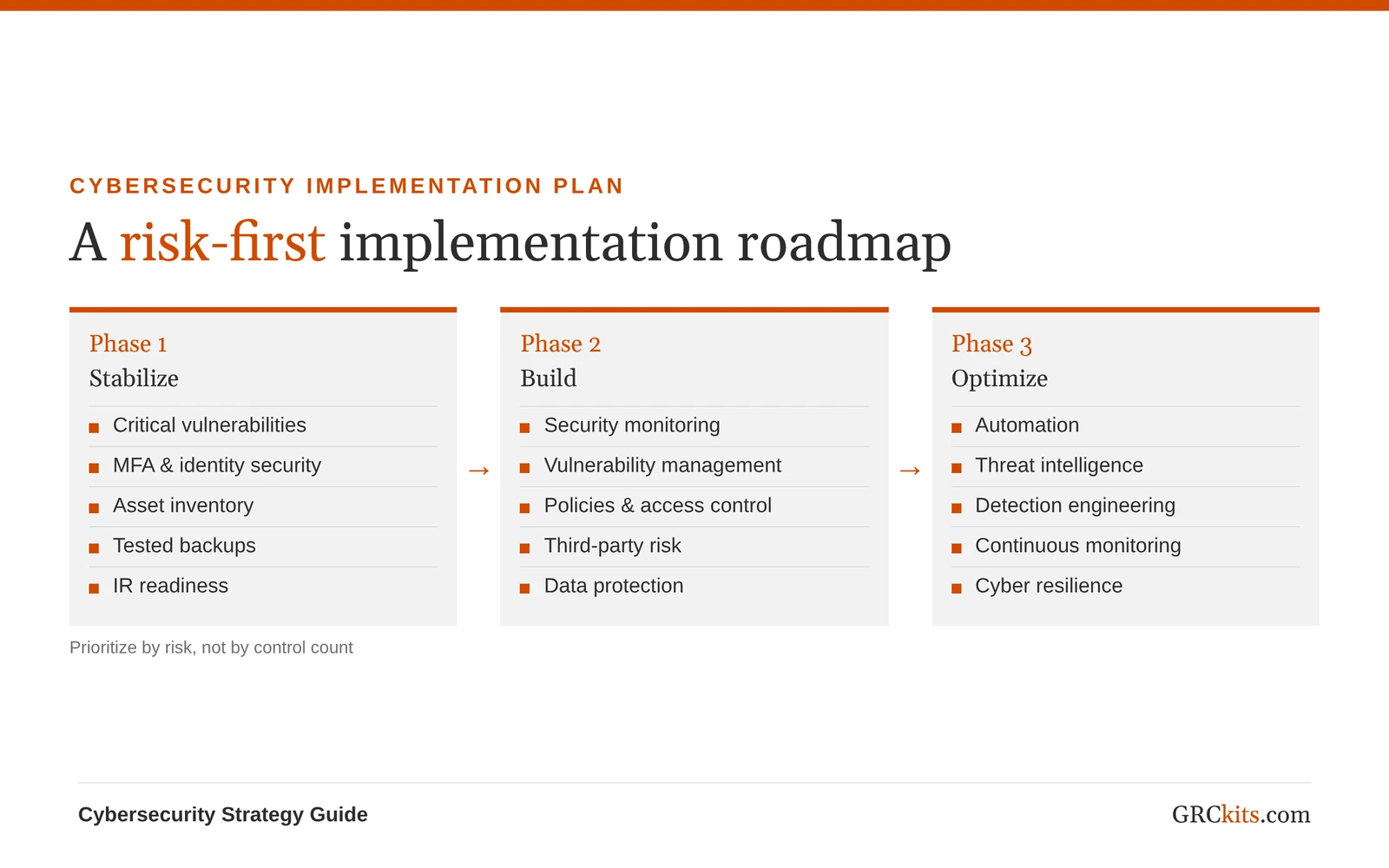
A cybersecurity implementation plan breaks the roadmap into projects with owners, deadlines, deliverables, dependencies, and success criteria. Each initiative should trace back to a strategic objective and to the risk it reduces. A practical cybersecurity implementation roadmap usually has three phases.
Phase 1 – Stabilize and Address Critical Risks
Close the most dangerous gaps first:
Fix critical and actively exploited vulnerabilities.
Strengthen identity security and enforce MFA, starting with privileged, remote, and email access.
Build a reliable asset inventory.
Protect and test backups, including offline or immutable copies.
Confirm incident response readiness: contacts, playbooks, and decision authority.
Deploy endpoint protection across managed devices.
Set up basic security governance and reporting.
Vulnerability remediation sits at the top of this list for a reason. Verizon's 2026 DBIR reports that 31% of breaches now start with software vulnerabilities, overtaking stolen passwords as the most common way attackers get in.
From the field: When I help organizations plan Phase 1, the first 90 days usually come down to four things: MFA on privileged and remote access, offline or immutable backups with a tested restore, critical patches on internet-facing systems, and a working incident response contact list and playbook. Everything else waits. A short list that actually gets finished earns more support for Phase 2 than a long one that is half done.
Phase 2 – Build and Strengthen Cybersecurity Capabilities
Set up centralized security monitoring for critical assets.
Formalize vulnerability management with risk-based SLAs.
Approve and communicate the core security policies.
Improve access controls, including joiner-mover-leaver processes and access reviews.
Run role-based security awareness training.
Launch a third-party risk management process.
Introduce data classification and data protection controls.
Conduct regular security testing and audits, such as penetration tests and control reviews.
Phase 3 – Optimize and Mature
Automate repetitive security workflows.
Put threat intelligence to work in daily operations.
Develop detection engineering and security analytics.
Move toward continuous control monitoring.
Practice incident response through tabletop exercises and technical simulations.
Mature security metrics and board reporting.
Strengthen overall cyber resilience.
Automation is also where the business case is strongest: IBM's 2026 study found that organizations making extensive use of security AI and automation saved USD 1.93 million per breach on average, compared with organizations using none.
Why risk-based prioritization matters: trying to implement every control at once spreads budget and people too thin. It delays real risk reduction and exhausts stakeholders. Sequencing work by risk delivers visible protection early and builds credibility for later phases.
Enterprise example: a mid-sized financial services firm might take this path:
First six months: MFA, privileged access, backup resilience, and critical patching.
The following year: 24/7 monitoring, third-party risk, and data protection.
Later years: automation and detection maturity.
Each stage is mapped to the firm's regulatory obligations.
Cybersecurity Strategy vs. Cyber Security Plan vs. Implementation Plan
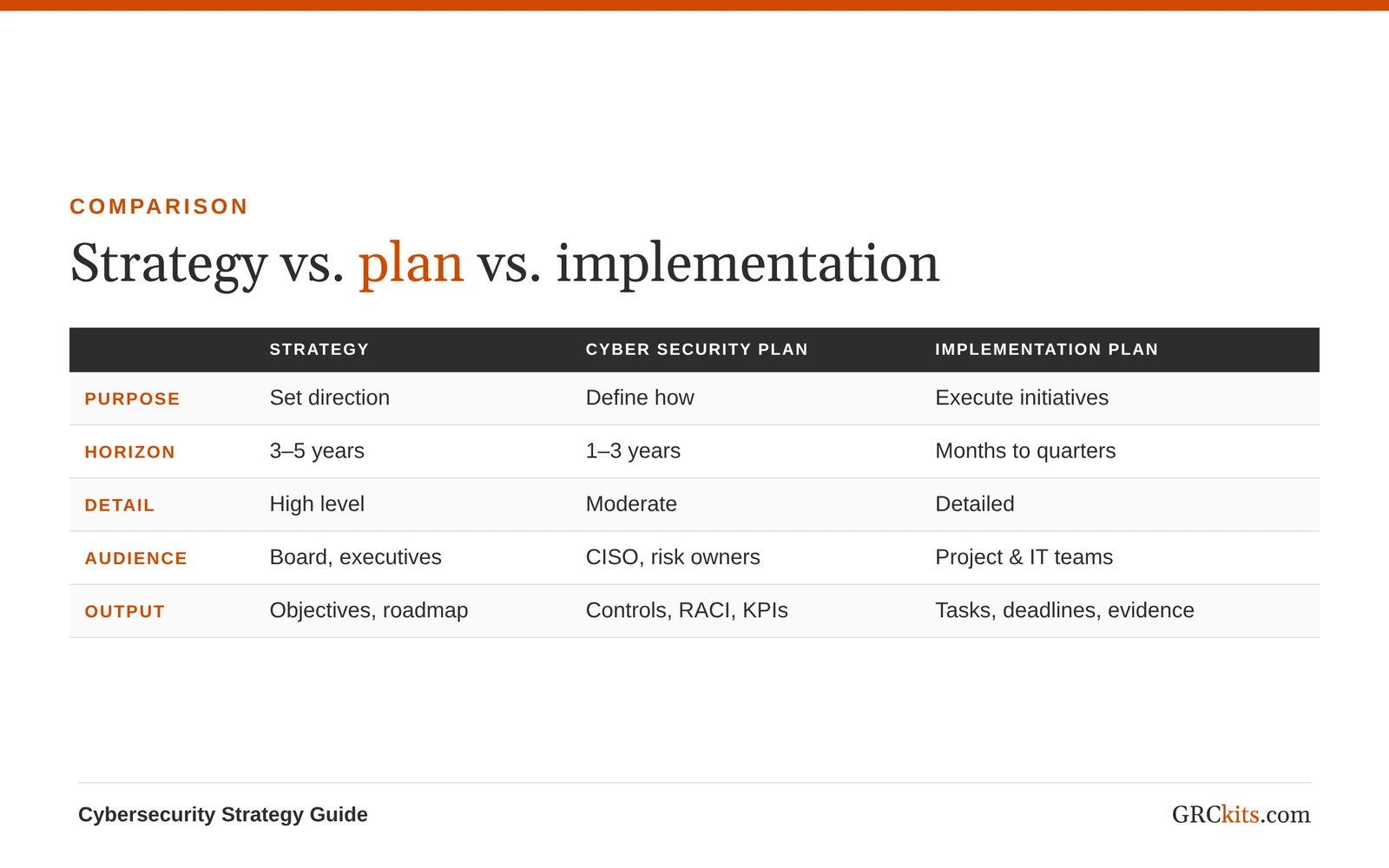
Criteria | Cybersecurity Strategy | Cyber Security Plan | Cybersecurity Implementation Plan |
|---|---|---|---|
Purpose | Set direction and priorities | Define how objectives will be achieved | Carry out specific initiatives |
Focus | Business risk, target state, investment themes | Controls, policies, owners, activities | Projects, tasks, deliverables, dependencies |
Time horizon | 3–5 years | 1–3 years, reviewed annually | Months to quarters |
Level of detail | High level | Moderate | Detailed |
Primary audience | Board, executives, CISO | CISO, security and IT leaders, risk owners | Project managers, security and IT teams |
Key deliverables | Vision, objectives, target maturity, roadmap, budget envelope | Documented program, RACI, control set, timeline, KPIs | Project plans, schedules, status reports, evidence |
Example | "Bring identity-related risk within appetite by year three" | "Deploy MFA and privileged access management across all business units" | "Enforce MFA for VPN users in Q2; owner: IAM lead" |
Key KPIs for Measuring Cybersecurity Strategy Effectiveness
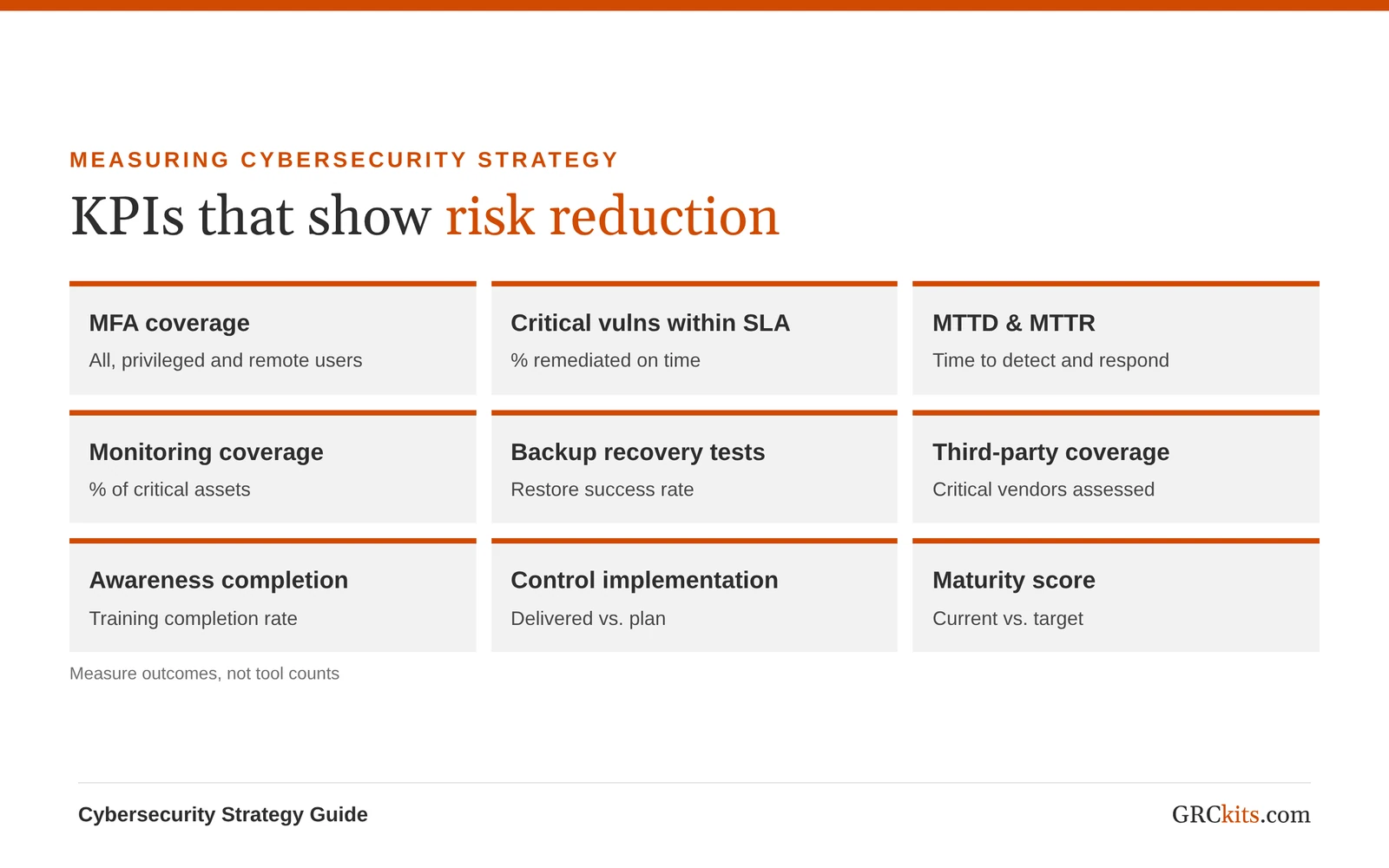
Useful metrics show whether risk is falling and resilience is improving:
Percentage of critical assets covered by security monitoring
Percentage of critical vulnerabilities fixed within SLA
MFA coverage for all users, privileged users, and remote access
Security awareness training completion rate
Incident response time against defined targets
Mean Time to Detect (MTTD)
Mean Time to Respond (MTTR)
Backup recovery test success rate
Third-party risk assessment coverage for critical vendors
Reduction in high and critical cybersecurity risks
Security controls implemented against plan
Targets turn these metrics into commitments. The examples below show where some organizations anchor them; set your own from your risk appetite and any regulatory deadlines that apply.
KPI | Example target | Basis |
|---|---|---|
Known exploited vulnerabilities remediated | Within 2 weeks of being added to CISA's KEV catalog | CISA BOD 22-01: mandatory for US federal agencies, widely used as a benchmark elsewhere |
Critical security patches installed | Within one month of release | PCI DSS v4.0 Requirement 6.3.3, for systems in PCI scope |
MFA coverage of privileged and remote access | 100% | Best practice |
Backup recovery tests | At least quarterly for critical systems, restored within the agreed recovery time objective | Best practice; take the recovery time objective from your business impact analysis |
Avoid vanity metrics such as the number of tools deployed or emails blocked. Executives need three answers:
Is our exposure shrinking?
Can we recover?
Is the investment delivering business outcomes?
Common Mistakes Organizations Make
Building strategy without understanding business risk. The result is a technical wish list.
Copying another organization's cybersecurity strategy. Different businesses have different risks, obligations, and maturity.
Focusing only on technology. People, processes, and governance often matter more.
Implementing frameworks without understanding requirements. Adopting every control adds cost without matching risk reduction.
Creating unrealistic roadmaps. Too many initiatives at once leads to stalled projects.
Ignoring resource limits. Plans must reflect the staff, skills, and budget actually available.
Lack of executive ownership. Without sponsorship, changes that span departments stall.
Failing to define KPIs. Progress can't be shown or managed.
Treating cybersecurity as a one-time project. It is a continuous program.
Failing to review and update the strategy. Threats, regulations, and the business all change.
From the field: The mistake I see most often in audits is a strategy copied from a framework's structure: one initiative per NIST CSF function or ISO/IEC 27001 control theme, with no link to what the business actually does. A useful test is to ask which initiative protects the organization's most important business service. If nobody can answer, the strategy isn't business-aligned yet.
Frequently Asked Questions
What do professionals utilize as the basis for cybersecurity strategies?
They combine several inputs:
business objectives and risk appetite
cybersecurity risk assessments and threat intelligence
critical assets
regulatory obligations
current maturity gaps
available resources
A framework such as NIST CSF 2.0 or ISO/IEC 27001 provides the structure.
How do you develop a cybersecurity strategy?
Follow these steps:
Understand the business context.
Identify critical assets.
Assess risk.
Measure maturity gaps.
Set measurable objectives.
Establish governance.
Build a prioritized roadmap.
Define the budget and KPIs.
Get executive approval.
What is the difference between a cybersecurity strategy and a cyber security plan?
The strategy sets the long-term direction and priorities. The plan documents the controls, owners, timelines, and budget that deliver them.
Which framework is best for a cybersecurity strategy?
No single framework fits every organization. NIST CSF 2.0 is a common strategic backbone, and ISO/IEC 27001 suits organizations that need certification. The CIS Controls suit organizations that need a prioritized starting point. Then map mandatory regulations, such as PCI DSS or DORA, to your chosen framework.
How often should a cybersecurity strategy be reviewed?
Review it at least once a year, and again after major incidents, regulatory changes, acquisitions, or significant technology changes. Most strategies cover three to five years.
Who owns the cybersecurity strategy?
The board or executive committee approves it and sets risk appetite. The CISO or security leader designs and drives it, and business leaders own the risks in their areas.
Conclusion
An effective cybersecurity strategy rests on business objectives, risk assessments, regulatory obligations, threat intelligence, organizational maturity, and stakeholder requirements. Frameworks such as NIST CSF 2.0, ISO/IEC 27001, and the CIS Controls provide valuable structure. Even so, professionals must tailor the strategy to the organization's environment, risk profile, business priorities, and available resources.
The most resilient organizations connect three layers:
A clear cybersecurity strategy approved by leadership.
A documented cyber security plan that assigns controls and ownership.
A practical cybersecurity implementation plan that sequences work by risk and measures results.
Start with the business context, assess risk honestly, prioritize realistically, and review regularly. That is how a cybersecurity program builds lasting security and resilience.
Ready to put this into practice? Explore GRCkits' cybersecurity strategy and roadmap toolkit, risk assessment templates, maturity assessment dashboards, and the full GRC kit library. Each kit helps you assess risk, prioritize initiatives, and report progress with confidence.

Written by
Shahidul Shubo
Cybersecurity GRC Consultant
Shahidul Shubo is a Cybersecurity GRC Consultant with 10+ years of experience in information security governance, risk management, regulatory compliance and IT audit, and has audited more than 120 organisations. He is CISA and CISM certified, an ISO/IEC 27001 Lead Auditor and Lead Implementer, and a Lead Auditor for ISO/IEC 27701, ISO/IEC 42001, ISO 22301 and ISO 9001. His technical credentials include AWS Solutions Architect, AWS Security Specialty, Red Hat RHCA and RHCE, Fortinet NSE and CCEP. He works hands-on with ISO 27001, NIST CSF and NCA ECC, and builds the practical templates and assessment tools published on GRCkits.
Connect on LinkedInNeed hands-on help?
Governance, Risk & Compliance (GRC)
Meet regulatory requirements, manage risk and maintain strong governance frameworks.
Talk to a GRC expert