Most ISO 27001 projects don't fail at the certification audit. They fail months earlier: when scope is drawn too wide, the risk assessment turns into a spreadsheet nobody owns, or 40 policies get written before anyone asks what the organisation actually needs to protect. By the time the auditor arrives, the documents exist but the evidence that the system works does not.
This guide walks through ISO 27001 implementation from the first conversation with leadership to a successful certification audit and beyond. For each step it explains what the standard requires, what you should produce, what evidence an auditor will look for, and where projects usually go wrong. It is based on ISO/IEC 27001:2022, including Amendment 1:2024.
ISO 27001 implementation in brief (quick answer)
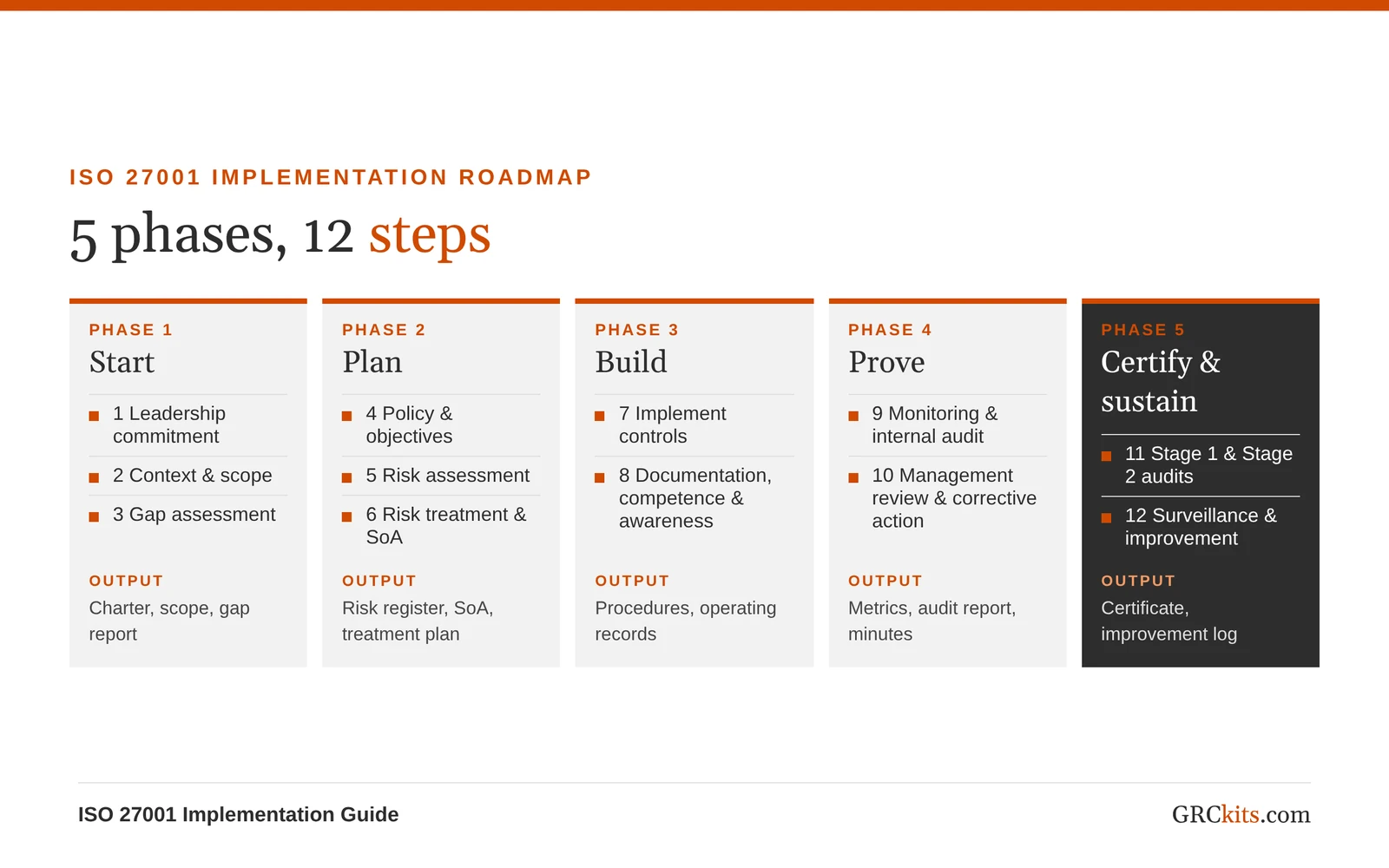
ISO 27001 implementation means building an information security management system (ISMS) that meets Clauses 4–10 of ISO/IEC 27001:2022. You define scope, get leadership commitment, assess information security risks, select controls from Annex A (93 controls) and record them in a Statement of Applicability, run the controls, then prove the system works through monitoring, internal audit and management review before a two-stage certification audit.
| Phase | Steps | Key outputs |
|---|---|---|
| 1. Start | Business case and leadership commitment, scope, gap assessment | Project charter, scope statement, gap report |
| 2. Plan | Governance and policy, risk assessment, risk treatment and SoA | Information security policy, risk register, Statement of Applicability, risk treatment plan |
| 3. Build | Implement controls, documentation, awareness and competence | Procedures, operating records, training evidence |
| 4. Prove | Monitoring and metrics, internal audit, management review | Measurement results, audit report, review minutes, corrective actions |
| 5. Certify and sustain | Stage 1 and Stage 2 audits, surveillance, continual improvement | Certificate, closed nonconformities, improvement log |
What ISO 27001 actually requires (and what it doesn't)
ISO/IEC 27001 is a management system standard. It does not tell you which firewall to buy. It tells you to run a repeatable system that identifies information security risks and treats them in a way leadership has approved. Getting this distinction right early saves months of wasted effort.
- Clauses 4–10 are mandatory. Every "shall" in these clauses must be met for certification: context and scope (4), leadership (5), planning, including risk assessment and treatment (6), support (7), operation (8), performance evaluation (9) and improvement (10).
- Annex A controls are selected, not automatically required. Annex A lists 93 controls in four themes: organisational (37), people (8), physical (14) and technological (34). You must compare your risk treatment against all of them and justify every inclusion and exclusion in the Statement of Applicability (SoA).
- ISO/IEC 27002:2022 is guidance. It explains how each Annex A control can be implemented. It is useful, but it is not auditable on its own and you cannot be certified against it.
- ISO/IEC 27005:2022 is risk guidance. It helps you design the risk assessment method required by Clause 6.1.2. Using it is optional.
The 2022 edition also added Clause 6.3 (planning of changes to the ISMS) and 11 new Annex A controls, including threat intelligence (5.7), information security for use of cloud services (5.23), ICT readiness for business continuity (5.30), configuration management (8.9), data leakage prevention (8.12), monitoring activities (8.16) and secure coding (8.28). Amendment 1:2024 added a requirement to consider whether climate change is a relevant issue in Clauses 4.1 and 4.2.
If you still hold documents written for the 2013 edition (114 controls in 14 domains), they need rework. The transition period for 2013 certificates ended on 31 October 2025.
Before you start: roles, budget and a realistic timeline
ISO 27001 implementation is a business change project with a security core, not an IT side project. Put three things in place before Step 1.
People. At minimum you need:
| Role | Responsibility in the project |
|---|---|
| Executive sponsor (CEO, COO or CIO) | Approves scope, policy, risk acceptance criteria and budget; chairs management review |
| ISMS manager / project lead | Runs the plan, owns the ISMS documentation, coordinates audits |
| Risk owners (business and IT heads) | Accept and own risks and treatment actions for their areas |
| Control owners (IT, HR, facilities, legal, procurement) | Operate controls and produce evidence |
| Internal auditor (independent of the work audited) | Performs the Clause 9.2 internal audit |
Budget drivers. Cost depends on scope size, the number of sites, how mature your current controls are, whether you use a consultant, tooling (for example a GRC tool or ready-made templates), remediation work such as MFA, logging or backups, and certification body fees. Ask two or three accredited certification bodies for quotes early; audit days are based on headcount and complexity, so the quote also tells you how big your scope looks from the outside.
Timeline. As an indicative range from practice, not a rule, a small or mid-sized organisation with a focused scope and some existing controls often needs 6–12 months from kick-off to Stage 2. Larger or multi-site scopes take longer. The minimum is usually set by evidence, not documents: auditors expect to see the ISMS operating, which means records from monitoring, at least one internal audit and a management review.
Phase 1: Start
Step 1: Build the business case and secure leadership commitment
Clause 5.1 requires top management to demonstrate leadership: aligning the ISMS with strategy, providing resources and promoting continual improvement. An email saying "please get us certified" does not meet this.
Build the case around the reason the organisation actually needs ISO 27001: customer or tender requirements, regulatory expectations, reducing breach impact, or entering new markets. Then get a signed project charter that names the sponsor, objectives, budget and target dates.
Evidence an auditor will ask for: approved charter or board minutes, the signed information security policy, management review minutes and resource decisions.
Common pitfall: leadership signs everything and then disappears. In the Stage 2 audit, auditors often interview top management directly. If the sponsor cannot explain the scope, the top risks or the security objectives, expect a finding.
Step 2: Define the context and the ISMS scope
Clauses 4.1 to 4.3 require you to understand internal and external issues, identify interested parties and their requirements, and document a scope that states its boundaries and interfaces.
Scope is the most important decision in the whole project, because it sets the size of every later step. Some practical guidance:
- Start from what customers are asking about. If clients need assurance about your SaaS platform, scope the people, processes, locations and technology that build, run and support that platform.
- Write interfaces explicitly. List what sits outside the scope but connects to it (for example group IT, an outsourced data centre, a payroll provider) and how you control those dependencies.
- Don't scope to avoid problems. Excluding a weak area that clearly handles in-scope information will be challenged by the auditor and erodes customer trust when they read the certificate.
- Include climate change in the context analysis. Since Amendment 1:2024, you must determine whether climate change is a relevant issue. "Not relevant, because…" with a reason is an acceptable answer for many organisations.
Outputs: context analysis (issues, for example from a PESTLE or SWOT), interested parties register, and a documented scope statement.
Step 3: Run a gap assessment
A gap assessment compares what you do today against Clauses 4–10 and the 93 Annex A controls. It turns "we need ISO 27001" into a concrete work list with owners and effort estimates.
Rate each requirement on a simple scale, for example not in place / partially in place / in place but not documented / in place and evidenced. Record who you interviewed and what you saw. That makes the result defensible and gives you a baseline to show progress to leadership.
A structured tracker helps here. Our ISO 27001:2022 control implementation tracker lists all Annex A controls with status, owner and target date, so the gap assessment becomes your implementation plan instead of a one-off report.
Phase 2: Plan
Step 4: Set governance, the information security policy and objectives
Clause 5.2 requires an information security policy approved by top management, and Clause 5.3 requires assigned roles, responsibilities and authorities. Clause 6.2 requires measurable information security objectives with plans for achieving them.
- Keep the top-level policy short (two to four pages). Put detail in topic-specific policies such as access control, acceptable use or supplier security, which Annex A control 5.1 expects.
- Write objectives you can measure, for example "100% of privileged accounts protected by MFA by Q2" rather than "improve security".
- Decide where the ISMS reports: a security steering committee or an existing risk committee. This connects ISO 27001 to the wider layers of governance in the organisation.
A ready-to-edit information security policy template for ISO 27001:2022 can shorten this step, but every template must be adapted to your actual scope, roles and risk appetite. Auditors notice copied policies that describe controls the organisation does not run.
Step 5: Perform the information security risk assessment
Clause 6.1.2 requires a defined and repeatable risk assessment process. The standard does not prescribe a method, but it does require you to:
- Establish risk acceptance criteria and criteria for performing assessments.
- Identify risks to the confidentiality, integrity and availability of information within scope, and name a risk owner for each.
- Analyse the potential consequences and realistic likelihood, and determine risk levels.
- Evaluate the risks against your criteria and prioritise them for treatment.
- Produce consistent, valid and comparable results when the assessment is repeated.
The 2022 edition does not require an asset-based method. Many organisations still start from an inventory of information assets because it makes risk identification concrete, and Annex A control 5.9 expects an asset inventory anyway. A scenario-based method (for example "ransomware encrypts the production database") is equally valid and often easier for business risk owners to understand.
Practical tips:
- Use a 5×5 likelihood × impact scale with written definitions for each level. Without definitions, two people will score the same risk differently, and the "comparable results" requirement fails.
- Aim for a register that people can maintain. A few dozen specific, owned risks are more useful than hundreds of generic ones copied from a threat catalogue.
- Make risk owners business people where possible. The IT manager should not own every risk.
From the field: Shahidul Shubo
When I was brought in as a consultant at a mid-sized bank in the USA with around 500 staff, its risk register held roughly 400 risks. Most were generic entries copied from a threat catalogue, such as "malware", "insider threat" or "natural disaster", with no link to a specific service or asset. Many had no named owner. Nobody was maintaining it, so the scores no longer reflected the bank's real exposure, and the register could not support risk treatment decisions or the Statement of Applicability.
Lesson: a smaller register of specific risks that business owners actually review is worth more than a long list that nobody owns.
The ISO 27001 risk assessment and risk register dashboard applies this structure in Excel: inherent risk, treatment, residual risk and an executive heat map.
Step 6: Treat risks and build the Statement of Applicability
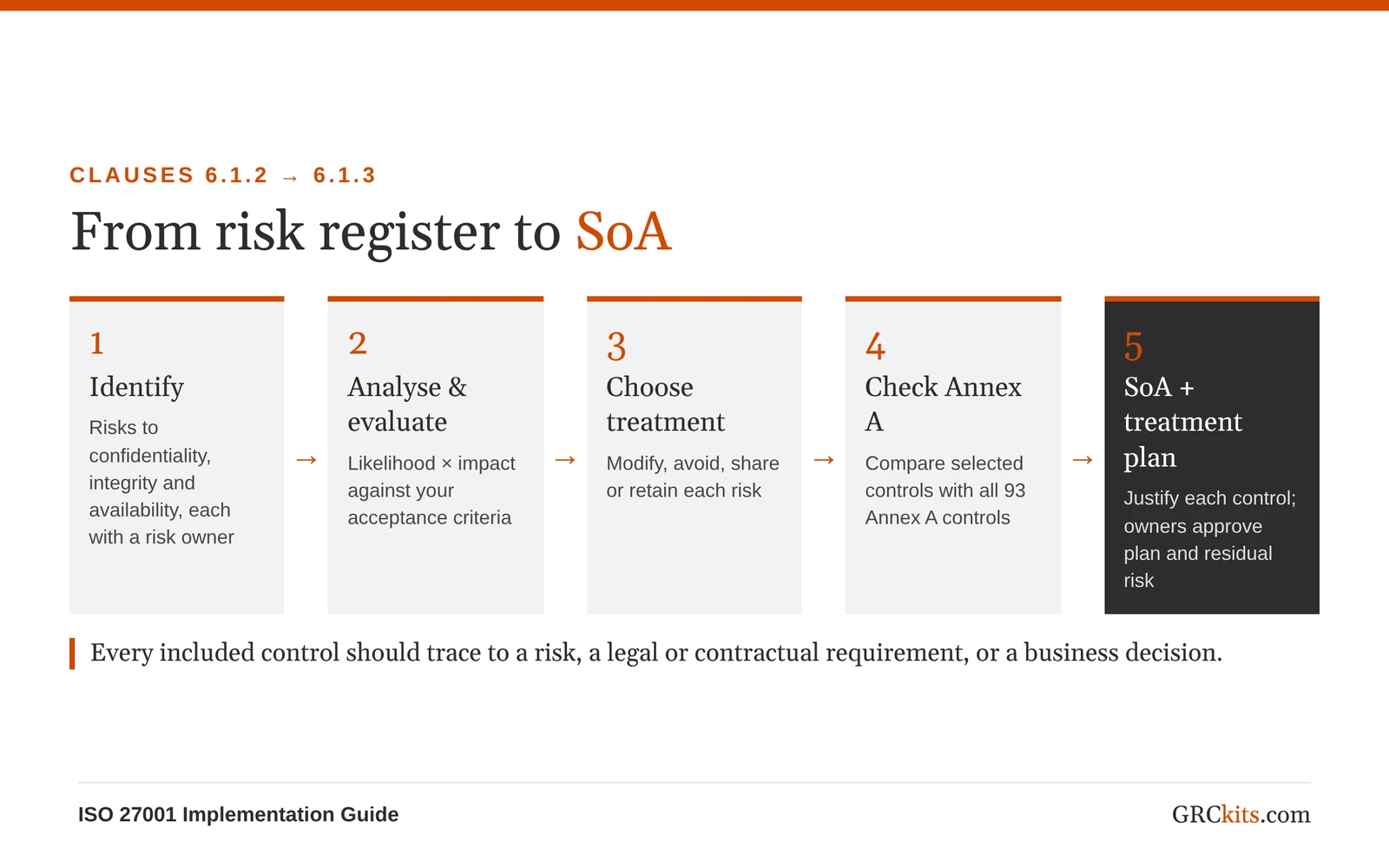
Clause 6.1.3 requires you to select appropriate treatment options for each risk (ISO/IEC 27005 describes them as modify, avoid, share or retain), determine the controls needed, compare them with Annex A, and produce two key documents:
- Statement of Applicability (SoA): for each of the 93 Annex A controls, whether it is included, the justification for inclusion, whether it is implemented, and the justification for any exclusion. You can also add controls from other sources, such as sector regulations.
- Risk treatment plan: the actions, owners, resources and dates for implementing selected controls, with risk owners' approval of the plan and acceptance of residual risks.
Auditors read the SoA closely. Common weak points are exclusions justified as "not applicable" without a reason, controls marked "implemented" with no evidence behind them, and an SoA that does not match the risk register. Every included control should trace back to at least one risk, a legal or contractual requirement, or a business decision.
Phase 3: Build
Step 7: Implement controls in priority order
Clause 8.1 requires you to plan, implement and control the processes needed for the ISMS, and Clause 8.3 requires you to implement the risk treatment plan. In practice this is the longest phase.
Sequence the work by risk, not by Annex A number. A sensible order for many organisations is:
- Quick wins that cut major risk: MFA, privileged access control, backups tested by restore, patching of internet-facing systems, endpoint protection.
- Controls that create evidence over time: logging and monitoring (8.15, 8.16), access reviews, vulnerability management (8.8), supplier reviews. Start these early, because the auditor will want several months of records.
- Process controls: incident management (5.24–5.28), change management (8.32), secure development (8.25–8.28) where relevant, business continuity readiness (5.29, 5.30).
- People and physical controls: screening, terms of employment, disciplinary process, secure areas, clear desk.
Track each control with an owner, a status and a link to evidence. When evidence lives in personal inboxes, the Stage 2 audit becomes a scramble.
Step 8: Complete documentation, competence and awareness
Clause 7.5 requires you to control documented information: identify it, review and approve it, version it and protect it. The standard explicitly requires certain documented information. The table below lists the core items.
| Documented information | Clause |
|---|---|
| ISMS scope | 4.3 |
| Information security policy | 5.2 |
| Risk assessment process | 6.1.2 |
| Risk treatment process | 6.1.3 |
| Statement of Applicability | 6.1.3 d) |
| Information security objectives | 6.2 |
| Evidence of competence | 7.2 |
| Documented information the organisation decides is needed for ISMS effectiveness | 7.5.1 b) |
| Operational planning and control information | 8.1 |
| Results of risk assessments | 8.2 |
| Results of risk treatment | 8.3 |
| Monitoring and measurement results | 9.1 |
| Audit programme and audit results | 9.2.2 |
| Results of management reviews | 9.3.3 |
| Nonconformities, actions taken and results of corrective actions | 10.2 |
Several Annex A controls also expect documentation when selected, for example operating procedures (5.37), the asset inventory (5.9), and legal and contractual requirements (5.31). Check the wording of each selected control.
For competence (7.2) and awareness (7.3), keep it practical. Role-based training for administrators, developers and managers counts for more than one annual slide deck. Keep attendance records, and test awareness with short quizzes or phishing simulations. Auditors interview staff and will ask simple questions such as "how do you report a security incident?"
Phase 4: Prove
Step 9: Monitor, measure and run the internal audit
Clause 9.1 requires you to decide what to monitor and measure, how, when, and who analyses the results. Clause 9.2 requires internal audits at planned intervals by auditors who are objective and impartial.
Useful ISMS metrics (choose a handful that match your objectives):
- Percentage of critical patches applied within the target window
- Percentage of privileged accounts with MFA
- Access reviews completed on schedule
- Mean time to detect and respond to security incidents
- Training completion and phishing simulation report rate
- Risk treatment actions overdue
- Corrective actions closed within the agreed time
The internal audit must cover the whole ISMS (Clauses 4–10 and the selected Annex A controls) within the audit programme cycle, and it must happen before Stage 2. It should find real issues. An internal audit report with zero findings in a first-year ISMS usually tells the external auditor the audit was not rigorous. For a refresher on method, see how internal audit works and how to build a risk-based internal audit plan. The ISO 27001 IT internal audit dashboard helps track audit scope, findings and corrective actions in one place.
Step 10: Hold the management review and close corrective actions
Clause 9.3 requires top management to review the ISMS at planned intervals. The 2022 edition lists required inputs, including the status of previous actions, changes in internal and external issues, changes in interested parties' needs, nonconformities and corrective actions, monitoring results, audit results, fulfilment of objectives, interested party feedback, risk assessment results and the status of the treatment plan, and opportunities for improvement.
Minutes should show decisions, not just a list of attendees. Clause 10.2 then requires you to react to every nonconformity: correct it, find the root cause, take corrective action to prevent recurrence, and review whether the action worked.
Phase 5: Certify and sustain
Step 11: Pass the Stage 1 and Stage 2 certification audits
Choose a certification body accredited by a national accreditation body that is a member of the International Accreditation Forum (IAF). Certification bodies for ISO 27001 work to ISO/IEC 17021-1 and ISO/IEC 27006-1. A certificate from an unaccredited body may not be accepted by your customers.
| Audit | What the auditor checks | How to prepare |
|---|---|---|
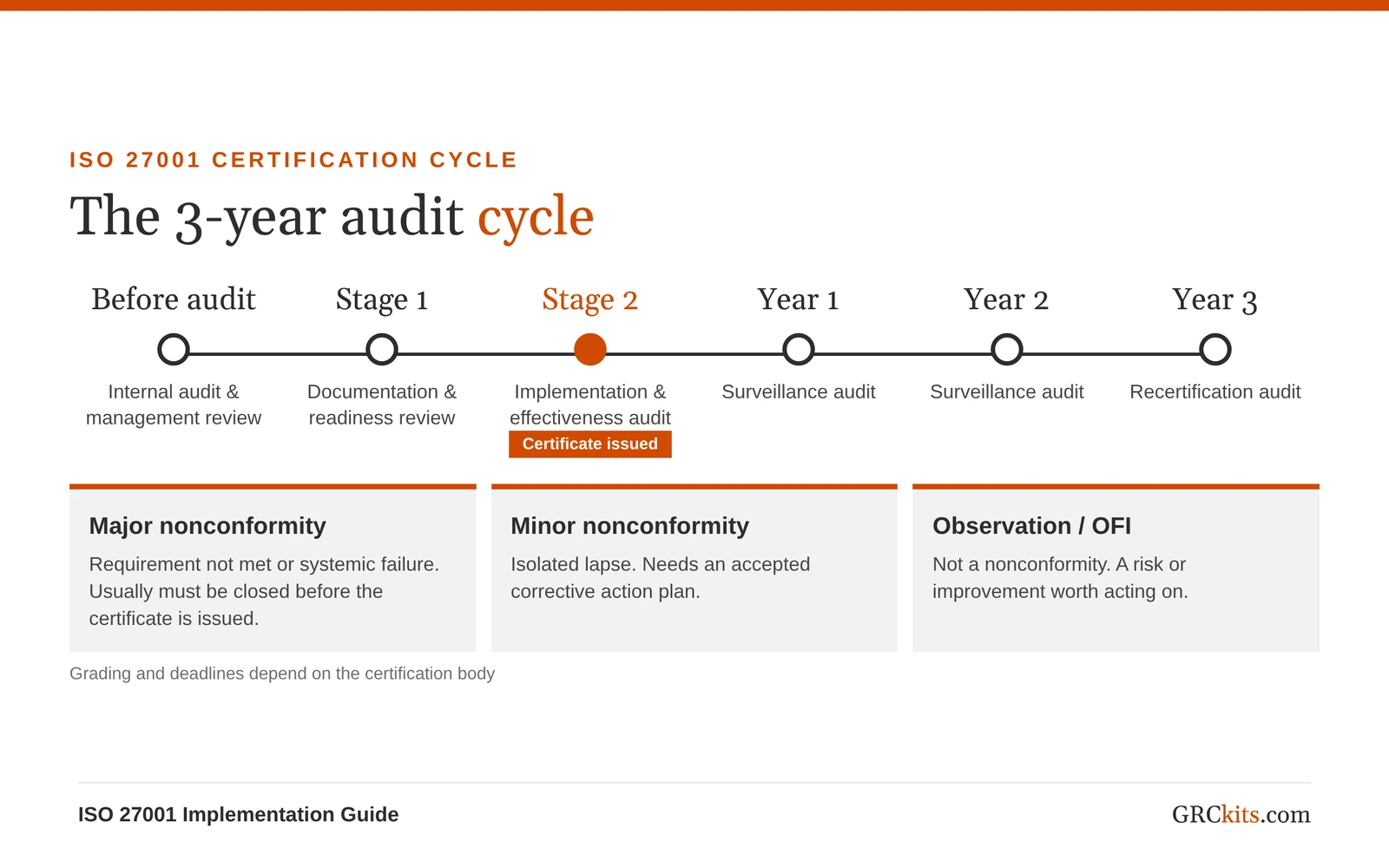
| Stage 1 | Scope, ISMS documentation, risk assessment, SoA and your readiness for Stage 2 | Have all mandatory documents approved; run the internal audit and management review first |
| Stage 2 | Whether the ISMS is implemented and effective, through interviews, sampling records and observing controls | Organise evidence by control; brief interviewees; make sure control owners are available |
| Surveillance (years 1 and 2) | A sample of the ISMS plus areas of previous findings | Keep the ISMS cycle running; close earlier nonconformities |
| Recertification (year 3) | The whole ISMS again | Review scope, risks and SoA against changes over three years |
Findings are usually graded as major nonconformities (a requirement not met or a systemic failure), minor nonconformities (an isolated lapse) and observations or opportunities for improvement. A major nonconformity normally has to be closed, with evidence, before the certificate is issued. The exact grading and timelines depend on the certification body's rules.
Step 12: Sustain and improve the ISMS
Certification is the start of the cycle, not the end. Clause 10.1 requires continual improvement, and surveillance audits check that the system is still running. Build an annual ISMS calendar with risk review, access reviews, policy reviews, supplier assessments, business continuity tests, internal audit and management review. Then treat it as part of normal operations.
Clause 6.3 also requires changes to the ISMS to be carried out in a planned way. A new office, cloud migration, acquisition or major product launch should trigger a scope and risk review, not just an IT change ticket.
Common ISO 27001 implementation mistakes and how to avoid them
These are patterns that come up repeatedly in ISO 27001 projects. They are professional observations, not requirements of the standard.
| Mistake | Why it hurts | Better approach |
|---|---|---|
| Writing all policies before the risk assessment | Policies describe controls that no risk justifies; the SoA and policies conflict | Risk assessment first, then policies for the controls you selected |
| Scope drawn as "the whole company" by default | Effort and audit days grow without adding customer value | Scope the services customers need assurance on, with clear interfaces |
| IT owns every risk | Business leaders never accept residual risk; Clause 6.1.3 approval is weak | Assign risk owners who own the affected process or service |
| SoA copied from a template | Exclusions and implementation status don't match reality | Build the SoA from the risk treatment decisions, control by control |
| Evidence collected the week before the audit | Records show one month of operation; auditor doubts effectiveness | Start evidence-producing controls (logs, reviews, tickets) early |
| Internal audit done by the person who built the ISMS | Objectivity requirement of Clause 9.2 not met | Use a trained colleague from another area or an external internal auditor |
| Certification treated as the finish line | Surveillance audit raises nonconformities on a stalled ISMS | Run an annual ISMS calendar and report metrics to leadership quarterly |
ISO 27001 readiness checklist before Stage 2
- Scope statement approved, with boundaries and interfaces stated
- Context, interested parties and climate-change relevance documented
- Information security policy and topic-specific policies approved and communicated
- Risk assessment method documented; risk register complete with named owners
- Statement of Applicability covers all 93 controls with justifications and status
- Risk treatment plan approved; residual risks accepted by risk owners
- Measurable objectives set and tracked
- Training and awareness records available
- Several months of operating evidence for key controls
- Monitoring and measurement results analysed
- Full internal audit completed, with findings and corrective actions
- Management review held with all required inputs, and decisions recorded
- Open nonconformities have corrective action plans and owners
How ISO 27001 relates to other frameworks
Many organisations implement ISO 27001 alongside other frameworks. Overlap is real and can reduce effort, but no framework automatically satisfies another. You still need a gap assessment against each one.
- NIST CSF 2.0 is a voluntary framework with no certification. Its six functions (Govern, Identify, Protect, Detect, Respond, Recover) map well to ISO 27001 controls, and a NIST CSF 2.0 maturity assessment can complement an ISMS with a maturity view.
- SOC 2 is an attestation report by a CPA firm against the AICPA Trust Services Criteria, not a certification. Control evidence from an ISMS can often be reused.
- Sector regulations such as DORA in the EU or NCA ECC in Saudi Arabia add mandatory requirements. Add them to your SoA as additional controls and to your interested parties register as legal requirements.
Templates and tools that speed up ISO 27001 implementation
Most of the time in a first ISO 27001 project goes into building the documentation framework: policies, procedures, registers, the SoA and audit checklists. Starting from a structured set of editable documents lets the team spend that time on the parts that need real judgement, such as scope, risk decisions and control implementation.
The ISO 27001 Full Assessment Toolkit contains 250+ editable Word and Excel templates aligned to ISO/IEC 27001:2022. It covers ISMS documents for Clauses 4–10, risk assessment and treatment, Annex A controls, the Statement of Applicability, policies, internal audit checklists and business continuity. Templates support implementation but do not guarantee certification. They must be tailored to your organisation, and the controls they describe must actually operate.
If you are building the security programme around the ISMS, the guide to creating a cybersecurity strategy and implementation roadmap shows how to connect ISO 27001 to wider business priorities.
Frequently asked questions
How long does ISO 27001 implementation take?
For a small or mid-sized organisation with a focused scope, 6–12 months from kick-off to the Stage 2 audit is a common indicative range. The time depends on scope size, existing control maturity, available staff and how quickly you can build operating evidence. Large or multi-site organisations usually take longer.
Are all 93 Annex A controls mandatory?
No. Clauses 4–10 are mandatory. Annex A controls are selected based on your risk assessment, legal and contractual requirements. However, you must consider all 93 in the Statement of Applicability and justify each one you exclude.
What is the difference between ISO 27001 and ISO 27002?
ISO/IEC 27001 contains the certifiable requirements for an ISMS. ISO/IEC 27002 is a guidance standard that explains how to implement the Annex A controls. You are certified against ISO 27001 only.
Can we implement ISO 27001 without a consultant?
Yes. The standard does not require a consultant. Organisations with an experienced security or GRC lead often implement it in-house using templates and training. A consultant mainly helps with speed, scope decisions and audit preparation. Certification bodies cannot provide consultancy to the organisation they certify.
What happens if the auditor finds a major nonconformity?
You normally have to correct it and provide evidence of corrective action, within the deadline set by the certification body, before the certificate is issued. A major finding at a surveillance audit can lead to suspension if it is not resolved in time.
How long is an ISO 27001 certificate valid?
A certificate is typically valid for three years, with surveillance audits in the first and second years and a recertification audit before it expires.
Does ISO 27001 cover privacy and GDPR?
Partly. ISO 27001 protects information, including personal data, but it does not meet all GDPR obligations such as lawful basis or data subject rights. ISO/IEC 27701 adds privacy information management requirements, and legal compliance still needs separate review.
Key takeaways
- ISO 27001 implementation is a management system project: Clauses 4–10 are mandatory, and Annex A controls are chosen by risk.
- Scope and the risk assessment decide the size and quality of everything that follows. Spend real time on them.
- The Statement of Applicability must trace back to risk decisions, not to a template.
- Auditors certify evidence of a working system, so start evidence-producing controls early and run a genuine internal audit and management review before Stage 2.
- Certification begins a three-year cycle of surveillance and improvement.
Your next step: run the gap assessment in Step 3 against the 93 Annex A controls and Clauses 4–10. It turns this roadmap into a dated plan your leadership can approve.
References: ISO/IEC 27001:2022, Information security management systems — Requirements (ISO); ISO/IEC 27001:2022/Amd 1:2024, Climate action changes (ISO); ISO/IEC 27002:2022, Information security controls (ISO); ISO/IEC 27005:2022, Guidance on managing information security risks (ISO); ISO/IEC 27006-1, Requirements for bodies providing audit and certification of ISMS (ISO); International Accreditation Forum.

Written by
Shahidul Shubo
Cybersecurity GRC Consultant
Shahidul Shubo is a Cybersecurity GRC Consultant with 10+ years of experience in information security governance, risk management, regulatory compliance and IT audit, and has audited more than 120 organisations. He is CISA and CISM certified, an ISO/IEC 27001 Lead Auditor and Lead Implementer, and a Lead Auditor for ISO/IEC 27701, ISO/IEC 42001, ISO 22301 and ISO 9001. His technical credentials include AWS Solutions Architect, AWS Security Specialty, Red Hat RHCA and RHCE, Fortinet NSE and CCEP. He works hands-on with ISO 27001, NIST CSF and NCA ECC, and builds the practical templates and assessment tools published on GRCkits.
Connect on LinkedInNeed hands-on help?
Information Security Management System (ISMS)
Design, implement and certify an ISO/IEC 27001 ISMS that protects the confidentiality, integrity and availability of your information.
Request a quote