A new CISO usually arrives to a long list of urgent requests: an open audit finding, a vendor that wants a security questionnaire answered by Friday, a tool renewal, and a board member who read about a ransomware attack over the weekend. The temptation is to start fixing things immediately. The risk is that you spend three months reacting, and at day 90 you still can't answer the question the CEO will eventually ask: "What are our biggest cyber risks, who owns them, and what are we doing about them?"
This guide gives you a CISO first 90 days plan built around five steps, each with a defined output. By the end of the quarter you should have evidence-based answers, clear accountability, a tested response capability and a prioritised roadmap the business has agreed to.
Quick answer: what should a new CISO do in the first 90 days?
In the first 90 days, a new CISO should (1) understand the business and what it cannot afford to lose, (2) establish a security baseline from real evidence, (3) assign owners to every material risk, (4) test incident response and recovery with a realistic exercise, and (5) turn the findings into a prioritised, risk-led security roadmap with owners, deadlines and measurable outcomes.
Why the first 90 days matter more than any other quarter
The first quarter is the only time a new security leader can ask basic questions without it looking like a gap in their knowledge. People expect you to listen, and they will usually tell you things they would not tell an incumbent: which controls exist only on paper, which system nobody wants to touch, and which incident was "handled quietly".
It is also the period in which your credibility is set. Executives judge a CISO less on technical depth than on whether security discussions start to make sense in business terms. A plan that produces five tangible outputs, one per step, gives you something concrete to report at each check-in instead of a list of activities.
Finally, governance expectations have risen. NIST CSF 2.0 (published February 2024) added a sixth function, Govern (GV), which covers organisational context, risk management strategy, roles and responsibilities, policy, oversight and supply chain risk. Many regulators now ask who in management is accountable for cyber risk, not just which controls are in place. The five steps below line up closely with that Govern function (see our guide to the layers of a governance framework), which makes the outputs reusable for audits and regulatory reviews.
The 5-step CISO 90-day framework at a glance
Step | Indicative timing | Key activities | Output at the end of the step |
|---|---|---|---|
01 Understand the business | Days 1–30 | Meet CEO, CFO, CIO, CRO, Legal; identify critical services; map sensitive data; list regulatory and contractual obligations | Business context map — what the business cannot afford to lose |
02 Establish the security baseline | Days 15–45 | Review asset and cloud inventories; assess identity and privileged access; identify critical vulnerabilities; analyse past audits, pen tests and incidents | Current risk assessment with evidence of key exposures |
03 Clarify risk ownership | Days 30–60 | Name an owner for each material risk; define remediation responsibilities and timelines; agree who may accept residual risk; set escalation thresholds linked to ERM | Risk ownership matrix with clear accountability and decision rights |
04 Test incident response & recovery | Days 45–75 | Run a realistic tabletop; validate escalation and decision authority; include IT, Legal, Comms and key vendors; test recovery of critical services and data | Tested response and recovery plan with identified gaps and fixes |
05 Build a risk-led security roadmap | Days 60–90 | Prioritise the most material risks; assign owners and deadlines; outline investment; set measurable outcomes and milestones | Prioritised action plan with clear ownership and risk reduction |
Timings are indicative and overlap deliberately. A 200-person company can move faster; a regulated multinational may need longer for steps 2 and 4.
Step 1: Understand the business (Days 1–30)
The first step is to learn what the organisation does, how it makes money and which failures would hurt it most. Security priorities that are not anchored in this context tend to be either too generic ("patch everything") or too technical to win budget.
Who to meet and what to ask
Schedule 45–60 minute conversations with the leadership team in the first two to three weeks. Use the same core questions with everyone so you can compare answers:
CEO: What are the company's top three objectives for the next 18 months? What would a "bad day" look like?
CFO: Which revenue streams or payment processes are most sensitive to downtime or fraud? How is risk currently reported and funded?
CIO / CTO: Which platforms are business-critical, which are fragile, and which are being replaced?
CRO / Head of Risk: How is enterprise risk scored, and what is the stated risk appetite?
General Counsel / Legal: Which laws, regulations and customer contracts impose security or breach-notification obligations?
Add the heads of the largest business units, internal audit, HR and the data protection officer where one exists. Internal audit is often the fastest route to an honest view of control weaknesses — especially if it already runs a risk-based internal audit plan.
Map critical services, sensitive information and obligations
From those conversations, build a single view with three layers:
Critical business services and processes — e.g. order-to-cash, payments, customer onboarding, manufacturing line control.
Sensitive information and key assets supporting each service — customer personal data, payment data, intellectual property, OT systems, key SaaS platforms.
Regulatory and contractual obligations attached to each — for example data protection law, sector regulation (such as DORA for EU financial entities or NCA ECC-2:2024 for in-scope Saudi entities), and customer contract clauses on breach notification. Confirm the exact obligations with Legal rather than assuming them.
Output — Business context map: a one- or two-page document answering "What can the business not afford to lose, and why?" This mirrors ISO/IEC 27001:2022 clauses 4.1 and 4.2 (understanding the organisation, its context and interested parties) and the NIST CSF 2.0 Organizational Context (GV.OC) category.
Common mistake: treating these meetings as introductions. Every meeting should produce at least one entry in the business context map or a named follow-up.
Step 2: Establish the security baseline (Days 15–45)
A security baseline is an evidence-based picture of where the organisation actually stands today. The aim is not a full maturity assessment — that comes later — but enough verified evidence to say which exposures are real and material.
Four areas to examine first
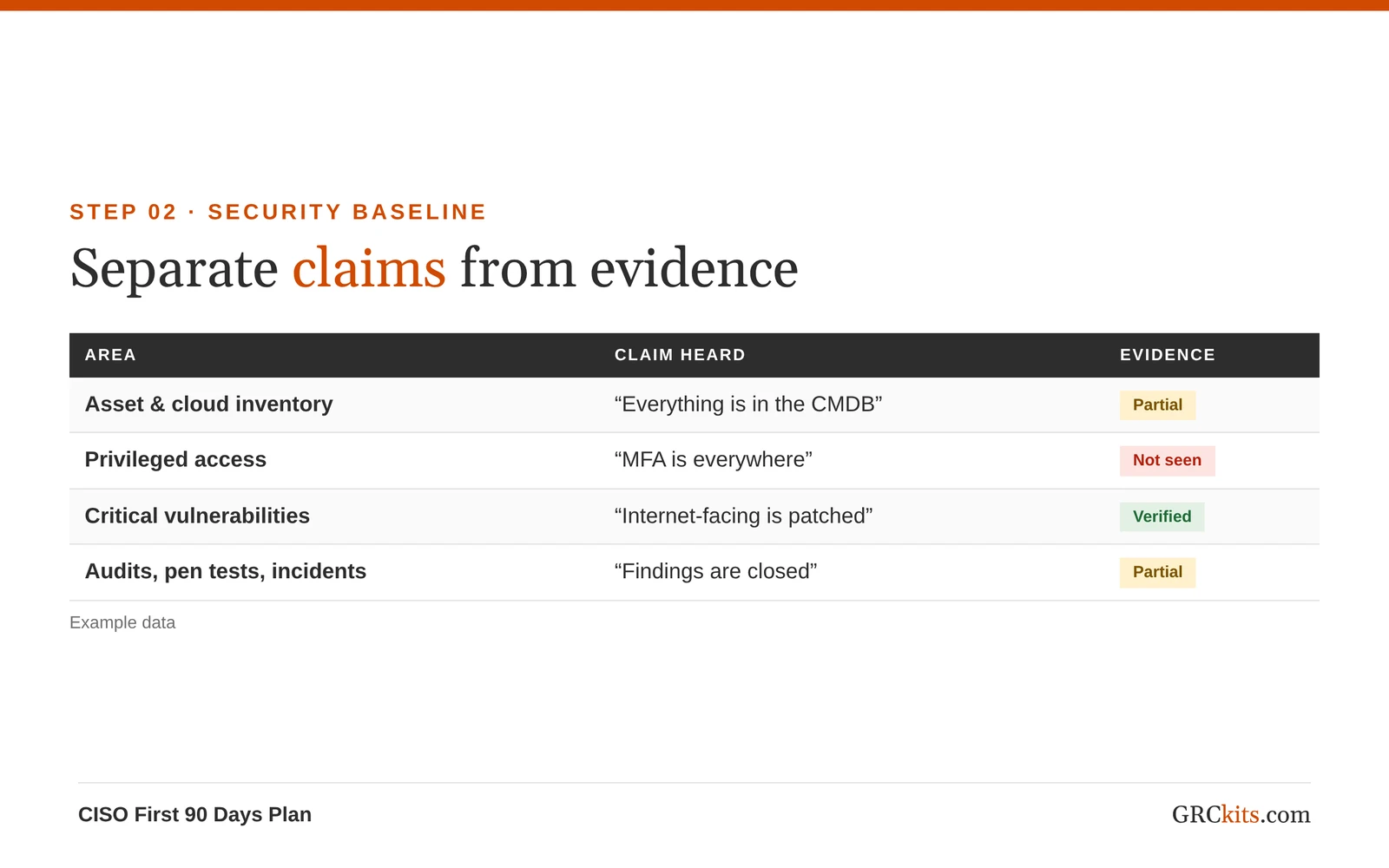
1. Asset and cloud inventories. Compare the CMDB, cloud account lists, endpoint management console and finance records for SaaS subscriptions. Gaps between them are a finding in themselves. You cannot protect, monitor or recover what is not on the list.
2. Identity and privileged access. Identity is the most common route into modern environments. Check how many accounts hold administrative rights (domain, cloud, SaaS super-admin), whether multi-factor authentication covers remote access and all privileged accounts, how joiners/movers/leavers are processed, and whether service accounts have owners.
3. Critical vulnerabilities and exposure. Look at internet-facing assets first. Review the last few scan reports, the age of unpatched critical vulnerabilities on exposed systems, and whether anything listed in the CISA Known Exploited Vulnerabilities (KEV) catalogue is present.
4. Past audits, penetration tests and incident records. Read the last two to three years of internal and external audit reports, pen-test reports and post-incident reviews. Pay attention to repeat findings: an issue raised three times is a governance problem, not a technical one.
Separate evidence from opinion
During interviews you will hear statements like "we have MFA everywhere" or "backups are tested". Record each as a claim and mark whether you have seen evidence (a configuration export, a restore log, a report). This distinction becomes very important when you present to the board.
Output — Current risk assessment: a short list (typically 10–20) of key exposures, each with the evidence behind it, the business service affected (from Step 1), and an initial likelihood/impact rating using the organisation's existing ERM scale where one exists.
Common mistake: commissioning a large external assessment in week two. It can be useful, but it often delivers after day 90. A focused internal baseline gets you to decisions faster; use external testing to validate specific gaps.
Step 3: Clarify risk ownership (Days 30–60)
Risk ownership means that every material cyber risk has a named business owner who is accountable for the decision to treat, transfer, avoid or accept it. The CISO advises, measures and coordinates — but should not be the default owner of every risk.
This principle is built into recognised standards. ISO/IEC 27001:2022 clause 6.1.2 requires the organisation to identify risk owners, and clause 6.1.3 requires risk owners to approve the risk treatment plan and accept residual information security risks. Our ISO 27001 implementation guide covers how this fits into the wider ISMS. NIST CSF 2.0 addresses the same theme under Roles, Responsibilities, and Authorities (GV.RR) and Risk Management Strategy (GV.RM).
What to define
Owner for each material risk — usually the executive who owns the affected business service or process, not IT by default.
Remediation responsibilities and timelines — who does the work (often IT or a vendor), by when, and who verifies completion.
Residual risk acceptance authority — who can accept which level of risk. For example, a business-unit head may accept "medium" risks while "high" risks require executive committee sign-off.
Escalation thresholds — when a risk, exception or overdue action must be escalated, and to whom.
Link to enterprise risk reporting — cyber risks should appear in the ERM register in the same language and scale as other enterprise risks.
Example risk ownership matrix (illustrative)
Risk | Risk owner | Remediation lead | Can accept residual risk | Escalate if |
|---|---|---|---|---|
Ransomware disrupts order processing | COO | Head of IT Infrastructure | Executive committee | Recovery test fails or RTO exceeded |
Unauthorised access to customer data | Chief Commercial Officer | IAM lead | CEO (high) / CCO (medium) | Privileged access review overdue > 30 days |
Critical SaaS vendor breach | Head of Procurement | Vendor management lead | CFO | Vendor rated high risk without assurance report |
Payment fraud via business email compromise | CFO | Finance systems lead | CFO | Any loss above agreed threshold |
This is an example only; owners and thresholds must reflect your organisation's structure and risk appetite.
Output — Risk ownership matrix with clear accountability and decision rights, approved by the executive team or risk committee.
Common mistake: letting the CISO sign risk acceptances "to keep things moving". It feels efficient, but it moves accountability away from the people who own the business outcome and weakens your independence.
Step 4: Test incident response and recovery (Days 45–75)
Testing incident response early shows whether the organisation can make decisions under pressure — and it is the fastest way to expose gaps that documents hide. A plan that has never been exercised should be treated as untested, however well written it is.
Run a realistic tabletop exercise
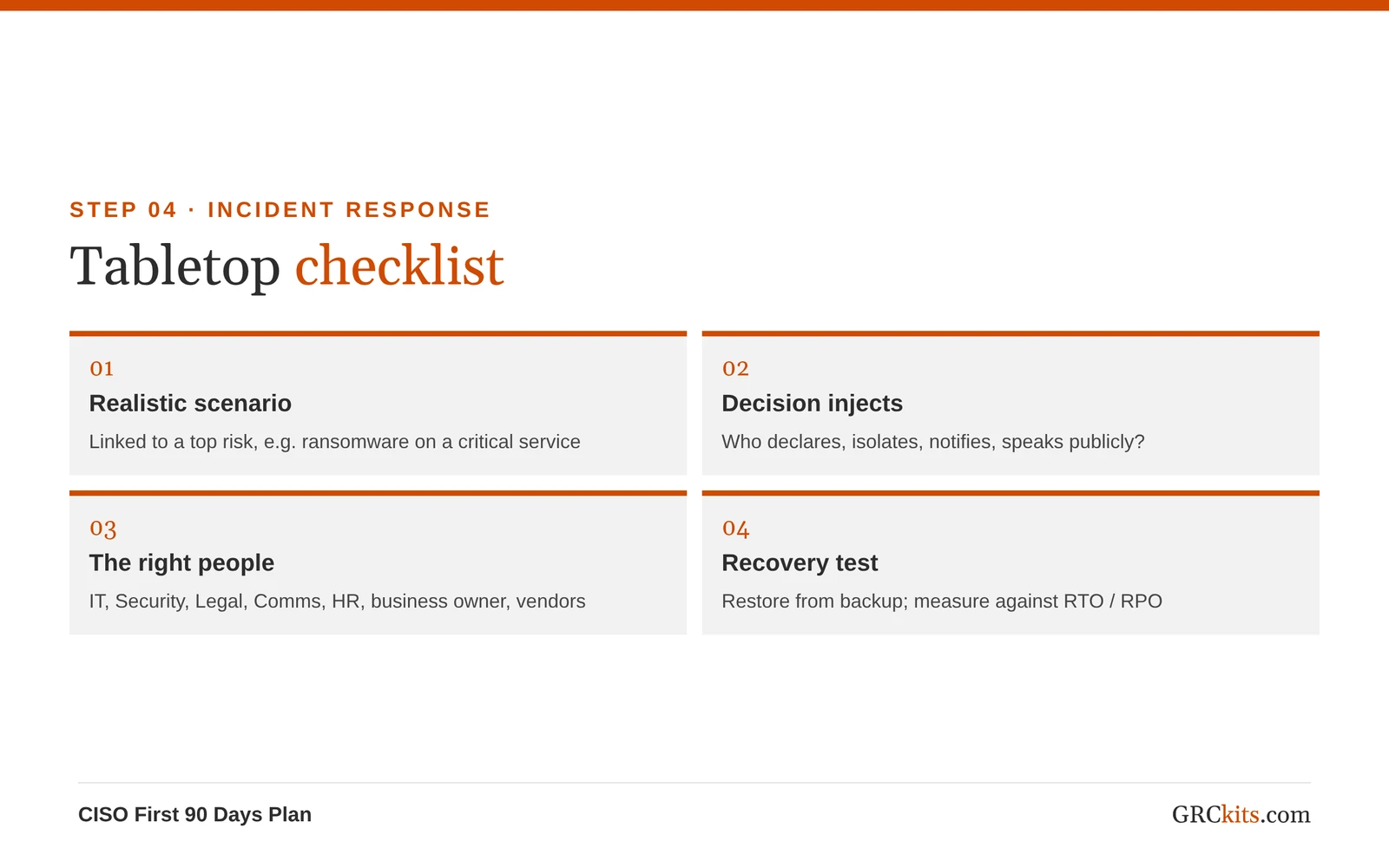
Pick a scenario linked to a top risk from Steps 2–3, such as ransomware encrypting a critical service or a compromise of a key SaaS provider. Keep it plausible for your environment. Useful sources of scenario material include the CISA Tabletop Exercise Packages (CTEPs), and NIST SP 800-61 Rev. 3 (2025) provides incident response recommendations aligned to CSF 2.0.
Design injects that force decisions, not just discussion:
At what point do we declare a major incident, and who declares it?
Do we isolate a production system that is generating revenue?
Who decides whether to notify regulators, customers or law enforcement — and within what deadline?
Who approves external communications and talks to the media?
How do we engage our incident response retainer, cyber insurer and key vendors?
Include the right people
Incident response is not an IT-only activity. Include IT and security operations, Legal, Communications/PR, HR, the business owner of the affected service, and — where possible — critical vendors and your incident response provider. For the executive session, keep it to 90–120 minutes and focus on decisions.
Test recovery, not just response
Tabletop exercises test decision-making; they do not prove you can restore systems. Alongside the tabletop, run or review at least one technical recovery test for a critical service: restore data from backup, confirm it is clean and complete, and measure actual recovery time against the agreed RTO and RPO. Relevant guidance includes ISO/IEC 27001:2022 Annex A controls 5.29 (information security during disruption), 5.30 (ICT readiness for business continuity) and 8.13 (information backup), and ISO 22301 for business continuity management. Ready-made business continuity forms can speed up recording test results.
Output — Tested response and recovery plan with a list of identified gaps, owners and fixes (for example, an out-of-date contact list, unclear notification authority, or backups that restore more slowly than the business expects).
Common mistake: writing a "perfect" scenario that the team is guaranteed to pass. An exercise that finds nothing has usually been designed to find nothing.
Step 5: Build a risk-led security roadmap (Days 60–90)
A risk-led security roadmap is a prioritised plan in which every initiative is justified by the material risk it reduces. It is the main deliverable of the first 90 days — and the bridge into a full cybersecurity strategy implementation roadmap and the document you will be measured against for the next 12–24 months.
How to prioritise
Start from the current risk assessment (Step 2), the owners (Step 3) and the exercise gaps (Step 4). For each material risk, ask:
How large is the risk in business terms (impact on the critical services from Step 1)?
Which action reduces it most, for the effort and cost involved?
Is there a regulatory or contractual deadline?
Does the action depend on something else (e.g. asset inventory before vulnerability management can be measured)?
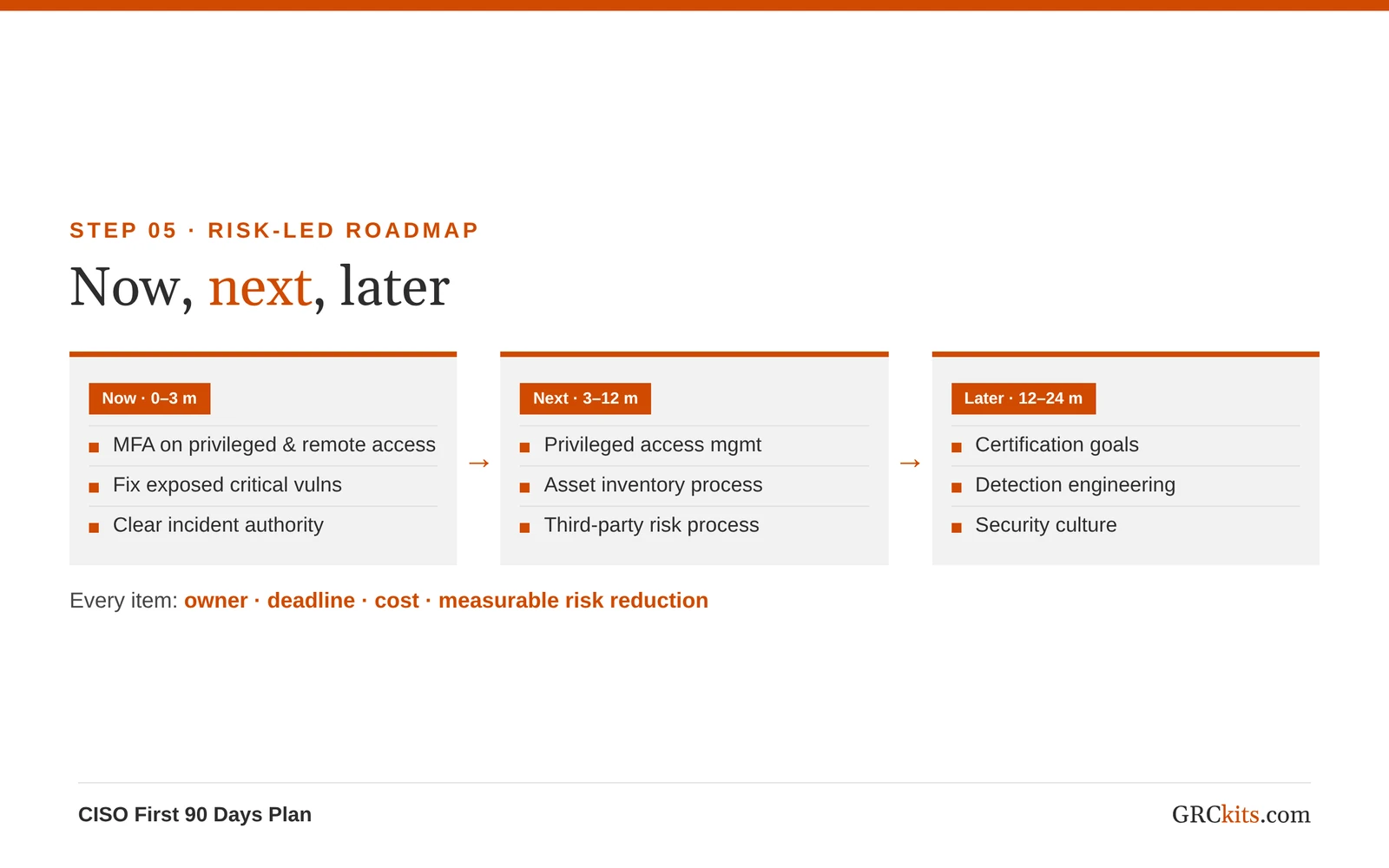
A simple Now / Next / Later view works well for executive audiences:
Horizon | Typical focus (example) |
|---|---|
Now (0–3 months) | Quick wins on top exposures: MFA on remaining privileged and remote access, fixing internet-facing critical vulnerabilities, clarifying incident decision authority |
Next (3–12 months) | Structural fixes: privileged access management, asset inventory process, backup immutability, third-party risk process |
Later (12–24 months) | Maturity and assurance: certification or attestation goals, detection engineering, security culture programme |
Define owners, investment and measurable outcomes
Each roadmap item needs an owner, a deadline, an estimated cost or resource need, and a measurable outcome tied to risk — for example "privileged accounts without MFA reduced from X to zero by Q2" rather than "deploy PAM tool". Report progress with a small set of KPIs and key risk indicators (KRIs) that the board can follow over time.
Output — A prioritised 90-day-plus action plan with clear ownership and expected risk reduction, presented to and endorsed by the executive team and, where appropriate, the board or audit committee.
What to report to the board at day 90
Keep the day-90 board or executive update short and decision-oriented. A useful structure is:
What the business cannot afford to lose — the critical services and data from Step 1.
Where we stand — top exposures with evidence, not opinions.
Who owns what — the approved risk ownership matrix.
How we performed under pressure — key findings from the exercise and recovery test.
What we will do and what it needs — the roadmap, investment request and the decisions you need from the board.
Use the organisation's ERM language and scale throughout. Avoid tool names and acronyms unless the audience uses them.
Seven mistakes new CISOs make in the first 90 days
Buying tools before understanding the risk. New tooling commitments in month one are rarely justified by evidence.
Rewriting every policy. Policy refresh matters, but it seldom reduces a top risk in the first quarter.
Owning every risk personally. See Step 3 — accountability belongs with the business.
Trusting claims without evidence. "We test backups" is a claim until you see a restore log.
Ignoring third parties. Critical SaaS and outsourced IT providers are often part of the most material risks; a structured third-party security assessment helps.
Speaking only in technical terms. Translate exposures into impact on revenue, operations, customers and regulatory standing.
Skipping quick wins. Two or three visible improvements in the first quarter build the credibility needed to fund the longer roadmap.
Tools and templates that speed up the first 90 days
Most of the effort in this framework goes into collecting evidence and turning it into decisions. Structured templates save time and give stakeholders a familiar format:
A risk register with ownership fields for Steps 2 and 3 — for example the ISO 27001 Risk Assessment & Risk Register Dashboard.
A maturity baseline against NIST CSF 2.0 for Step 2 — the NIST CSF 2.0 Cybersecurity Maturity Dashboard.
A roadmap template for Step 5 — the Cybersecurity Strategy Roadmap.
KPI templates for board reporting — Cybersecurity KPI Templates.
If you are building your first-quarter plan now, the Cybersecurity Strategy Roadmap gives you a ready structure to turn Step 1–4 findings into an executive-ready plan. Templates support the work; they don't replace the judgement and stakeholder agreement each step needs.
Frequently asked questions
What is a CISO 30-60-90 day plan?
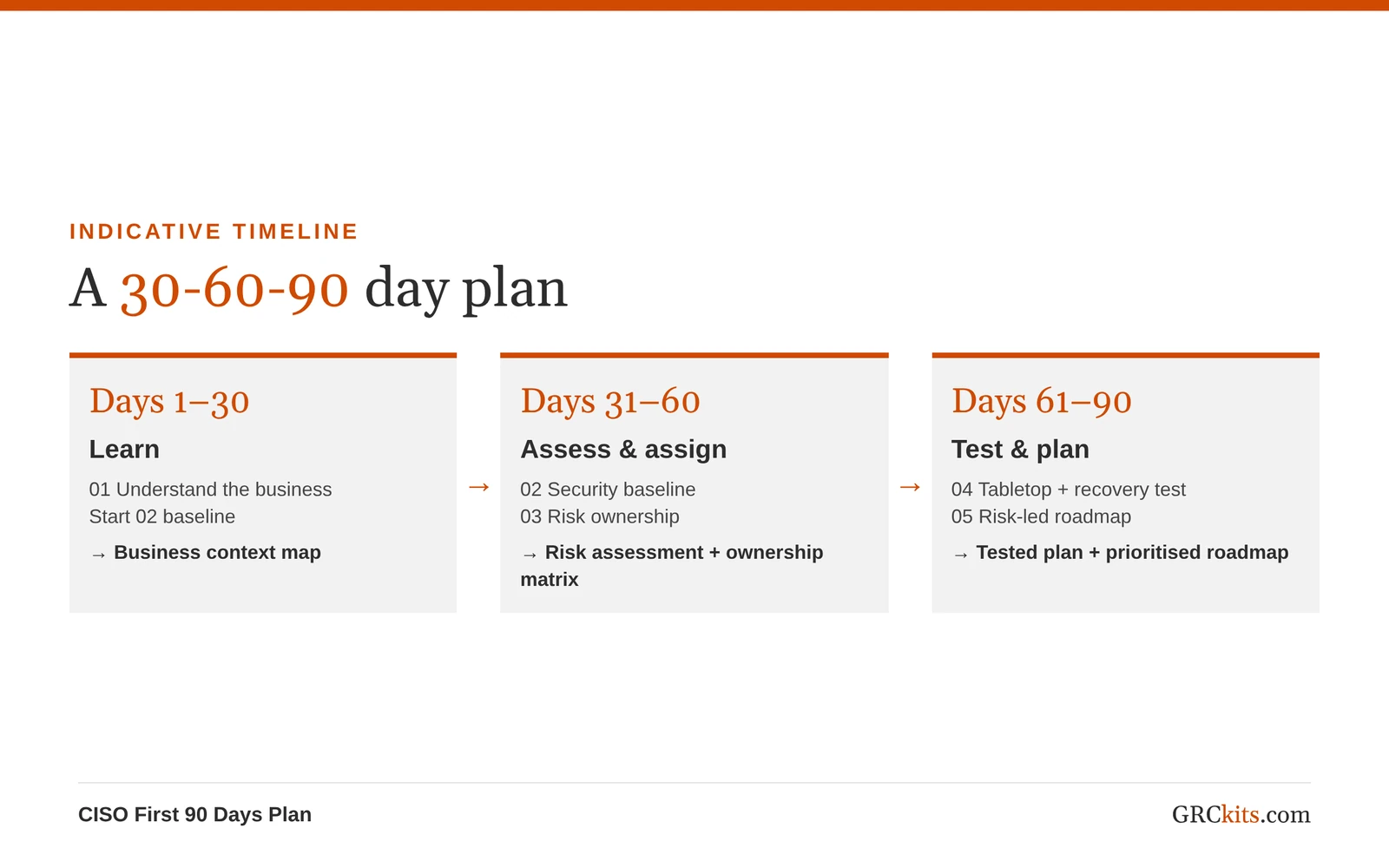
A CISO 30-60-90 day plan breaks the first quarter into three phases: learning the business and stakeholders (days 1–30), assessing security posture and ownership (days 31–60), and testing and planning (days 61–90). The five steps in this guide fit inside that structure.
Should a new CISO make changes in the first 90 days?
Yes, but selectively. Fix clear, high-impact exposures you find with evidence — such as missing MFA on privileged accounts or an exploited internet-facing vulnerability. Defer large programmes and tool purchases until the roadmap is agreed.
Who should own cybersecurity risk — the CISO or the business?
The business owner of the affected service or process should own the risk and accept residual risk. The CISO sets the method, advises on treatment, monitors progress and escalates. ISO/IEC 27001:2022 explicitly requires risk owners to approve treatment plans and accept residual risk.
How often should incident response be tested?
Most organisations aim for at least one tabletop exercise a year, plus additional exercises after major changes or incidents. Regulated sectors may have specific testing requirements — DORA, for example, includes digital operational resilience testing for EU financial entities. Confirm your obligations with compliance or legal teams.
What frameworks help structure a new CISO's first 90 days?
NIST CSF 2.0 (especially the Govern function) is useful for structuring the baseline and governance work, ISO/IEC 27001:2022 for risk ownership and treatment, NIST SP 800-61 Rev. 3 for incident response, and ISO 22301 for recovery and continuity. Choose the framework your organisation or regulator already uses.
What should a CISO present to the board after 90 days?
A short update covering critical business services, top evidence-based exposures, the risk ownership matrix, lessons from the incident exercise, and a prioritised roadmap with the investment and decisions required from the board.
Key takeaways
Anchor every security priority to what the business cannot afford to lose.
Base the baseline on evidence, not interview claims.
Give every material risk a business owner with clear acceptance authority.
Test response and recovery before you need them.
Finish with a risk-led roadmap that has owners, deadlines and measurable risk reduction.
Next step: block time this week for your first five leadership meetings and use the Step 1 questions above. If you want a head start on Step 5, start from a structured security strategy roadmap template and fill it in as each step produces its output.

Written by
Shahidul Shubo
Cybersecurity GRC Consultant
Shahidul Shubo is a Cybersecurity GRC Consultant with 10+ years of experience in information security governance, risk management, regulatory compliance and IT audit, and has audited more than 120 organisations. He is CISA and CISM certified, an ISO/IEC 27001 Lead Auditor and Lead Implementer, and a Lead Auditor for ISO/IEC 27701, ISO/IEC 42001, ISO 22301 and ISO 9001. His technical credentials include AWS Solutions Architect, AWS Security Specialty, Red Hat RHCA and RHCE, Fortinet NSE and CCEP. He works hands-on with ISO 27001, NIST CSF and NCA ECC, and builds the practical templates and assessment tools published on GRCkits.
Connect on LinkedInNeed hands-on help?
IS Audit
Independent information systems audits that strengthen IT governance and demonstrate compliance.
Request an audit