Many organisations say they "have governance" because they have a board, a policy library and an annual compliance report. Then an incident or an audit shows that nobody owned the risk, the policy was never put into practice, and the dashboard reported green while controls were failing.
A working governance framework prevents that. It connects leadership's direction to the rules people follow, the risks the organisation manages, the work done every day, the checks that confirm it works, and the changes made when it doesn't. This guide breaks that system into six layers. For each layer it explains who owns it, what it should produce, what evidence an auditor will ask for, and how to tell when it is broken.
What is a governance framework? (Quick answer)
A governance framework is the structure of roles, rules and oversight processes an organisation uses to set direction, make decisions, manage risk and hold people accountable for results. In practice it works in six connected layers: leadership sets direction, policies set the rules, risk and compliance manage exposure, operations execute, monitoring and assurance check effectiveness, and continuous improvement fixes what the checks find.
| # | Governance layer | Core question it answers | Typical owner |
|---|---|---|---|
| 1 | Governance leadership | Where are we going, and how much risk will we accept? | Board, executive committee |
| 2 | Policy and framework | What are the rules, and who decides what? | Executive management, policy owners |
| 3 | Risk and compliance | What could go wrong, and what must we comply with? | Risk management, compliance (second line) |
| 4 | Management and operations | Are we actually doing what the rules require? | Business and IT managers (first line) |
| 5 | Monitoring and assurance | Does it work as intended? | Control monitoring, internal audit (third line), external auditors |
| 6 | Continuous improvement | What are we changing because of what we learned? | Management, with oversight by the board or committees |
Governance vs management: why the difference matters
Governance and management are often used as if they mean the same thing. They don't, and confusing them is one of the most common reasons governance becomes ineffective.
- Governance sets direction, approves risk appetite and holds people accountable. It is about oversight and decision rights.
- Management plans, builds, runs and monitors activities to achieve that direction. It is about execution.
Established frameworks draw the same line. ISACA's COBIT 2019 separates governance objectives (the Evaluate, Direct and Monitor domain) from management objectives. The IIA's Three Lines Model (2020) describes a governing body that is accountable for oversight, management that takes first- and second-line roles, and an independent internal audit function in the third line.
When a board starts approving firewall changes, or a security manager quietly sets the organisation's risk appetite, the layers have collapsed into each other. The six-layer model below keeps them distinct while showing how they connect.
Layer 1: Governance leadership — setting the direction
Governance leadership is the layer where the board, executive management and governance committees decide what the organisation is trying to achieve, how much risk it will accept to get there, and who is accountable for what.
Without this layer, governance turns into a documentation exercise: policies get written because an auditor asked for them, not because leadership needs them to steer the business.
Key responsibilities
- Set vision, values and strategic priorities.
- Define the governance structure: committees, charters, reporting lines and decision rights.
- Approve the risk appetite statement, key policies and major initiatives.
- Set the tone for an ethical, accountable culture — including how leaders react to bad news.
Outputs and evidence an auditor will ask for
- Board and committee charters (for example audit, risk, or IT steering committee terms of reference)
- An approved risk appetite statement
- Minutes showing that risks and audit findings were discussed and decided on, not just "noted"
- A documented strategy (for security, often a cybersecurity strategy and implementation roadmap)
Signs this layer is weak: risk appetite exists only as a sentence in a policy; committee meetings run late or get cancelled; the board learns about major risks from the press rather than from management.
For cybersecurity specifically, NIST CSF 2.0 added a dedicated Govern (GV) function covering organisational context, risk management strategy, roles and responsibilities, policy, oversight, and cybersecurity supply chain risk management. It is a useful checklist for what leadership-level cyber governance should cover, even if you don't adopt the whole framework.
Layer 2: Policy and framework — translating strategy into structure
The policy and framework layer turns leadership's direction into clear, written expectations: policies, standards, procedures and guidelines that tell people what must be done, by whom, and with what authority.
It helps to keep the document hierarchy clear, because each level has a different owner and change frequency:
| Document type | Purpose | Approved by | Changes |
|---|---|---|---|
| Policy | States intent and mandatory principles ("what" and "why") | Board or executive management | Rarely; reviewed annually |
| Standard | Sets specific, measurable requirements (for example minimum password length) | Function head | When technology or risk changes |
| Procedure | Step-by-step instructions ("how") | Process owner | Frequently |
| Guideline | Recommended practice; not mandatory | Process owner | As needed |
Key responsibilities
- Publish policies, standards and procedures that reflect strategy and risk appetite.
- Define roles, responsibilities and decision-making authority (a RACI or delegation-of-authority matrix works well).
- Align internal requirements with laws, regulations and contracts that apply to you.
- Keep documents consistent so that business units don't each invent their own rules.
A policy without an implementation path is only a statement of intent. If you are building an information security policy set, a structured ISO/IEC 27001:2022 information security policy template can save weeks of drafting — but it still has to be tailored to your scope, risks and organisation.
Signs this layer is weak: policies are copied from another company and reference systems you don't use; nobody can say who owns a policy; "approved" documents have no approval date or version history.
Layer 3: Risk and compliance — understanding and managing exposure
The risk and compliance layer identifies what could prevent the organisation from achieving its objectives, decides how to treat those risks within the approved appetite, and tracks the legal, regulatory and contractual obligations the organisation must meet.
Governance must be risk-driven. The aim isn't to eliminate every risk; it is to make informed decisions and keep exposure within the limits leadership has approved. Guidance such as ISO 31000:2018 (risk management) and the COSO Enterprise Risk Management — Integrating with Strategy and Performance (2017) framework both stress integrating risk into strategy and decision-making rather than treating it as a separate compliance task.
Key responsibilities
- Identify, assess and prioritise risks using a consistent method (likelihood, impact, and existing controls).
- Maintain an obligations register: laws, regulations, standards and contracts.
- Agree risk treatment plans — mitigate, transfer, avoid or formally accept — with named owners and due dates.
- Report risk posture, compliance status and accepted risks to management and the board.
Outputs and evidence
- Risk methodology and a current risk register with owners, ratings and treatment status (an ISO 27001 risk assessment and risk register dashboard is one way to structure this)
- Signed risk acceptances for risks above appetite
- Compliance obligations register and the latest compliance status report
Signs this layer is weak: the risk register is updated once a year just before the audit; every risk is rated "medium"; risk acceptances are signed by people with no authority to accept them.
Layer 4: Management and operations — executing governance
The management and operations layer is where governance actually happens: managers and teams implement policies, run controls, manage resources and keep records that prove the work was done.
In the Three Lines Model, this is mainly the first-line role — the people who own the processes and the risks inside them. Second-line functions (risk, compliance, information security) support and challenge them, but they don't replace operational ownership.
Key responsibilities
- Implement policies and controls inside real business processes (onboarding, change management, access reviews, supplier management and so on).
- Allocate people, budget and tools to the controls that matter most.
- Perform recurring compliance and control activities on schedule.
- Keep accurate records and evidence: tickets, logs, approvals, review sign-offs.
Outputs and evidence
- Control owner list and control calendar
- Evidence of performance (for example quarterly user access review sign-offs, change approval records, backup restore tests)
- Implementation status for each required control — a control implementation tracker makes gaps visible at a glance
Signs this layer is weak: controls exist on paper but evidence is created retroactively before audits; the same few people "own" dozens of controls; exceptions are approved informally over chat.
Layer 5: Monitoring and assurance — validating effectiveness
The monitoring and assurance layer checks whether controls and governance arrangements actually work, and reports the result honestly to the people who need to act on it.
You cannot assume a control is effective because a policy exists or a process was designed. Assurance comes at different depths:
- Ongoing monitoring by management — KPIs, KRIs, automated alerts, self-assessments.
- Second-line review — risk and compliance teams test controls and challenge the first line.
- Independent assurance — internal audit, which in the Three Lines Model reports to the governing body to protect its independence. The IIA's Global Internal Audit Standards (effective January 2025) set the professional requirements for this function.
- External assurance — certification audits (for example ISO/IEC 27001), regulatory inspections and attestation reports such as SOC 2.
If you want to see how this works in practice, see our guide to how internal audit works and how to build a risk-based internal audit plan that focuses audit effort on the highest risks.
Outputs and evidence
- Monitoring dashboards with defined thresholds
- Control test results and audit reports with rated findings
- A findings tracker that shows owner, due date and status for every issue
- Assurance reports presented to the audit or risk committee
Signs this layer is weak: dashboards are always green; audit findings are reopened year after year; internal audit reports only to the CFO or the CIO whose areas it audits.
Layer 6: Continuous improvement — strengthening resilience
The continuous improvement layer turns findings, incidents and changes in the environment into concrete updates to strategy, policies, risk assessments and operations.
Risks evolve, regulations change and technology moves on. A governance framework that isn't updated slowly drifts away from reality. Management system standards build this in: ISO/IEC 27001:2022, for example, requires management review (clause 9.3), corrective action for nonconformities (clause 10.2) and continual improvement of the management system (clause 10.1).
Key responsibilities
- Fix the root cause of findings, not only the symptom.
- Update policies, controls and processes after incidents, audits and lessons learned.
- Reassess risks when the business, technology or threat landscape changes.
- Measure governance maturity over time and set target levels.
Outputs and evidence
- Corrective action plans with root cause analysis
- Management review minutes with decisions and actions
- Post-incident reviews and lessons-learned logs
- Maturity assessments showing current versus target state (for cybersecurity, a NIST CSF 2.0 maturity dashboard can track progress by function)
Signs this layer is weak: the same root cause appears in several incidents; corrective actions are closed with "staff reminded"; policies haven't changed in three years despite new systems and regulations.
How the six layers work together: the governance cycle
The six layers form a cycle, not a ladder. Results from monitoring, audits, incidents and performance reviews flow back into leadership decisions, policy updates, risk assessments and operational changes.
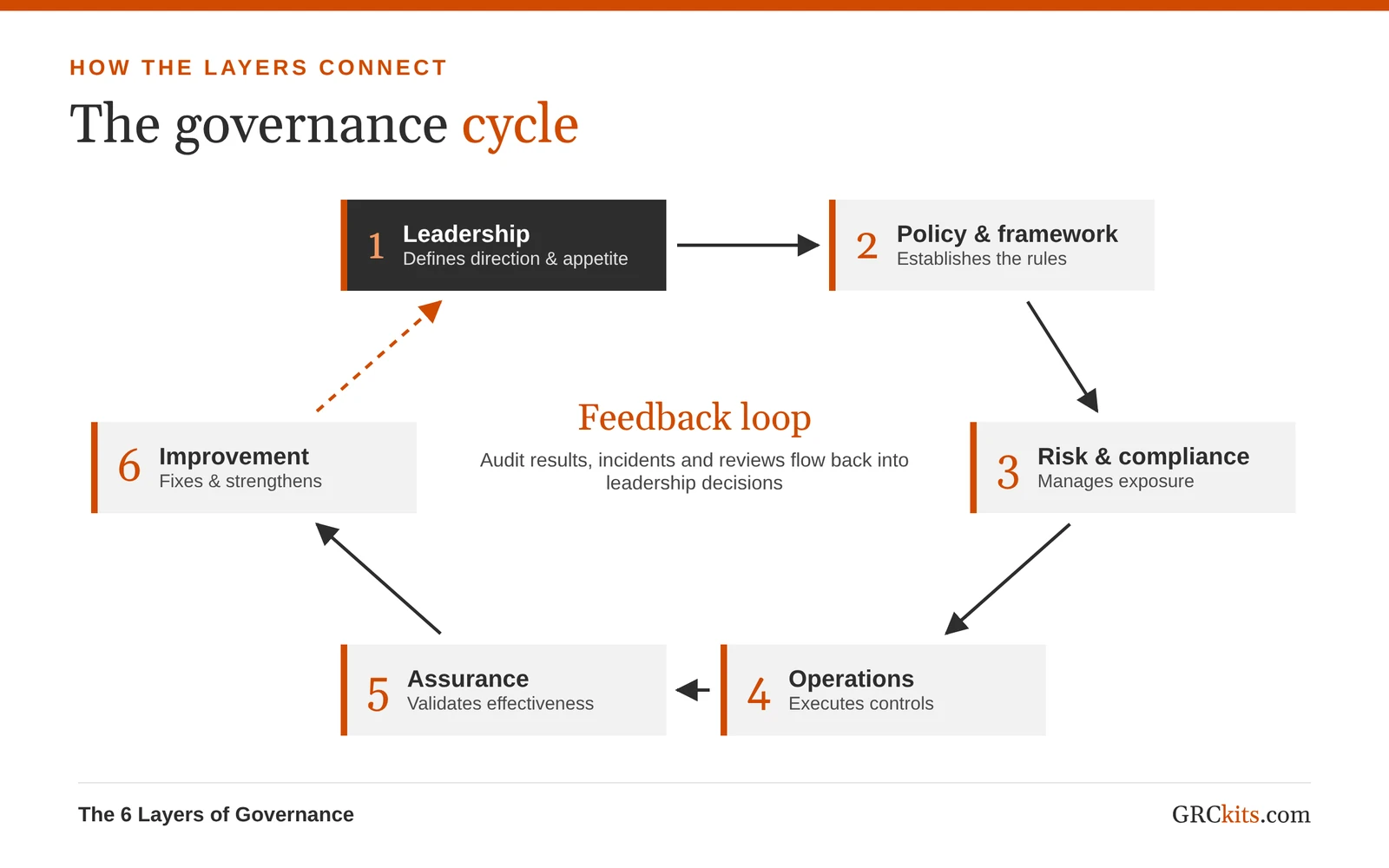
- Leadership defines direction and risk appetite.
- Policies establish the rules that put that direction into practice.
- Risks and obligations are assessed against appetite.
- Operations execute the required controls and keep evidence.
- Monitoring and assurance validate that controls work.
- Continuous improvement fixes gaps — and reports back to leadership, which adjusts direction.
The feedback path is what most organisations miss. If audit findings go to a tracker but never reach the risk register, or if risk acceptances never come back to the board, the cycle is broken even though every individual layer "exists".
Who owns each layer? A responsibility map with evidence
The table below brings ownership and evidence together. It is a practical starting point for a governance gap assessment: for each row, ask whether the owner is named and whether the evidence exists today.
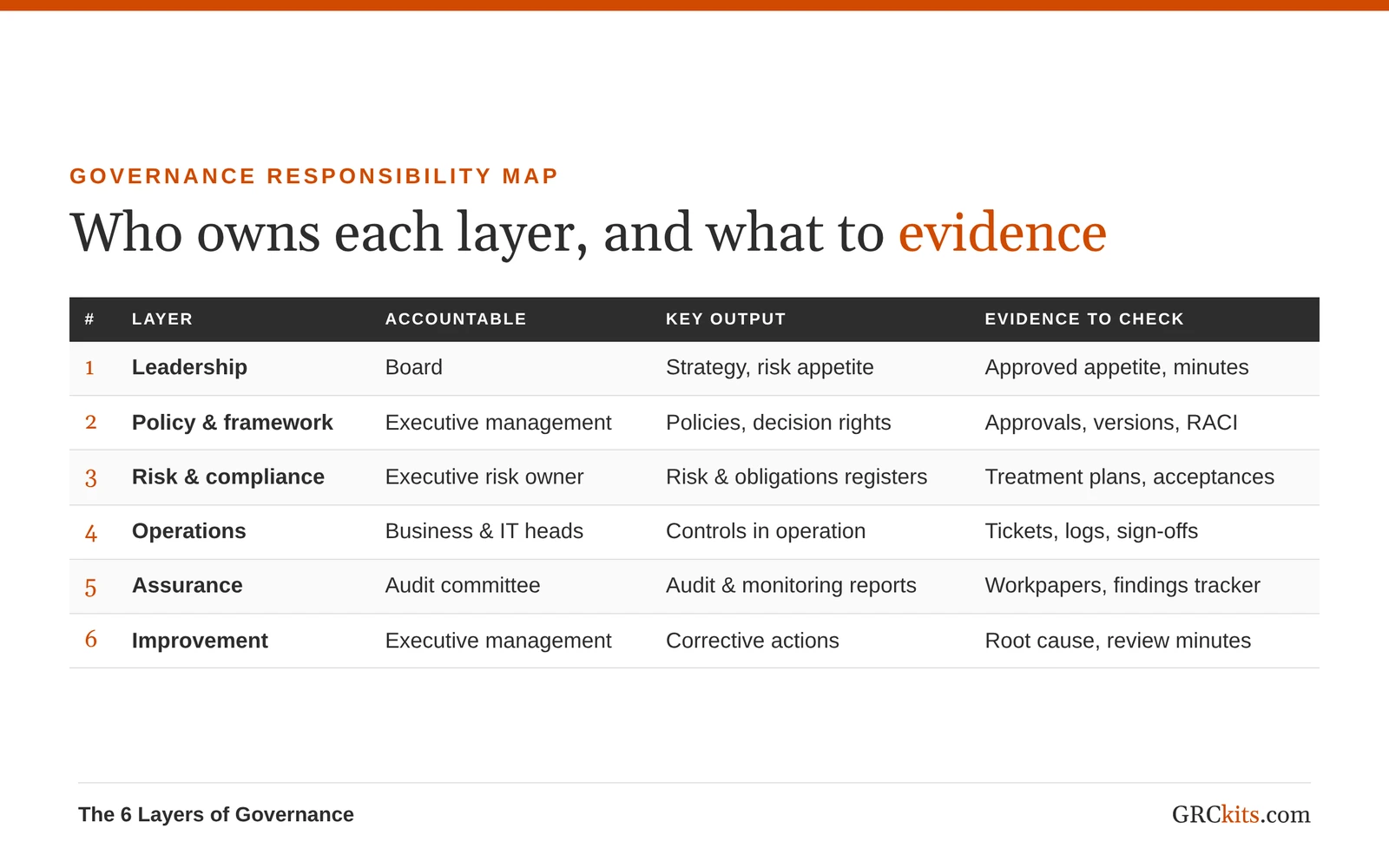
| Layer | Accountable | Responsible | Key output | Evidence to check |
|---|---|---|---|---|
| 1. Leadership | Board | Executive committee | Strategy, risk appetite | Approved appetite statement, committee minutes |
| 2. Policy and framework | Executive management | Policy owners | Policy set, decision rights | Version history, approval records, RACI |
| 3. Risk and compliance | Executive risk owner (CRO or equivalent) | Risk, compliance, security teams | Risk register, obligations register | Current ratings, treatment plans, signed acceptances |
| 4. Operations | Business and IT heads | Control owners | Controls in operation | Tickets, logs, review sign-offs |
| 5. Assurance | Audit committee | Internal audit, second-line testers | Audit and monitoring reports | Test workpapers, findings tracker |
| 6. Improvement | Executive management | Process and control owners | Corrective actions, updated documents | Root cause analysis, closed actions, review minutes |
Exact titles vary by size and sector. In a smaller organisation one person may hold several roles — that's acceptable as long as nobody is assuring their own work.
How to implement a governance framework: 7 practical steps
If you are setting up or repairing a governance framework, work through the layers in this order:
- Agree the scope and drivers. Is this corporate governance, IT governance, cybersecurity governance or all three? List the regulations, standards and contracts that apply.
- Confirm leadership ownership. Name the accountable executive and the oversight committee. Get the risk appetite approved, even as a first simple version.
- Map the current state against the six layers. Use the responsibility table above. Mark each layer as missing, informal, defined or measured.
- Fix the policy foundation. Close the biggest policy gaps first, and assign an owner and review date to every document.
- Connect risk to controls. Make sure each high risk has controls with named owners, and each control has evidence of operation.
- Set up monitoring and reporting. Agree a small set of KPIs and KRIs, a findings tracker and a regular reporting rhythm to the committee.
- Close the loop. Schedule management reviews that decide on findings, accepted risks and changes — and record those decisions.
Useful governance metrics by layer
Pick a few metrics per layer instead of dozens. Examples:
- Leadership: percentage of committee meetings held as scheduled; number of above-appetite risks reported to the board.
- Policy: percentage of policies reviewed within their review date.
- Risk and compliance: percentage of high risks with an agreed treatment plan; overdue treatment actions.
- Operations: percentage of key controls with current evidence.
- Assurance: audit plan completion rate; number of repeat findings.
- Improvement: average age of open findings; percentage of corrective actions closed on time.
Governance maturity: where is your organisation today?
Most organisations aren't strong in all six layers at once. A simple maturity view helps you prioritise:
| Level | Description | Typical sign |
|---|---|---|
| 1 — Ad hoc | Governance depends on individuals | Decisions made informally; little documentation |
| 2 — Documented | Policies and structures exist | Good paperwork, weak evidence of operation |
| 3 — Implemented | Controls operate consistently | Evidence available; risk register used in decisions |
| 4 — Measured | Performance is monitored and reported | KPIs and KRIs reach the board; assurance is independent |
| 5 — Optimised | Feedback drives continuous improvement | Lessons learned change strategy and controls quickly |
This is a generic, illustrative scale. Frameworks such as SAMA CSF or COBIT use their own defined maturity or capability levels, so use theirs where they apply to you.
Many organisations stall at level 2: they have the documents but not the operational evidence or the feedback loop. Moving to level 3 usually means focusing on layers 4 and 5 rather than writing more policies.
Common governance mistakes to avoid
- Treating governance as a compliance project. Certification or an audit pass is a by-product, not the goal.
- Copying policies without adapting them. Auditors quickly spot references to systems or roles that don't exist.
- Letting the same team design, operate and assure a control. This removes independence and hides weaknesses.
- Reporting activity instead of outcomes. "120 phishing emails blocked" says less than "two critical risks above appetite, one overdue".
- Ignoring the feedback loop. Findings that never change a policy, a budget or a risk rating mean layer 6 doesn't exist.
Mapping the six layers to common frameworks
The six layers are a way of organising governance, not a standard in their own right. The indicative mapping below shows where well-known frameworks address each layer. Coverage is partial, and using one framework doesn't make you compliant with another — a gap analysis is still needed.
| Layer | ISO/IEC 27001:2022 | NIST CSF 2.0 | IIA Three Lines Model | COSO ERM (2017) |
|---|---|---|---|---|
| 1. Leadership | Clause 5 (Leadership) | Govern: Organizational Context, Risk Management Strategy | Governing body | Governance and Culture; Strategy and Objective-Setting |
| 2. Policy and framework | Clause 5.2 (Policy); Annex A 5.1 | Govern: Policy; Roles, Responsibilities and Authorities | Management | Governance and Culture |
| 3. Risk and compliance | Clauses 6.1, 8.2, 8.3 | Govern; Identify | Second-line roles | Performance |
| 4. Operations | Clause 8; Annex A controls | Protect, Detect, Respond, Recover | First-line roles | Performance |
| 5. Assurance | Clause 9 (incl. 9.2 internal audit) | Govern: Oversight | Internal audit (third line) | Review and Revision |
| 6. Improvement | Clause 10 | Govern: Oversight; Improvement (ID.IM) | All roles, overseen by the governing body | Review and Revision; Information, Communication and Reporting |
For the broader, organisation-wide view, ISO 37000:2021 (Governance of organizations — Guidance) sets out principles for governing bodies and is a good reference when designing layer 1.
Tools that make governance practical
Governance becomes manageable when each layer has a working artefact rather than a blank page. A sensible toolkit covers: a strategy and roadmap (layer 1), a policy set (layer 2), a risk register (layer 3), a control implementation tracker (layer 4), an audit and findings dashboard (layer 5) and a maturity assessment (layer 6).
If you are starting with security governance, the Cybersecurity Strategy & Roadmap toolkit helps you set direction and priorities in one place, and the ISO 27001 IT internal audit dashboard supports the assurance layer. Use them as starting points and adapt them to your own risks and structure.
Frequently asked questions
What are the main layers of governance?
The six layers are governance leadership, policy and framework, risk and compliance, management and operations, monitoring and assurance, and continuous improvement. Together they connect direction, rules, risk, execution, validation and change into one cycle.
What is the difference between governance and compliance?
Governance decides direction, accountability and risk appetite. Compliance is one part of it: making sure the organisation meets the laws, regulations, standards and contracts that apply. An organisation can be compliant on paper and still poorly governed if decisions and accountability are unclear.
How does the Three Lines Model fit into a governance framework?
The IIA's Three Lines Model describes roles rather than layers. The governing body oversees (layer 1), management holds first- and second-line roles (layers 2 to 4, and part of 5), and internal audit provides independent assurance (layer 5). Both models agree that assurance must be independent from the work it reviews.
Who is responsible for governance in an organisation?
The board or governing body is ultimately accountable. Executive management is responsible for putting governance into practice, every manager owns the risks and controls in their area, and internal audit gives independent assurance on whether it all works.
How long does it take to implement a governance framework?
It depends on size, scope and starting maturity. A small organisation with clear leadership support can often establish the basics — named owners, approved risk appetite, core policies and a risk register — within a few months. Reaching consistent operation and measurable reporting usually takes longer, because it requires evidence over several review cycles.
Is cybersecurity governance different from corporate governance?
Cybersecurity governance applies the same six layers to cyber risk. It sits inside corporate governance: the board still sets appetite and oversight, while frameworks such as NIST CSF 2.0 (Govern function) and ISO/IEC 27001:2022 provide specific structure for security.
Key takeaways
- Governance is a system that links strategy, rules, risk, execution, assurance and improvement — not a collection of policies.
- Each layer needs a named owner, a clear output and evidence that it operates.
- Keep governance (oversight and decisions) separate from management (execution), and keep assurance independent.
- The feedback loop from assurance and incidents back to leadership is what makes governance improve over time.
Next step: take the responsibility table above, score each layer for your organisation, and pick the one weakest layer to strengthen this quarter.

Written by
Shahidul Shubo
Cybersecurity GRC Consultant
Shahidul Shubo is a Cybersecurity GRC Consultant with 10+ years of experience in information security governance, risk management, regulatory compliance and IT audit, and has audited more than 120 organisations. He is CISA and CISM certified, an ISO/IEC 27001 Lead Auditor and Lead Implementer, and a Lead Auditor for ISO/IEC 27701, ISO/IEC 42001, ISO 22301 and ISO 9001. His technical credentials include AWS Solutions Architect, AWS Security Specialty, Red Hat RHCA and RHCE, Fortinet NSE and CCEP. He works hands-on with ISO 27001, NIST CSF and NCA ECC, and builds the practical templates and assessment tools published on GRCkits.
Connect on LinkedIn