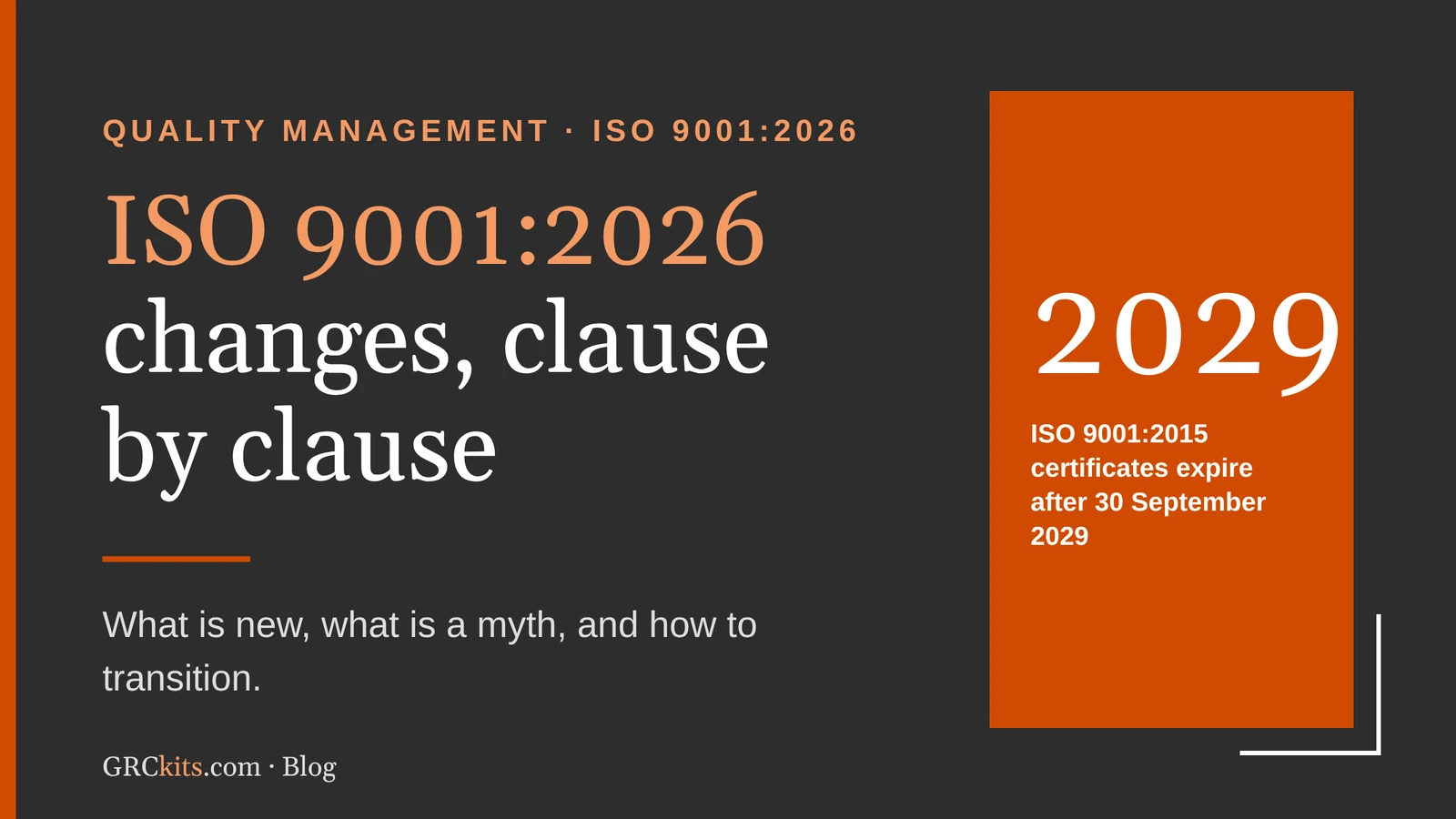
ISO 9001:2026 is no longer a draft. ISO published the sixth edition of the quality management standard on 16 September 2026. It is the new version of ISO 9001 and the first full ISO 9001 revision since 2015, and every organisation certified to ISO 9001:2015 now has a fixed deadline to move across. The good news is that the ISO 9001:2026 changes are an evolution, not a rewrite: the structure, the process approach and risk-based thinking stay. The work is in a handful of targeted changes that auditors will now expect to see in practice.
This guide explains every significant change clause by clause, separates real requirements from the myths that circulated during the draft stage, and gives you a transition plan and gap checklist you can start using this week.
ISO 9001:2026 in Brief (Quick Answer)
ISO 9001:2026 is the 2026 edition of the international quality management system standard. It replaces ISO 9001:2015 and its 2024 climate amendment, keeps the same harmonized structure, and adds targeted changes: quality culture and ethical behaviour (5.1.1, 7.3), separate requirements for risks and opportunities (6.1), stronger change planning (6.3), clause 3 terms, and an expanded Annex A. Certificates to ISO 9001:2015 stop being valid after 30 September 2029.
Item | ISO 9001:2026 |
|---|---|
Published | 16 September 2026 (sixth edition) |
Replaces | ISO 9001:2015 and Amendment 1:2024 (climate action) |
Structure | Harmonized structure, clauses 4 to 10 in the same order |
Size of change | Moderate: targeted new and clarified requirements |
Transition period | 3 years, set by Global Accreditation Cooperation (Global ACI) |
ISO 9001:2015 certificates expire | After 30 September 2029 |
Official details of the edition are on the ISO 9001 standard page at iso.org.
ISO 9001:2026 Changes, Clause by Clause
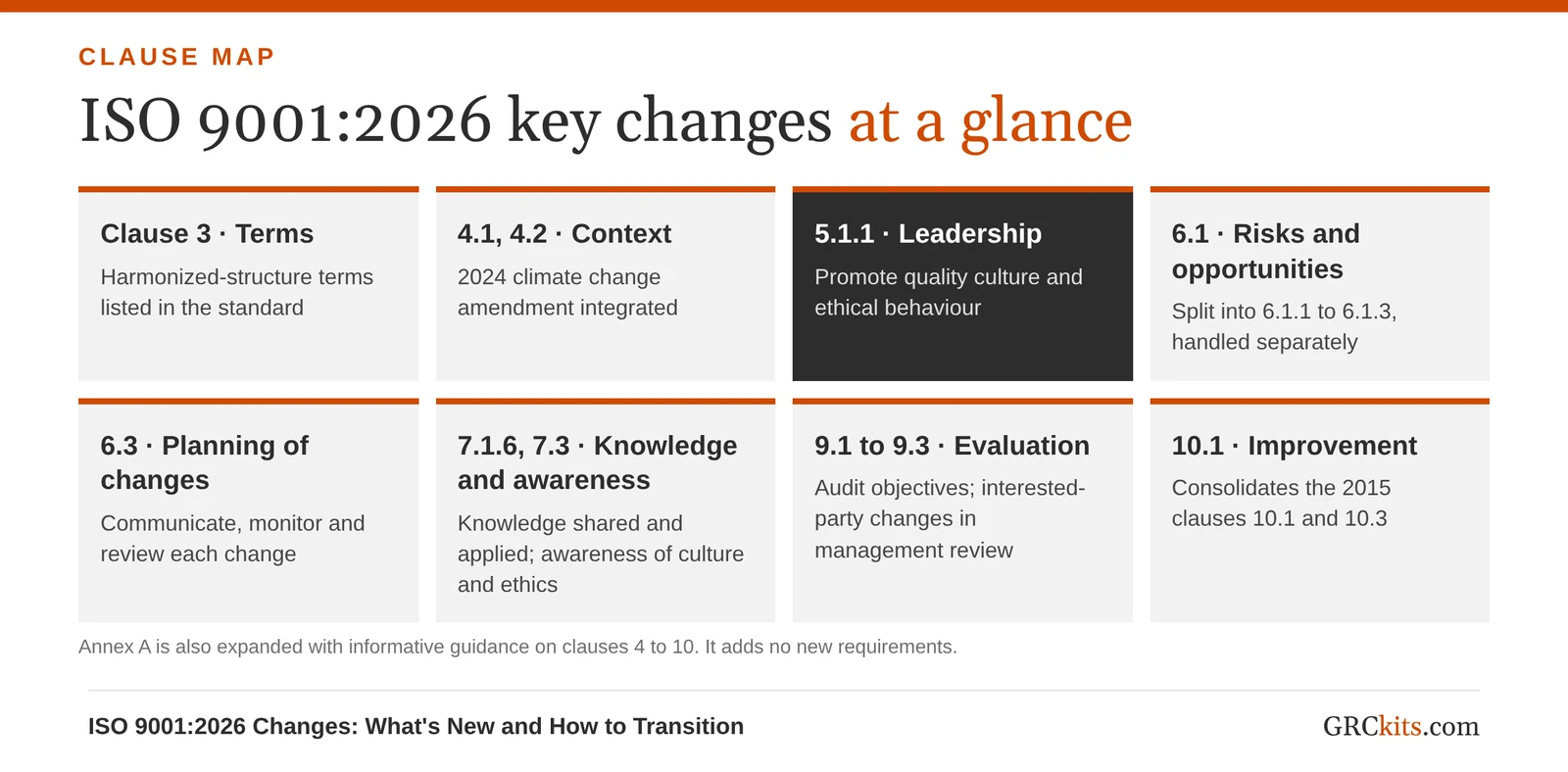
The table shows where each change sits and what it means for an existing QMS. Requirements are summarised in our own words; always check the wording in your licensed copy of the standard.
Clause | What changed in ISO 9001:2026 | What it means for your QMS |
|---|---|---|
3 Terms and definitions | Core harmonized-structure terms now listed in the standard, alongside the reference to ISO 9000 | Align internal definitions with the new terms and ISO 9000:2026 |
4.1, 4.2 Context and interested parties | 2024 climate change amendment integrated; clearer wording on which interested-party requirements the QMS addresses | Keep your climate determination and show which requirements you have chosen to address |
5.1.1 Leadership | Top management must promote quality culture and ethical behaviour | Evidence that leaders act on culture and ethics, not only sign policies |
6.1 Risks and opportunities | Split into 6.1.1 to 6.1.3, with risks and opportunities handled separately | Separate entries for risks and opportunities, each analysed and evaluated |
6.3 Planning of changes | Change planning reinforced: communication, monitoring of effectiveness and review of results | A change record that closes the loop after the change |
7.1.4, 7.3 Environment and awareness | A note links the work environment to culture and ethics; awareness now covers quality culture and ethical behaviour | Update induction and awareness content and test it in interviews |
7.1.6 Organizational knowledge | Knowledge retained, applied and shared | Show how knowledge moves between people, not only where it is stored |
8 Operation | Targeted updates, for example customer communication on contingency actions and requirements passed to external providers | Review customer communication and supplier requirements |
9.1 to 9.3 Performance evaluation | Clearer expectations for customer satisfaction methods, audit objectives and management review inputs | Define objectives per internal audit; add changes in interested parties to review inputs |
10.1 Continual improvement | Consolidates the 2015 improvement requirements from 10.1 and 10.3 | Usually a renumbering exercise in your procedures |
Annex A | Expanded informative guidance on clauses 4 to 10 | Guidance only; no new obligations |
Certification bodies describe the revision the same way; see the clause summary from DNV for an independent view.
Clause 3: Terms Inside the Standard
ISO 9001:2015 sent readers to ISO 9000 for every definition. The 2026 edition lists the core harmonized-structure terms directly in clause 3, while still referring to ISO 9000, which was itself revised in May 2026. Practically, check that your quality manual and procedures use terms such as risk, documented information and interested party in the same sense as the standard. The same approach appears in other recent revisions, such as the ISO/IEC 27000:2026 update for information security.
Clauses 4.1 and 4.2: Climate Change Is Now Built In
The 2024 amendment asked organisations to determine whether climate change is a relevant issue and whether interested parties have climate-related requirements. ISO 9001:2026 integrates that wording. If you already responded to the amendment, review your context analysis rather than starting again. If you concluded climate change is not relevant, keep the reasoning on record, because an auditor will ask how you reached it.
Clauses 5.1.1, 7.1.4 and 7.3: Quality Culture and Ethical Behaviour
This is the change most people will notice. Top management must now promote quality culture and ethical behaviour, a note to 7.1.4 connects the working environment to that culture, and awareness under 7.3 extends to it. The standard does not prescribe a culture programme or a survey. Auditors will look for consistency between what leaders say and what happens: how quality problems are raised, whether people feel able to stop a nonconforming product, and how leadership decisions weigh quality against cost or deadlines.
Good evidence includes leadership communications, records of quality concerns raised and acted on, ethics or speak-up arrangements, and staff who can explain in their own words what is expected of them. If you are mapping who owns what at leadership level, the layers of governance framework is a useful way to set it out.
Clause 6.1: Risks and Opportunities Are Separated
The 2015 edition treated risks and opportunities in one breath, and many organisations recorded opportunities as an afterthought. Clause 6.1 is now split into subclauses that deal with risks and opportunities separately, with Annex A explaining the intent. A practical response is to give opportunities their own entries, owners and actions, and to show that both are analysed and evaluated rather than simply listed. The structure of a good risk register template works well here: add an opportunity section with the same owner, rating and action columns.
Clause 6.3: Planning Changes Properly
Change planning now has to consider communication of the change, monitoring whether it worked, and reviewing the results. A change log that records the decision but not the follow-up will no longer be enough. If your organisation also runs ISO/IEC 27001:2022, which has its own clause 6.3 on planning of changes, one change procedure can serve both systems.
Clause 7.1.6: Knowledge That Is Used, Not Just Stored
Organizational knowledge must be retained, applied and shared. Auditors will look past the document library to how knowledge moves: handovers when experienced staff leave, lessons learned after nonconformities, and how new starters reach what they need.
Clauses 8, 9 and 10: Targeted Refinements
Operations see focused updates rather than new processes, for example clearer expectations on informing customers about contingency actions and on communicating relevant requirements to external providers. In clause 9, each internal audit should have defined objectives, customer satisfaction monitoring methods should be suitable, and management review must consider changes in the needs and expectations of relevant interested parties. Our guides on how internal audit works and building a risk-based internal audit plan show how to set objectives for each audit. Clause 10.1 brings the improvement requirements of the old 10.1 and 10.3 together.
Annex A: More Guidance, No Extra Requirements
Annex A has been substantially expanded to explain the structure, terminology and intent of clauses 4 to 10. It is informative, so it adds no obligations, but expect auditors to use it when interpreting requirements. It is worth reading alongside each clause during your gap analysis.
What Has Not Changed: Common ISO 9001:2026 Myths
Several claims made during the draft stage did not reach the final standard. Before you invest in changes, check them against the published text.
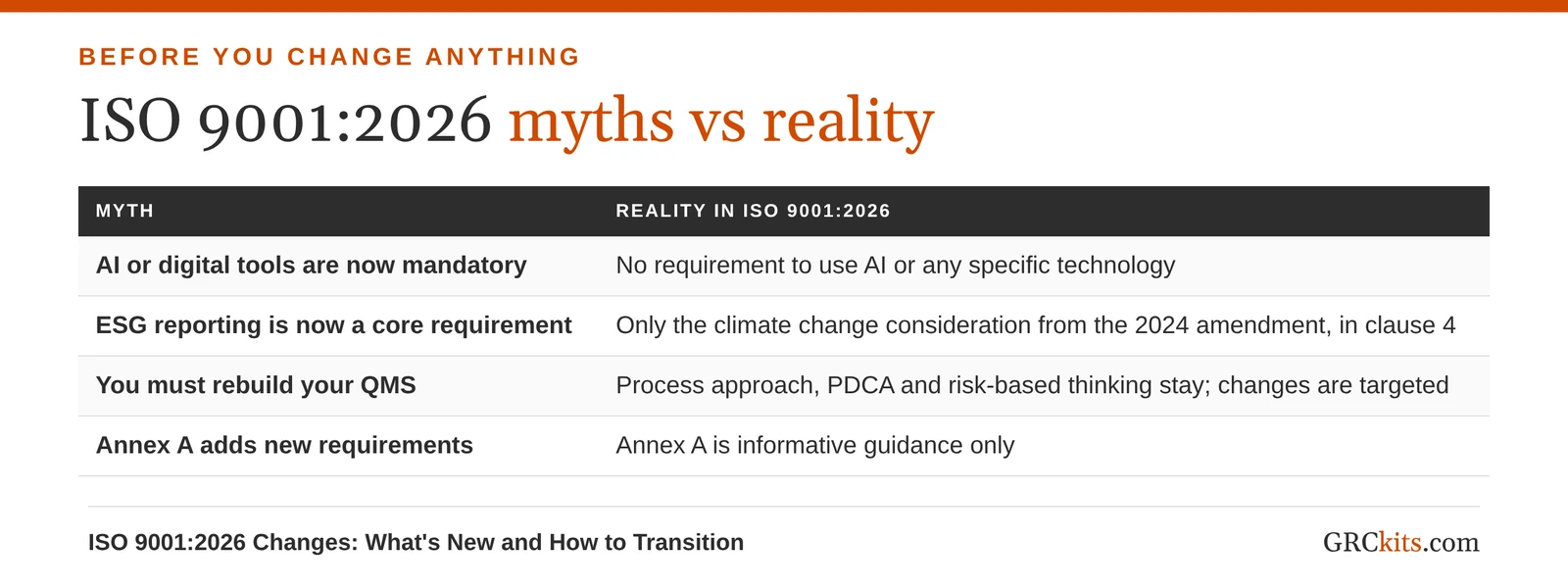
Myth | Reality in ISO 9001:2026 |
|---|---|
AI or digital tools are now mandatory | No requirement to use AI or specific technology. Annex A mentions technology as a possible source of improvement. |
ESG reporting is now a core requirement | The climate change consideration from the 2024 amendment is integrated in clause 4. There is no ESG reporting requirement. |
The documentation requirements were overhauled | Documented information requirements remain largely as in 2015. |
You must rebuild the QMS | The process approach, PDCA cycle and risk-based thinking remain central. Most work is targeted updates. |
As LRQA notes, the 2026 revision is a targeted evolution of the 2015 edition rather than a restructuring.
ISO 9001:2026 Transition Deadline and Timeline
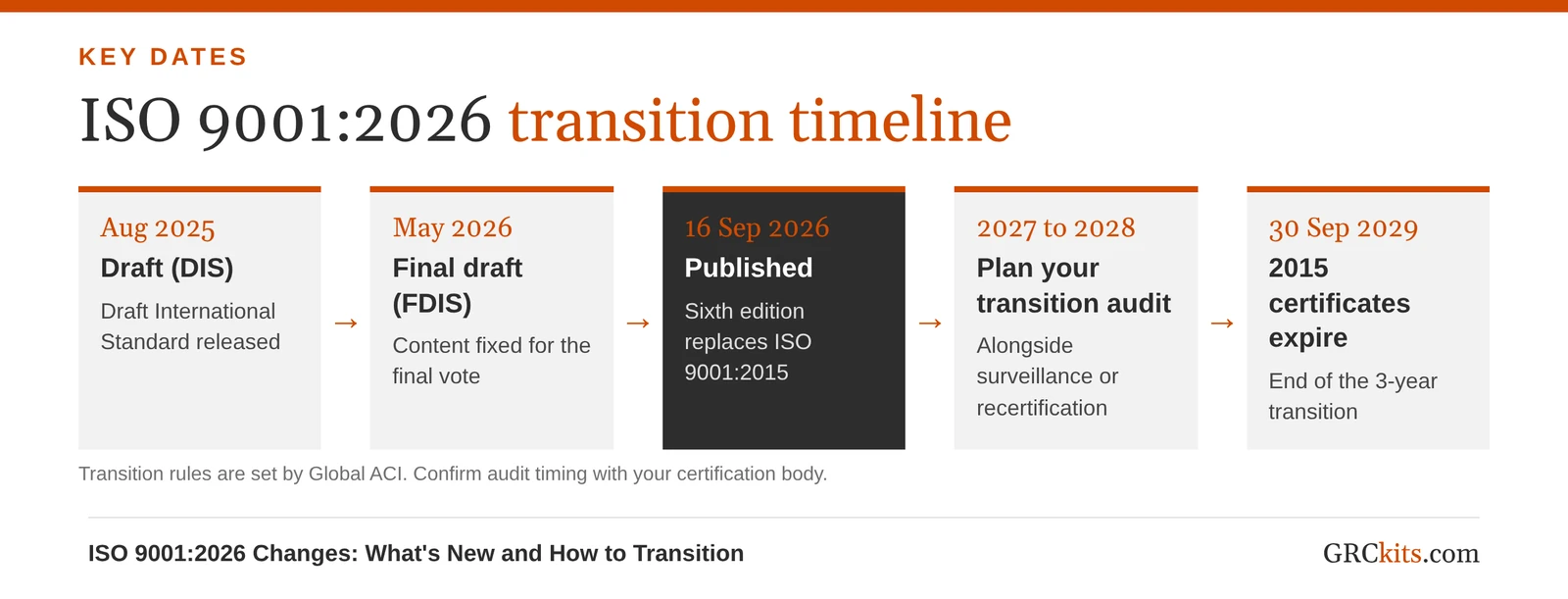
Global ACI, the international accreditation body, has set a three-year transition. ISO 9001:2015 certificates remain valid during that period and cease to be valid after 30 September 2029. Transition audits can usually be combined with a surveillance or recertification audit, or held separately, as DQS explains; confirm the timing and any extra audit time with your certification body.
Leaving it to 2029 is risky. Certification body capacity is always tightest in the final year of a transition, and a nonconformity found late leaves little time to close it before the old certificate expires. Planning the transition audit for your 2027 or 2028 surveillance visit gives you room to fix gaps.
How to Transition to ISO 9001:2026: An 8-Step Plan
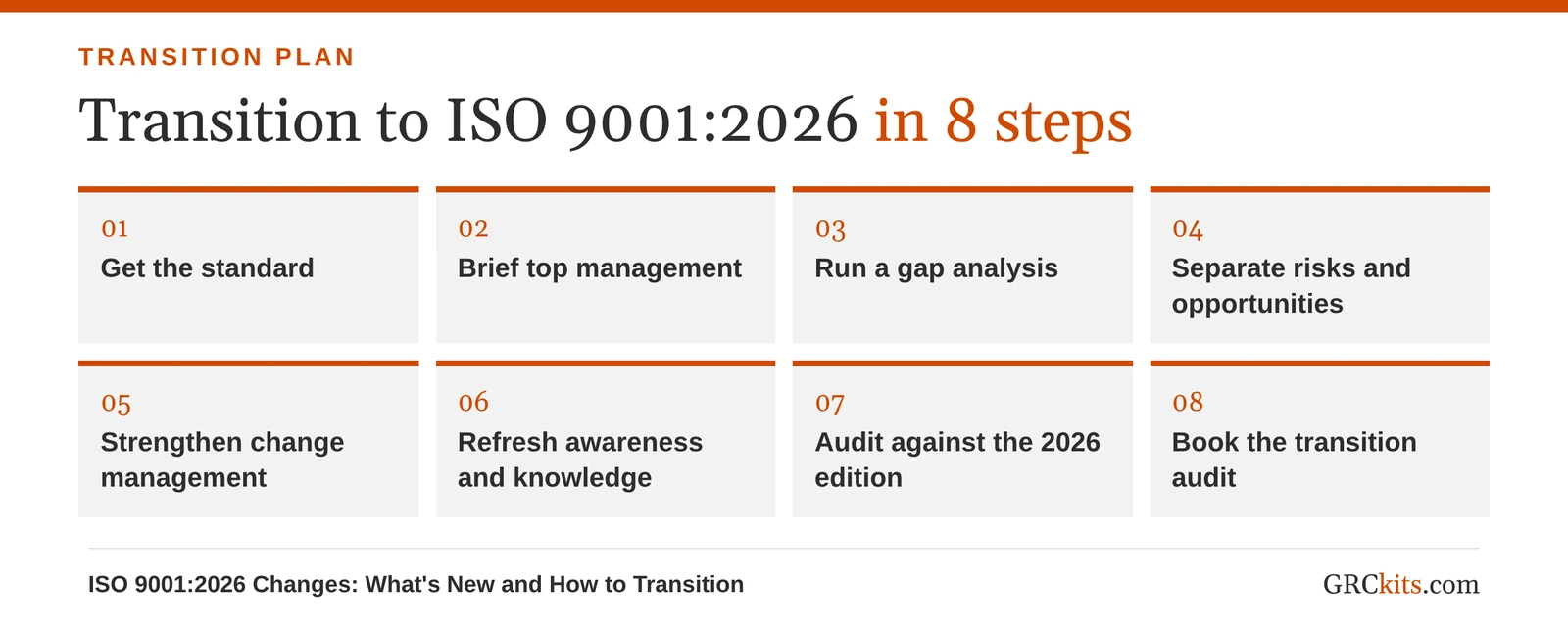
Get the standard. Buy ISO 9001:2026 and, if useful, ISO 9000:2026. Work from the published text, not summaries.
Brief top management. Clause 5.1.1 makes leaders directly responsible for quality culture and ethical behaviour; they need to understand what that means before anyone else changes documents.
Run a gap analysis. Compare your QMS with each changed clause and Annex A. Use the checklist below.
Update risk and opportunity management. Separate opportunities from risks, assign owners and record analysis and evaluation for both.
Strengthen change management. Add communication, effectiveness monitoring and review of results to your change procedure.
Refresh awareness and knowledge processes. Update induction and awareness content for quality culture and ethics, and show how knowledge is shared and applied.
Audit against the new edition. Set objectives for each internal audit and run at least one full internal audit and a management review using the 2026 inputs.
Book the transition audit. Agree the date and scope with your certification body, ideally alongside a planned surveillance or recertification visit.
ISO 9001:2026 Gap Analysis Checklist
Question | Evidence an auditor may ask for |
|---|---|
Does the context analysis address climate change? | Context review record with the climate determination and reasoning |
Are interested-party requirements the QMS addresses clearly identified? | Interested-party register showing which requirements are in scope |
How does top management promote quality culture and ethical behaviour? | Leadership communications, speak-up arrangements, decisions on quality issues |
Do people know the expected culture and ethical behaviour? | Awareness material, training records, interview responses |
Are risks and opportunities handled separately, with analysis and evaluation? | Risk and opportunity register with owners, ratings and actions |
Do planned changes include communication, monitoring and review? | Change records closed with a review of results |
Is organizational knowledge retained, applied and shared? | Handover records, lessons learned, knowledge base usage |
Does each internal audit have defined objectives? | Audit programme and audit plans |
Does management review cover changes in interested-party needs? | Management review minutes using the 2026 inputs |
ISO 9001:2026 and Integrated Management Systems
Because ISO 9001:2026 keeps the harmonized structure, it still fits alongside ISO/IEC 27001, ISO 14001 and ISO 45001 in one integrated management system. Shared elements such as context, leadership, change planning, internal audit and management review can run once for all standards, with standard-specific requirements added where needed. If you are combining quality with information security, the ISO 27001 implementation guide shows how the same planning, risk and audit processes can serve both systems.
Frequently Asked Questions
What is the new version of ISO 9001?
The new version is ISO 9001:2026, the sixth edition, published on 16 September 2026. This ISO 9001 revision replaces ISO 9001:2015, whose certificates stay valid until 30 September 2029.
When was ISO 9001:2026 published?
ISO published ISO 9001:2026 on 16 September 2026. It is the sixth edition and replaces ISO 9001:2015.
What is the ISO 9001:2026 transition deadline?
The transition period is three years. ISO 9001:2015 certificates cease to be valid after 30 September 2029.
Do I need to recertify for ISO 9001:2026?
You need a transition audit rather than a new certification from scratch. It can usually be combined with a surveillance or recertification audit; confirm the details with your certification body.
What is the biggest change in ISO 9001:2026?
For most organisations, the explicit requirement for top management to promote quality culture and ethical behaviour (5.1.1), supported by awareness (7.3), and the separation of risks and opportunities in 6.1.
Is AI required by ISO 9001:2026?
No. The standard does not require AI or any specific technology.
Is Annex A of ISO 9001:2026 mandatory?
No. Annex A is informative guidance on the intent of clauses 4 to 10. It adds no requirements, but it helps auditors and implementers interpret them consistently.
Conclusion
The ISO 9001:2026 changes ask most organisations to sharpen what they already do rather than rebuild their QMS. The areas that need real attention are leadership's role in quality culture and ethics, separate handling of risks and opportunities, and change planning that closes the loop. Start with the gap checklist above, update the processes it flags, and book your transition audit well before 30 September 2029.

Written by
Shahidul Shubo
Cybersecurity GRC Consultant
Shahidul Shubo is a Cybersecurity GRC Consultant with 10+ years of experience in information security governance, risk management, regulatory compliance and IT audit, and has audited more than 120 organisations. He is CISA and CISM certified, an ISO/IEC 27001 Lead Auditor and Lead Implementer, and a Lead Auditor for ISO/IEC 27701, ISO/IEC 42001, ISO 22301 and ISO 9001. His technical credentials include AWS Solutions Architect, AWS Security Specialty, Red Hat RHCA and RHCE, Fortinet NSE and CCEP. He works hands-on with ISO 27001, NIST CSF and NCA ECC, and builds the practical templates and assessment tools published on GRCkits.
Connect on LinkedIn