A critical IT vendor is onboarded on a Friday. The contract is signed, system access is granted, and on Monday the vendor starts handling customer data. Six months later, an incident reveals what nobody noticed: the vendor's risk assessment was never formally approved.
Knowing how internal audit works is what catches that gap before it turns into an incident. This guide walks through the four internal audit process steps (plan, test, evaluate, report) using a critical supplier audit as the running example. You will see what evidence auditors ask for, how a finding is written using criteria, condition, cause and effect, and why a finding stays open until evidence proves the fix works.
Key takeaways
A risk-based internal audit focuses effort on the exposures that matter most, not on every control equally.
Every test compares what you observe (condition) against what should exist (criteria).
A strong finding names the cause, the exposure, an owner and a due date.
Management fixes the issue; internal audit validates the fix with evidence.
A finding is never closed on management's word alone.
What is a risk-based internal audit?
A risk-based internal audit is an audit approach that directs testing toward the areas where a control failure would hurt the organization most. Instead of checking every control equally, auditors rank risks, test the critical controls first, and report findings in terms of business exposure.
This matters because audit time is limited. A bank or NBFI may have hundreds of vendors in its audit universe, but only a handful touch customer data, payment systems or core banking. Those critical suppliers deserve the deepest testing.
The approach is built into the IIA Global Internal Audit Standards, which expect audit plans and engagements to be driven by risk. It also fits the three lines model: management owns and runs controls, risk and compliance functions oversee them, and internal audit gives independent assurance that they work. [INTERNAL LINK: Three lines model explained]
Step 1: Plan a risk-based engagement
Good audits are won or lost in planning. Audit engagement planning decides what you will test, what evidence you need and what "good" looks like before a single document is reviewed.
Our example engagement: audit the onboarding of a critical supplier, such as a cloud hosting provider or a core banking software vendor.
Define scope and focus areas
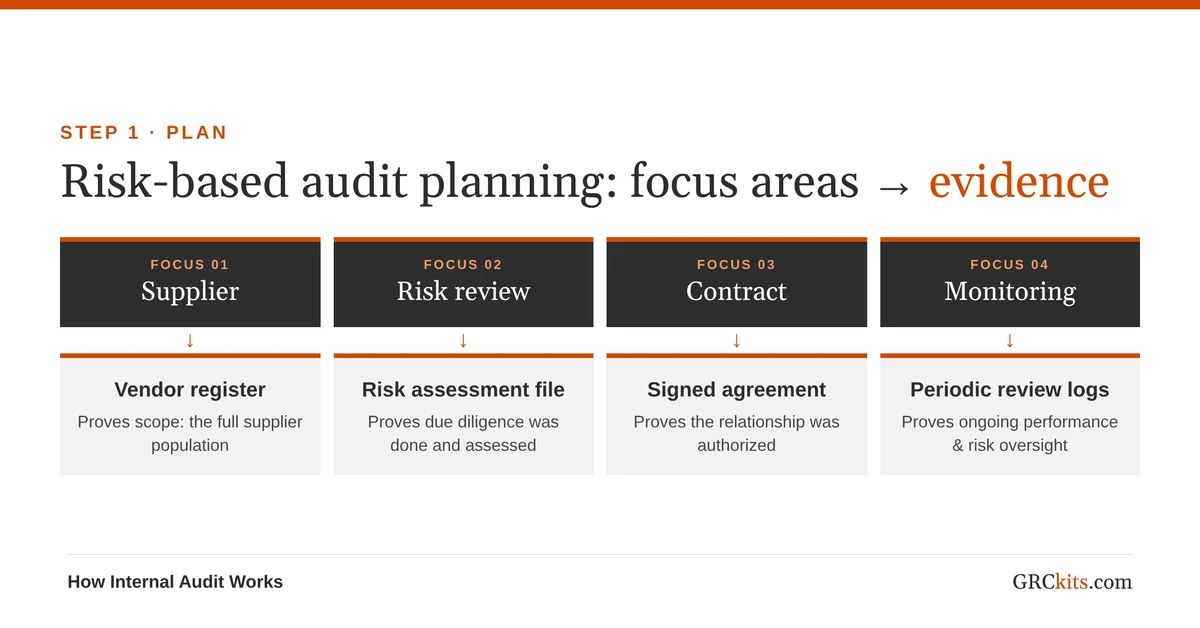
Break the supplier lifecycle into four focus areas. Each one is a point where risk can slip through:
1 Supplier population: which vendors exist and which are classified as critical.
2. Risk review: whether due diligence was done before onboarding.
3. Contract: whether the agreement was signed and authorized.
4. Monitoring: whether the supplier's performance and risk are reviewed over time.
Identify the audit evidence
Each focus area needs evidence that proves the control actually operated. Vendor due diligence audit evidence should be documented, dated and traceable to a person.
Focus area | Evidence to request | What it proves |
|---|---|---|
Supplier | Vendor list / register | Scope: the full population of suppliers |
Risk review | Risk assessment file | Due diligence was performed and assessed |
Contract | Signed terms and agreement | The relationship was authorized |
Monitoring | Periodic review logs | Ongoing performance and risk oversight |
Define the criteria
Criteria are the expected control practices you test against. Without them, a finding is just an opinion. Build them in three moves:
• Set objectives: prioritize the most critical exposures, such as vendors with access to customer data.
• Map criteria: use approved policies, such as your third-party risk management (TPRM) policy, procurement policy and regulatory guidelines.
• Plan tests: choose risk-based procedures, such as inspecting sign-offs, re-performing a risk rating or sampling review logs.
Step 2: Test the four control areas
Control testing is where planning meets reality. For each area, the auditor compares what they observe with what the criteria expect, then records a result.
• Governance: Is there a named owner for the supplier relationship? The auditor checks the vendor register and the RACI or delegation document.
• Due diligence: Was the risk assessment completed and formally signed off before onboarding? The auditor inspects the risk file for an approval with name and date.
• Contracting: Is the agreement signed by authorized signatories, with security and audit-right clauses? The auditor matches signatures against the delegation of authority.
• Monitoring: Are periodic reviews happening on schedule? The auditor samples review logs against the review calendar.
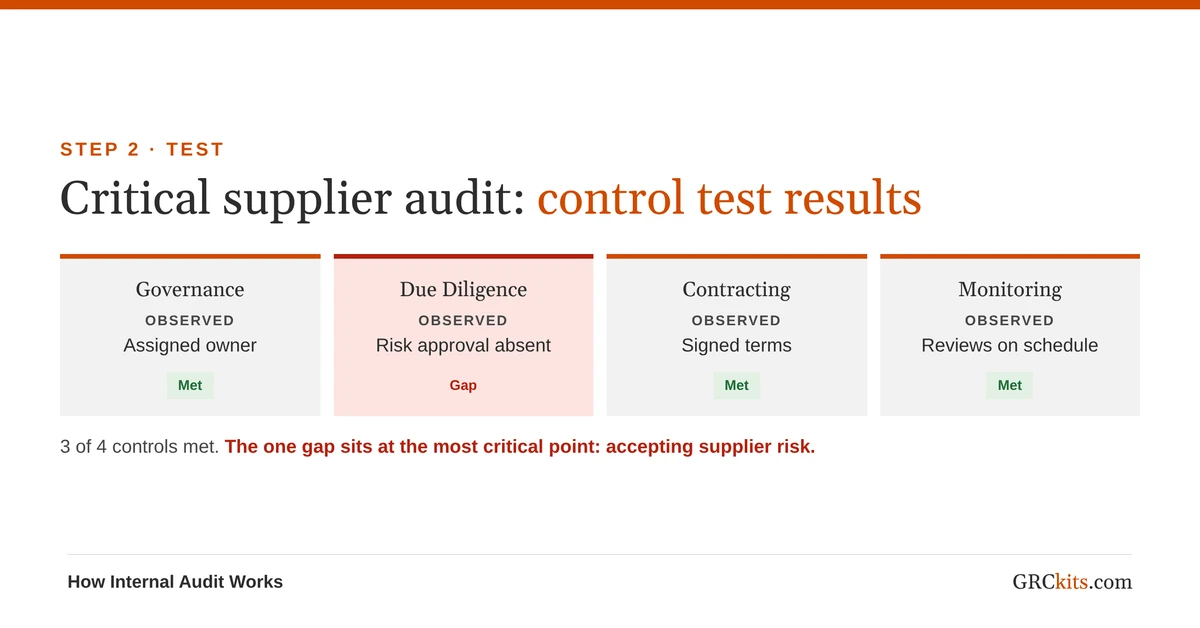
This example is based on a real critical supplier audit, with identifying details changed. The results looked like this:
Control | Observed | Expected | Result |
Governance | Assigned owner | Defined responsibility | MET |
Due diligence | Approval absent | Documented risk sign-off | GAP |
Contracting | Signed terms | Authorized agreement | MET |
Monitoring | Reviews on schedule | Risk-based checks | MET |
Three of four controls work. One does not, and it sits at the most important point: the decision to accept the supplier's risk.
From the field: In supplier audits, the gap I find most often is vendor access that is never removed. The contract ends or the service moves in-house, but the vendor's accounts and remote access stay active. Add offboarding to every third-party audit: compare the list of ended contracts with active vendor accounts.
Step 3: Evaluate the finding using criteria, condition, cause and effect
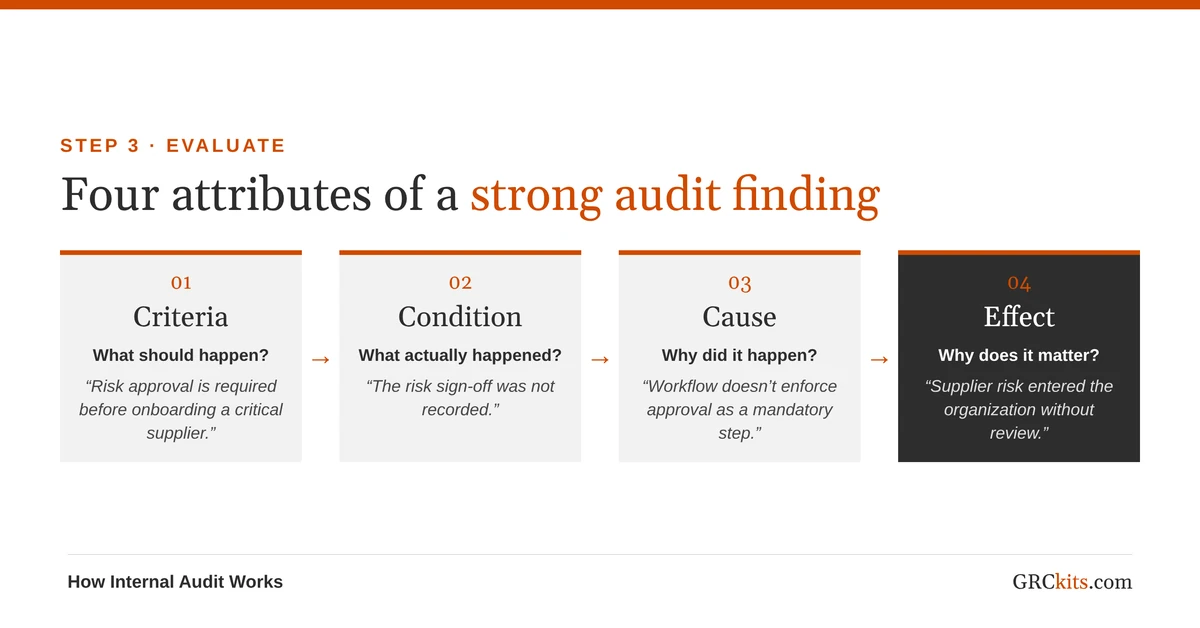
A gap is not yet a finding. To turn it into one that management will act on, structure it with the four audit finding attributes: criteria, condition, cause and effect (often called exposure).
• Criteria: what should happen. Risk approval is required before a critical supplier is onboarded.
• Condition: what actually happened. The risk sign-off was not recorded.
• Cause: why it happened. This needs root cause analysis with management, not a guess.
• Effect / exposure: why it matters. Supplier risk entered the organization without review.
Finding the real cause
The cause drives the fix, so investigate it with the process owner. Realistic causes in this case could include:
1. The onboarding workflow lets procurement proceed without a mandatory approval step.
2. The TPRM policy does not clearly say who approves critical-supplier risk.
3. Business pressure led to a verbal approval that was never documented.
Each cause leads to a different corrective action: a system control, a policy update, or training and enforcement.
This is also what the IIA expects: Standard 14.3 (Evaluation of Findings) of the Global Internal Audit Standards asks internal auditors to work with management to identify the root causes of findings where possible.
From the field: The weak root cause I hear most often from management is "lack of awareness". It rarely survives a second question: if people were unaware, why did the process let the step be skipped? Keep asking until you reach the process or control gap, because more training will not fix a workflow that lets a contract be signed without risk approval.
How to write an internal audit finding (with example)
Finding: Risk Approval Gap (Rating: High)
Criteria: The TPRM policy requires documented risk approval before onboarding any critical supplier.
Condition: For [Supplier X], the risk assessment was completed, but no approval by the designated risk owner was recorded before the contract start date.
Cause: The onboarding workflow does not enforce risk approval as a mandatory step before contract execution.
Effect: The organization accepted supplier risk without management review, which may expose it to data, operational and regulatory risk.
Recommendation: Make documented risk approval a mandatory gate in the onboarding workflow and obtain retrospective approval for [Supplier X].
Owner: Supplier risk lead · Due date: [agreed date]
Notice the finding is specific, factual and fixable. It names one supplier, one missing control and one accountable owner.
Step 4: Report and follow up
The audit report presents the finding and the overall conclusion to management and, for significant issues, to the audit committee. Management then responds with a management action plan: what they will change, who owns it and by when.
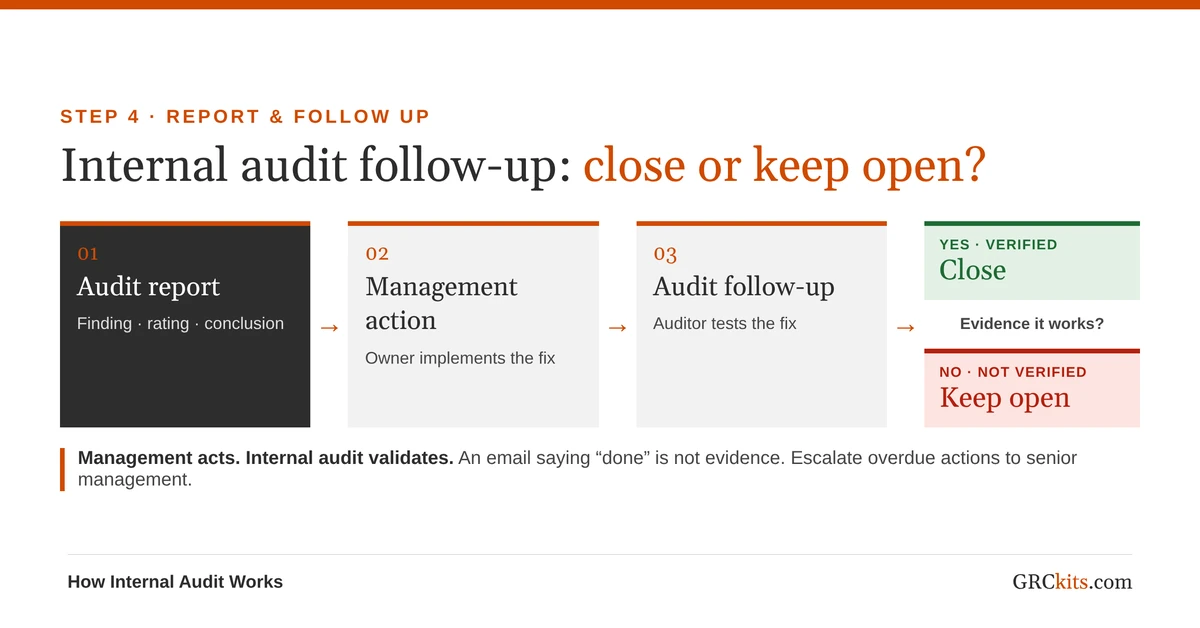
The follow-up is where many audit functions fall short. The rule is simple: management acts; internal audit validates.
1. Audit report: finding, rating and conclusion are issued.
2. Management action: the owner implements the control change.
3. Audit follow-up: the auditor tests whether the fix works.
4. Decision: if verified, close the action. If not verified, keep it open.
Internal audit follow-up process: when to close a finding
Close a finding only when evidence shows the corrective action is designed well and operating. An email saying "done" is not evidence.
Close the finding (verified) | Keep it open (not verified) |
Workflow screenshot shows risk approval is now a mandatory gate | Management states the workflow "will be updated" |
Retrospective approval for Supplier X is signed and dated | Approval is promised but not on file |
A sample of new onboardings all show recorded approval | No new onboardings yet to test operating effectiveness |
Track every open action against its due date. An ISO 27001 IT internal audit dashboard keeps findings, owners and due dates in one place. When actions become overdue, escalate: first to senior management, then to the audit committee if the risk remains unresolved.
Standard 15.2 of the Global Internal Audit Standards requires internal audit to confirm that management has implemented the agreed recommendations or action plans, so closure needs evidence, not a status update.
From the field: The follow-up problem I see most often is a fix that addresses the symptom, not the cause. The missing approval gets signed after the fact and the finding is put forward for closure, but the onboarding workflow still allows the same gap. Before closing, test that the cause is fixed, for example by sampling onboardings made after the change.
Supplier onboarding audit checklist
Use this checklist to plan your next third-party risk audit. Adjust it to your own policy and regulator's expectations.
☐ A complete vendor register exists, with critical suppliers clearly classified
☐ Each critical supplier has a named relationship owner
☐ Criticality criteria are defined in an approved TPRM policy
☐ A risk assessment was completed before onboarding
☐ Risk acceptance was approved by the designated authority, with name and date
☐ Security and data-protection due diligence (questionnaire, certifications) is on file
☐ The contract is signed by authorized signatories per the delegation of authority
☐ The contract includes security, confidentiality, incident-notification and right-to-audit clauses
☐ Access granted to the supplier is limited to what the contract requires
☐ Periodic performance and risk reviews are scheduled and logged
☐ Issues from past reviews are tracked to closure
☐ An exit or termination plan exists for the supplier
Common mistakes auditors make
1. Closing findings without evidence. Accepting management's word turns follow-up into a formality.
2. Writing a vague cause. "Lack of awareness" rarely explains anything. Dig until you find the process or control weakness.
3. No owner or due date. A recommendation without an accountable person and a date will drift.
4. Testing everything equally. Spending as much time on a stationery supplier as on a core banking vendor defeats the purpose of a risk-based internal audit.
5. Mixing condition and effect. "Sign-off missing" is the condition. "Unreviewed supplier risk" is the effect. Keep them separate so readers see why the gap matters.
Frequently asked questions
What are the main internal audit process steps?
Most internal audits follow four steps: plan the engagement around key risks, test the controls, evaluate any gaps as findings, and report and follow up. Planning sets the scope and criteria, testing gathers evidence, evaluation explains why gaps matter, and follow-up confirms management's fixes actually work.
What is the difference between criteria, condition, cause and effect?
Criteria describe what should happen, based on policy or regulation. Condition is what the auditor actually found. Cause explains why the gap exists, and effect describes the risk or impact it creates. Together they make a finding clear, defensible and easy for management to act on.
When should an internal audit finding be closed?
A finding should be closed only after internal audit has seen evidence that the corrective action is in place and working. That might be a system screenshot, signed approvals or a sample of transactions. A management statement that the issue is fixed is not enough on its own.
What evidence is needed for a vendor due diligence audit?
Typical evidence includes the vendor register, the completed risk assessment, a dated risk approval, security questionnaires or certifications, the signed contract, and periodic review logs. Each piece should be traceable to a person and a date so the auditor can confirm the control operated when it should have.
How does risk-based internal audit apply to banks and NBFIs?
Banks and NBFIs rely heavily on third parties for core banking, payment switches, cloud and connectivity. A risk-based internal audit lets them focus on vendors that touch customer data or critical systems. Financial regulators, including Bangladesh Bank, expect institutions to manage outsourcing and ICT vendor risk under its Guideline on ICT Security (Version 4.0). In March 2026 Bangladesh Bank also issued a Cybersecurity Framework (Version 1.0), which scheduled banks, finance companies, MFS providers and payment service providers must implement by 31 December 2026.
Who is responsible for fixing an audit finding?
Management is responsible. The process or control owner named in the finding designs and implements the fix by the agreed date. Internal audit stays independent: it recommends, monitors progress and validates the result, but it does not implement the control itself.
Conclusion
Now you know how internal audit works in practice: plan around the highest risks, test controls against clear criteria, write findings that explain cause and effect, and close them only when evidence proves the fix. In our critical supplier audit, three controls passed. The one that failed, risk approval, was the one that mattered most. That is exactly what a risk-based approach is designed to catch.
Apply the same four steps to your next third-party risk audit, and your findings will be clearer, your follow-ups stronger and your audit committee better informed.
Related reading: how to build a risk-based internal audit plan for the year, and the IT audit career guide if you are building these skills.

Written by
Shahidul Shubo
Cybersecurity GRC Consultant
Shahidul Shubo is a Cybersecurity GRC Consultant with 10+ years of experience in information security governance, risk management, regulatory compliance and IT audit, and has audited more than 120 organisations. He is CISA and CISM certified, an ISO/IEC 27001 Lead Auditor and Lead Implementer, and a Lead Auditor for ISO/IEC 27701, ISO/IEC 42001, ISO 22301 and ISO 9001. His technical credentials include AWS Solutions Architect, AWS Security Specialty, Red Hat RHCA and RHCE, Fortinet NSE and CCEP. He works hands-on with ISO 27001, NIST CSF and NCA ECC, and builds the practical templates and assessment tools published on GRCkits.
Connect on LinkedInNeed hands-on help?
IS Audit
Independent information systems audits that strengthen IT governance and demonstrate compliance.
Request an audit