ISO/IEC 27000 is the document most ISMS practitioners cite for definitions such as "risk owner", "nonconformity" or "information security event". The sixth edition, ISO/IEC 27000:2026, changes that role. It is no longer a vocabulary standard, its title has changed, and its structure now explains how the ISO/IEC 27000 family fits together. This article sets out what changed from the 2018 edition, what did not change, and the small set of updates an ISO 27001 implementation programme should make.
Quick answer: what changed in ISO/IEC 27000:2026?
ISO/IEC 27000:2026 (sixth edition, published July 2026) replaces ISO/IEC 27000:2018. It has a new title, adds a section on information security concepts and principles, restructures the document around how ISMS standards relate to each other, and cuts Clause 3 down to only the terms needed for those concepts. It is no longer a terminology document, and it is still not a certifiable standard.
Publication facts at a glance
Item | Detail |
|---|---|
Designation | ISO/IEC 27000:2026, Edition 6 |
Published | July 2026 |
Replaces | ISO/IEC 27000:2018 (fifth edition), now withdrawn |
Committee | ISO/IEC JTC 1/SC 27 |
Document status | Horizontal document under the ISO/IEC Directives, Part 1 |
European adoption | EN ISO/IEC 27000:2026, adopted without changes; supersedes EN ISO/IEC 27000:2020 |
National versions | BS EN ISO/IEC 27000:2026 (UK), DIN EN ISO/IEC 27000:2026-11 (Germany), EVS-EN ISO/IEC 27000:2026 (Estonia) |
Certifiable? | No |
The five official changes
The foreword of the 2026 edition lists the main technical changes. These are the changes you can treat as confirmed.
1. A new title
2018: Information technology — Security techniques — Information security management systems — Overview and vocabulary
2026: Information security, cybersecurity and privacy protection — Information security management systems — Overview
Two things happened. The prefix now matches the naming SC 27 uses across the family (ISO/IEC 27001:2022 and ISO/IEC 27002:2022 already carry it). And the words "and vocabulary" were removed, which signals the bigger change below.
2. Restructured as an overview of the ISMS family
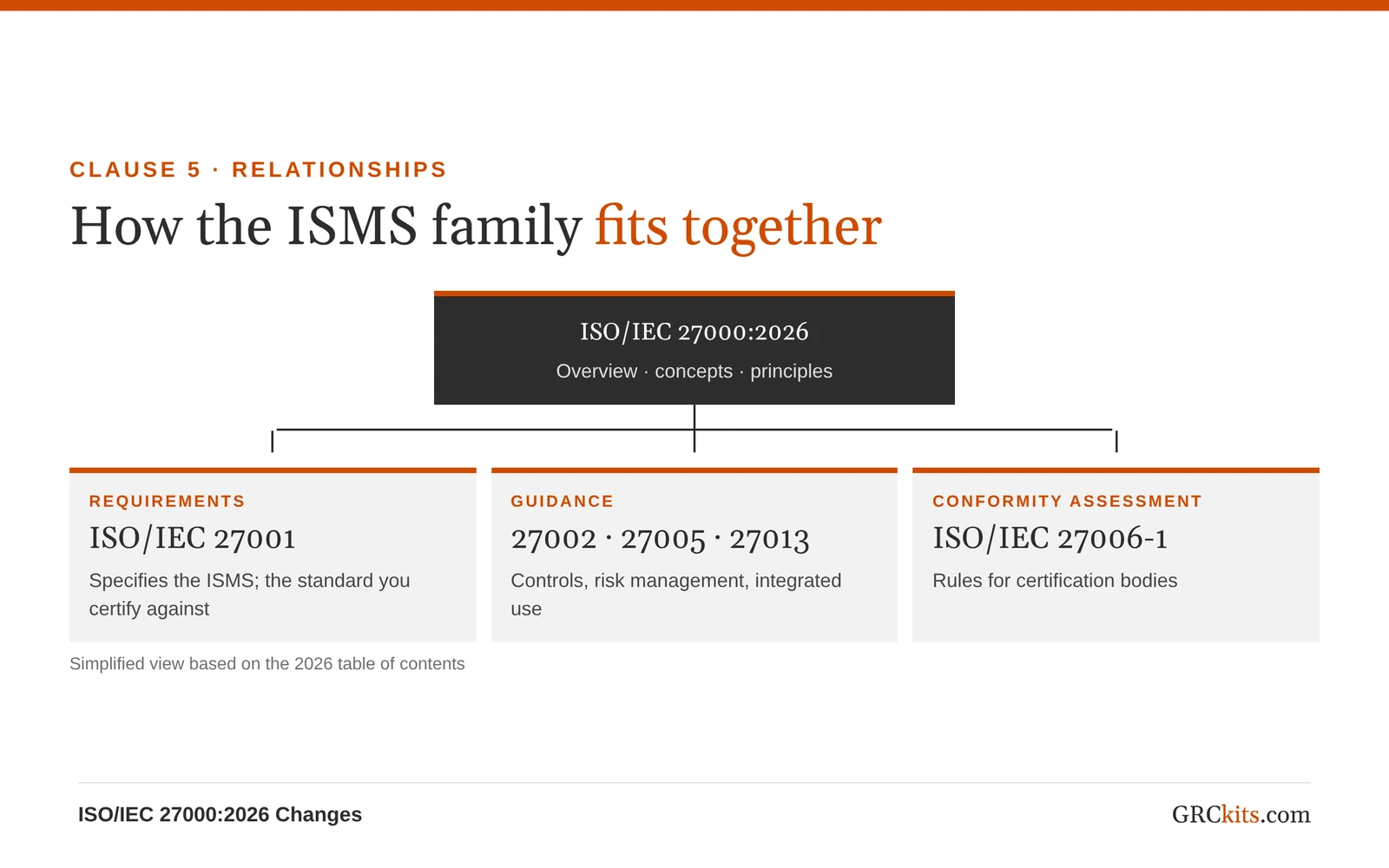
The document is reorganised to explain what each ISMS-related document does and how the documents relate. Based on the published table of contents, Clause 5 now covers:
ISO/IEC 27001 as the specification of an ISMS
candidate necessary information security controls
fulfilment of ISMS requirements
use of the ISMS, including integrated implementation guidance such as ISO/IEC 27013
control assessment, attributes, processes and competence
conformity assessment through ISO/IEC 27006-1
relationships between the standards
For a practitioner, this is effectively an official map of the family: which document is a requirement, which is guidance, and which supports certification bodies.
3. New content on concepts and principles
A new Clause 4, Concepts and principles, explains the ideas behind information security and an ISMS. The 2018 edition touched on these inside its overview clauses; the 2026 edition gives them a dedicated structure (4.1 Concepts and 4.2 Principles).
4. Clause 3 reduced to the terms the document itself needs
Clause 3 now defines only the terms used to present the concepts and principles in this document. The long vocabulary list that made the 2018 edition the go-to glossary is no longer in the main body.
5. No longer a terminology document
The foreword states this directly, and ISO's own summary says the same: the edition focuses on overview, concepts and relationships rather than serving as a terminology document.
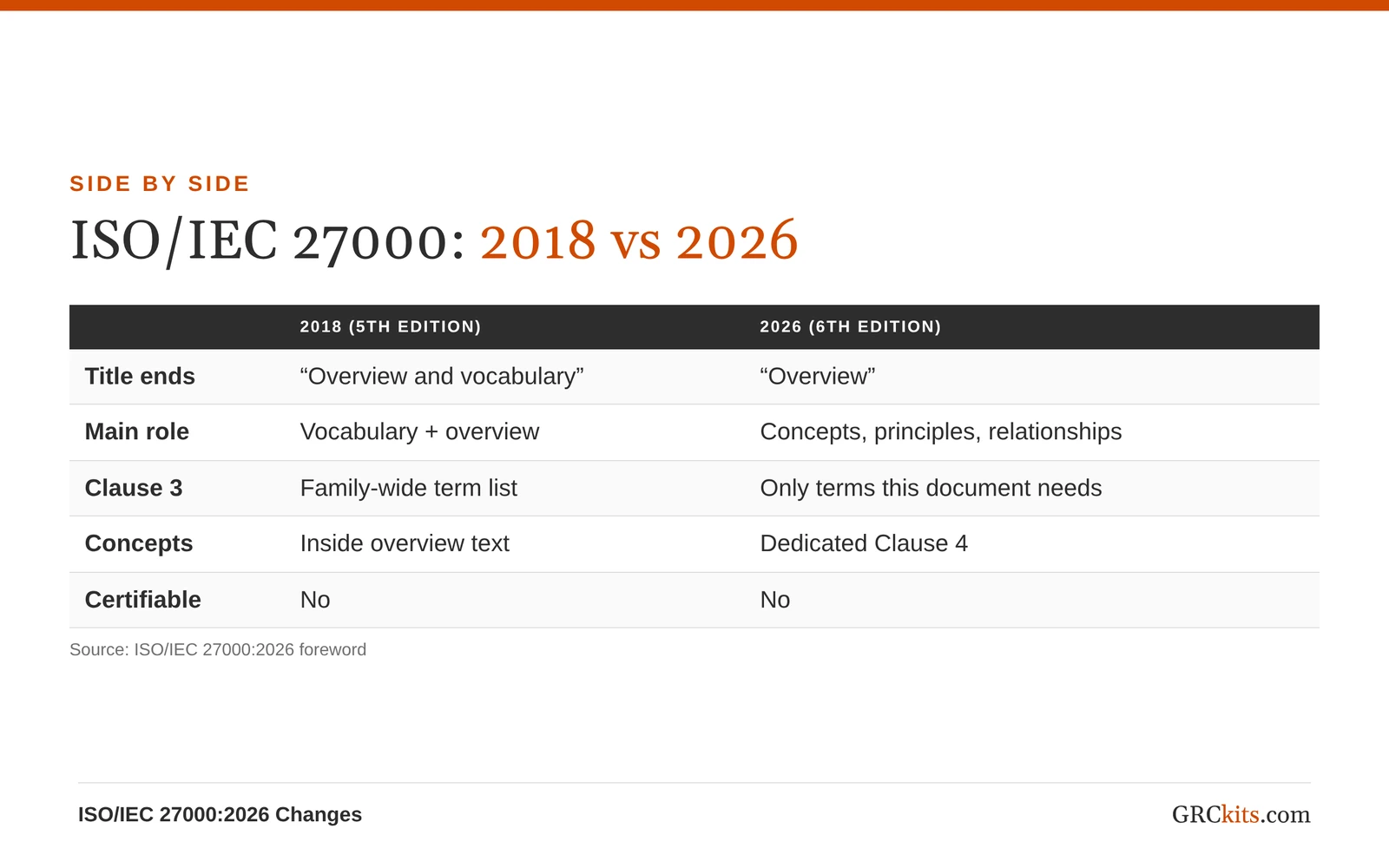
ISO/IEC 27000:2018 vs 2026: side-by-side comparison
Aspect | ISO/IEC 27000:2018 | ISO/IEC 27000:2026 |
|---|---|---|
Title ends with | "Overview and vocabulary" | "Overview" |
Primary role | Vocabulary + overview | Overview, concepts, principles, relationships |
Clause 3 | Extensive family-wide vocabulary | Only terms needed for this document |
Concepts and principles | Covered within overview text | Dedicated Clause 4 |
Map of the family | Described | Restructured Clause 5 with relationships |
Certifiable | No | No |
What commentators are saying
Certification body DQS, in its August 2026 commentary, describes further themes: a more flexible way of managing terminology across the family, continued use of confidentiality, integrity and availability with more attention to properties such as authenticity, accountability and non-repudiation, and closer alignment of risk concepts with ISO 31000. These points are not in the foreword's list of changes, so treat them as interpretation and check the full text before relying on them.
Does ISO/IEC 27000:2026 affect your ISO 27001 certification?
Not directly. ISO/IEC 27000 has never contained requirements. You are certified against ISO/IEC 27001:2022, and its requirements (Clauses 4–10, plus the Annex A controls selected through risk assessment and justified in the Statement of Applicability) are unchanged by this publication. There is no transition deadline for ISO/IEC 27000:2026.
There is one subtle point. ISO/IEC 27001:2022 refers to ISO/IEC 27000 for its terms and definitions, and that reference does not name an edition, so in principle the latest edition applies. If a term your ISMS relies on is no longer defined in the 2026 edition, you need to know where the authoritative definition now lives. A practical option is the ISO Online Browsing Platform, which lets anyone search terms and definitions across ISO standards free of charge.
Expect ISO/IEC 27001, ISO/IEC 27002 and other family members to align with the new edition as they are revised.
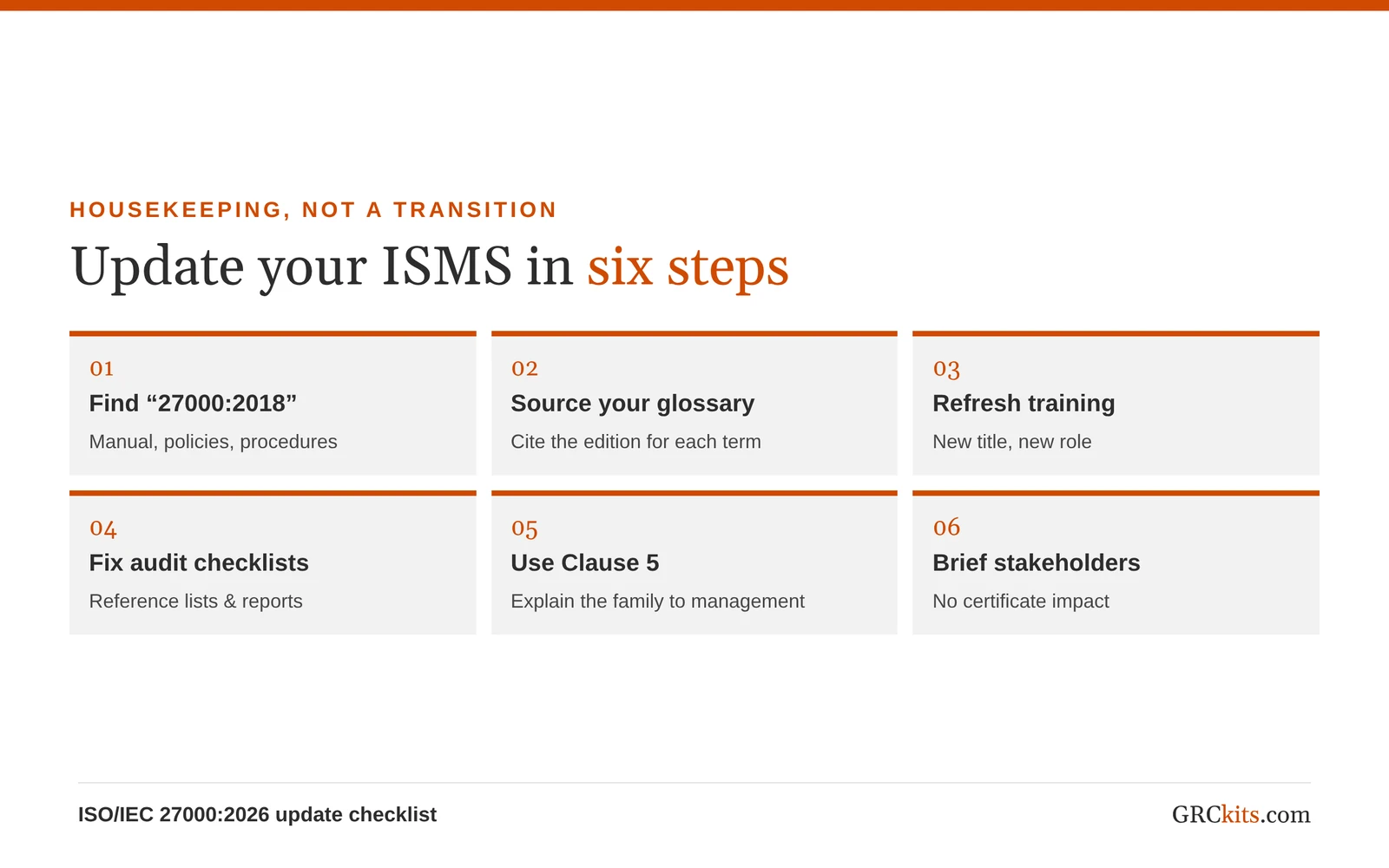
What to update in your ISMS: a six-step checklist
None of these are certification requirements. They are housekeeping steps that keep documentation accurate and avoid audit queries.
Search your ISMS documents for "27000:2018". Update references in the ISMS manual, information security policy, procedures and glossary. Where you cite a specific definition, keep the edition in the citation so the meaning stays fixed.
Review your ISMS glossary. If it was copied from ISO/IEC 27000:2018, keep it but label the source. For terms no longer in the 2026 edition, record the source you now rely on (for example ISO/IEC 27001:2022 itself, ISO/IEC 27005:2022 or ISO 31000:2018).
Update training and awareness material that quotes the old title or calls ISO/IEC 27000 "the vocabulary standard".
Update internal audit checklists and reports that list ISO/IEC 27000:2018 as a reference. If you are planning this year's cycle, see how internal audit works and how to build a risk-based internal audit plan.
Use Clause 5 as a scoping aid. Its relationship view helps explain to management which documents are requirements (27001), guidance (27002, 27005) and certification-body rules (27006-1).
Brief your certification body or clients that no transition is needed, so nobody plans an unnecessary project.
Common mistakes to avoid
Saying "we must transition to ISO 27000:2026". There is nothing to transition; ISO/IEC 27000 is not certifiable.
Citing ISO/IEC 27000:2026 for a definition it no longer contains. Check the term is actually in Clause 3 before citing it.
Treating commentary as the standard. Blog summaries, including this one, are not the text. Quote the standard only after reading it.
Assuming ISO 27001 changed. ISO/IEC 27001:2022 (with Amendment 1:2024) remains the current requirements standard.
Tools and templates
If your ISMS documentation still references the 2018 vocabulary edition, this is a good moment to tidy the whole set. The ISO 27001 Full Assessment Toolkit helps you review your ISMS against ISO/IEC 27001:2022 in one pass, and the ISO 27001:2022 control implementation tracker keeps control status and evidence in one place. If you would rather have support, our ISMS (ISO 27001) service covers design, implementation and certification readiness.
FAQ
When was ISO/IEC 27000:2026 published?
In July 2026, as the sixth edition. It replaces ISO/IEC 27000:2018.
Is ISO/IEC 27000:2026 certifiable?
No. Organisations are certified against ISO/IEC 27001. ISO/IEC 27000 explains concepts and how the family fits together.
Do I need to update my ISO 27001 certificate?
No. The new edition does not change ISO/IEC 27001:2022 requirements and has no transition period.
Is ISO/IEC 27000 still the vocabulary for ISO 27001?
Not in the old sense. Clause 3 now defines only terms used within the document itself. Check the specific term, and use the ISO Online Browsing Platform or the relevant standard where it is no longer defined.
Why does the new title mention cybersecurity and privacy protection?
It reflects the scope of ISO/IEC JTC 1/SC 27, which publishes its standards under the heading "Information security, cybersecurity and privacy protection". ISO/IEC 27001:2022 and 27002:2022 already use it.
Conclusion
ISO/IEC 27000:2026 is a repositioning, not a new set of rules. It drops "vocabulary" from its role, gains dedicated concepts and principles, and maps how the ISMS family works together. Certificates are unaffected. Your next step: search your ISMS documentation for "27000:2018" and update references and glossary sources in one pass.
Sources
ISO — ISO/IEC 27000:2026 (edition, publication date, scope)
ISO/IEC 27000:2026 foreword and table of contents (official list of changes)
DQS — ISO/IEC 27000:2026 released (commentary)
BSI, DIN and EVS catalogue entries for the national adoptions

Written by
Shahidul Shubo
Cybersecurity GRC Consultant
Shahidul Shubo is a Cybersecurity GRC Consultant with 10+ years of experience in information security governance, risk management, regulatory compliance and IT audit, and has audited more than 120 organisations. He is CISA and CISM certified, an ISO/IEC 27001 Lead Auditor and Lead Implementer, and a Lead Auditor for ISO/IEC 27701, ISO/IEC 42001, ISO 22301 and ISO 9001. His technical credentials include AWS Solutions Architect, AWS Security Specialty, Red Hat RHCA and RHCE, Fortinet NSE and CCEP. He works hands-on with ISO 27001, NIST CSF and NCA ECC, and builds the practical templates and assessment tools published on GRCkits.
Connect on LinkedInNeed hands-on help?
Information Security Management System (ISMS)
Design, implement and certify an ISO/IEC 27001 ISMS that protects the confidentiality, integrity and availability of your information.
Request a quote