Most internal audit plans fail quietly. Nobody rejects them. They get approved, filed and followed, and at the end of the year the audit team has tested the same low-risk processes it tested last year, while the cloud migration, the new AI tool and the critical supplier nobody looked at carry the real exposure.
A risk based internal audit plan fixes that. Instead of rotating through every department on a fixed cycle, you rank what could hurt the organization most and point your limited audit days at it. This guide walks through the full internal audit planning process in eight steps, with a sample risk heat map and a one-page annual audit plan you can adapt.
If you want to see what happens after the plan is approved, when a single engagement is planned, tested and reported, read our companion guide on how internal audit works in 4 risk-based steps.
What is a risk-based internal audit plan?
A risk-based internal audit plan is the list of audits the internal audit function will carry out over a period, usually a year, chosen and prioritized according to the organization's most significant risks. It answers three questions for the board and audit committee:
What will internal audit look at, and what will it deliberately leave out?
Why those areas, based on a documented risk assessment?
What resources (people, skills, budget, tools) does the plan need?
The IIA's Global Internal Audit Standards expect exactly this. Standard 9.4 asks the chief audit executive to base the internal audit plan on a documented assessment of the organization's strategies, objectives and risks, to review it regularly, and to have it approved by the board. A plan built on "we always audit payroll in March" doesn't meet that bar.
Risk-based vs. cyclical audit planning
A cyclical plan audits every area every two or three years regardless of risk. It feels fair and is easy to explain, but it spreads effort evenly across areas that are anything but even. Risk-based audit planning accepts that some low-risk areas may go several years without a full audit, so that high-risk areas get attention every year, or even continuously.
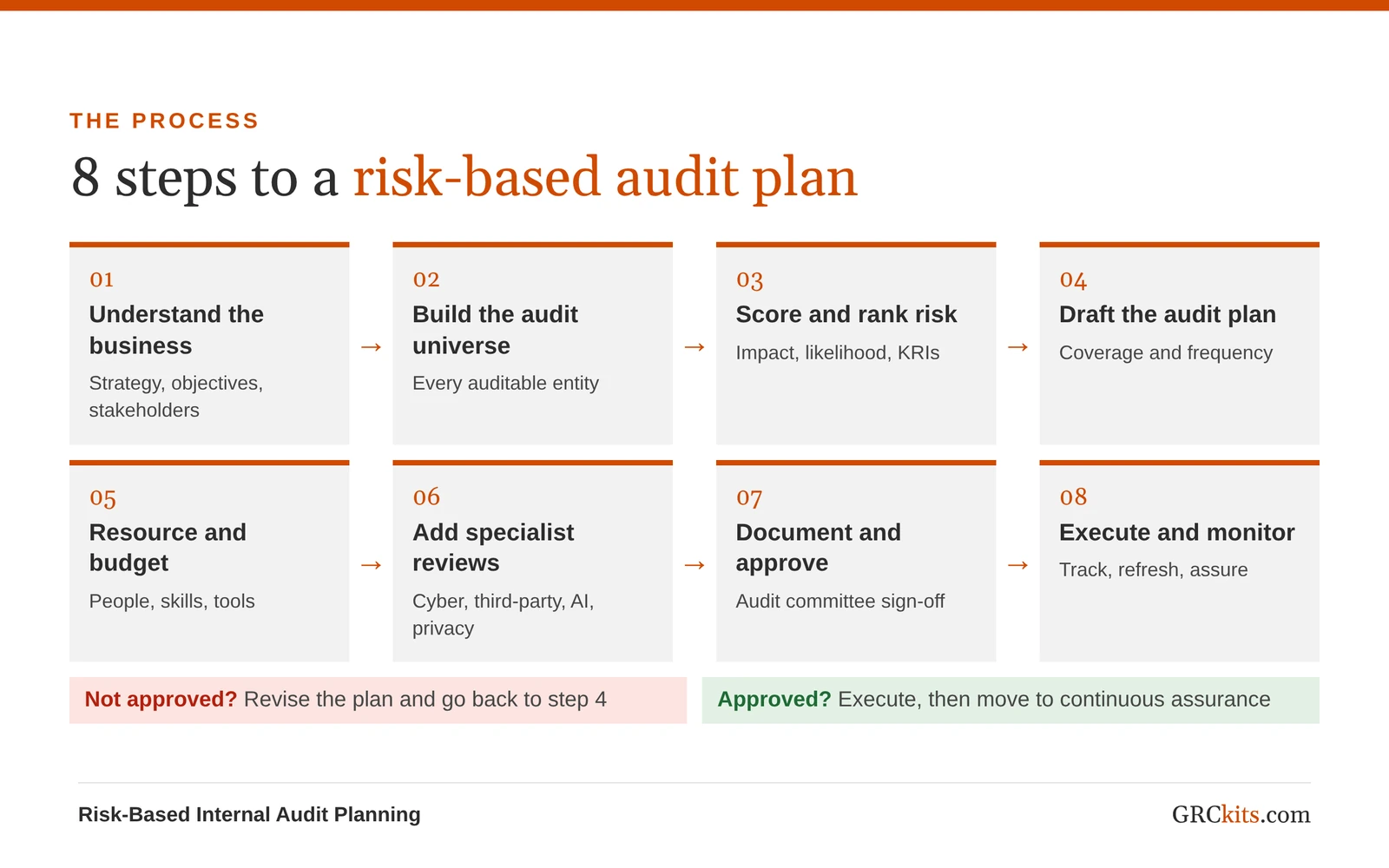
The 8-step internal audit planning process
Step 1: Understand the business and align with stakeholders
Start with the business, not the audit. Read the strategy, the latest board minutes, the risk register and any regulatory correspondence. Then talk to people: the CEO or COO, the CFO, the CISO, the head of compliance, and the audit committee chair.
Ask each of them the same two questions: "What keeps you up at night?" and "What is changing in the next 12 months?" New systems, acquisitions, outsourcing deals, regulatory deadlines and new products are where risk concentrates. Write the answers down. They become evidence that your plan reflects stakeholder input.
Step 2: Define the audit universe and risk scope
The audit universe is the complete list of everything internal audit could audit. Build it from several angles so nothing falls through the gaps:
Business processes: procurement, sales, payroll, treasury, customer onboarding
Technology: cloud platforms, core applications, network, identity and access, IT change management
Third parties: critical suppliers, outsourced services, cloud providers
Compliance obligations: data protection, sector regulation, ISO 27001 or SOC 2 commitments
Emerging areas: AI and model risk, ESG reporting, operational resilience
A mid-sized organization typically ends up with 40 to 120 auditable entities. Keep each entry at a size you could realistically audit in one engagement. "IT" is too big. "Cloud infrastructure security" is about right.
From the field: The gap I find most often in audit planning is an incomplete audit universe. Process areas such as procurement and payroll are listed, but IT areas, critical third parties and recently launched systems are missing, so they never get scored and never reach the plan. Before you score anything, check the universe against the IT asset inventory, the vendor list and this year's project portfolio.
Step 3: Score and rank risk
Now run an audit risk assessment across the universe. The simplest approach that holds up is a 5×5 matrix: score each entity from 1 to 5 for impact and for likelihood, then multiply. Enrich the likelihood score with real data wherever you can:
Key risk indicators (KRIs): incident counts, overdue patches, failed backups, access review exceptions
Prior audit results: open findings, repeat issues, time since the last audit
Change: new systems, restructuring, staff turnover in key roles
Assurance from others: recent external audits, ISO 27001 certification, SOC 2 reports
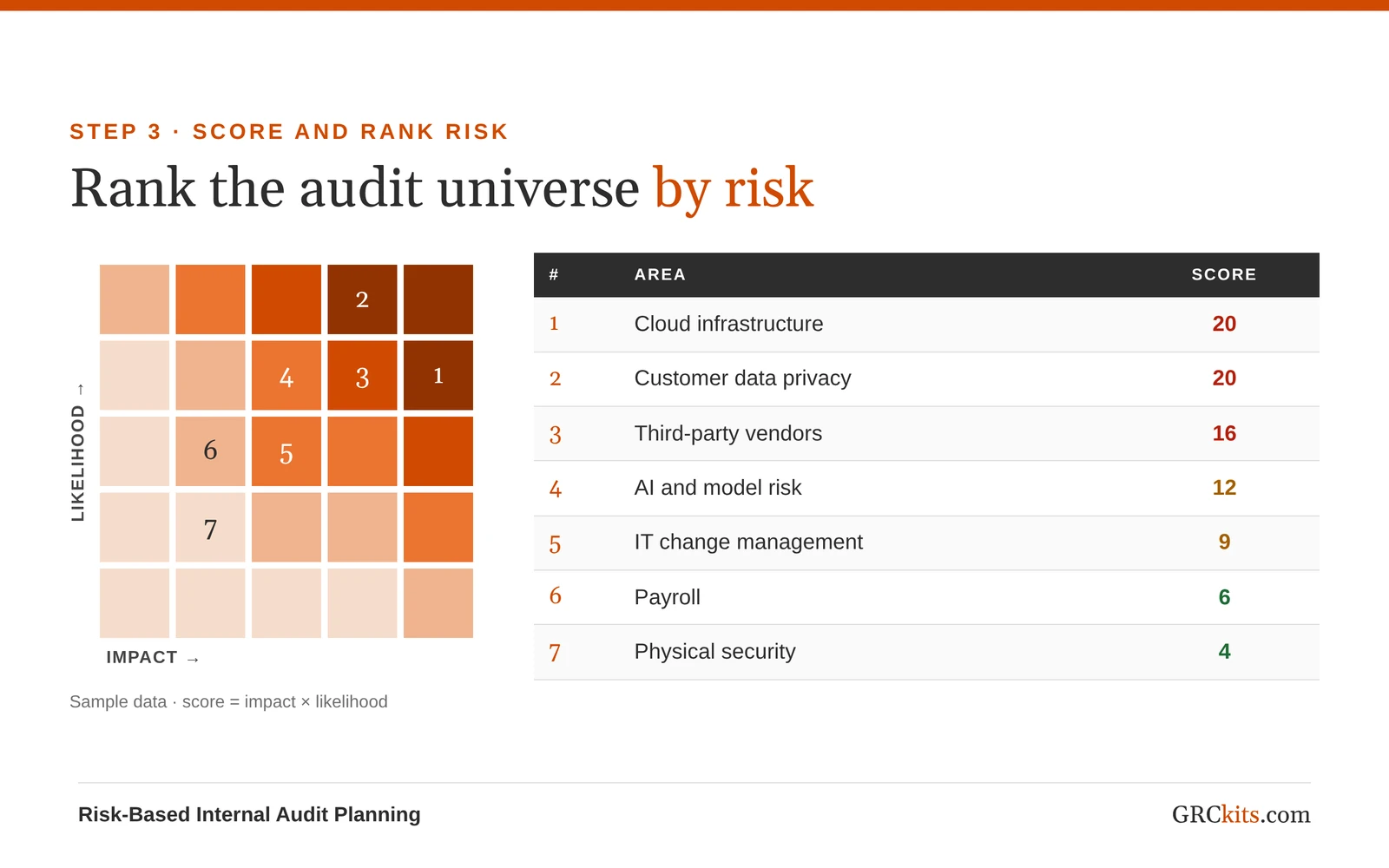
Audit area | Impact (1–5) | Likelihood (1–5) | Score | Risk level |
|---|---|---|---|---|
Cloud infrastructure | 5 | 4 | 20 | High |
Customer data privacy | 4 | 5 | 20 | High |
Third-party vendors | 4 | 4 | 16 | High |
AI and model risk | 3 | 4 | 12 | Medium |
IT change management | 3 | 3 | 9 | Medium |
Payroll | 2 | 3 | 6 | Low |
Physical security | 2 | 2 | 4 | Low |
Sample data. Score = impact × likelihood; risk levels use the bands in this guide (high 15–25, medium 8–14, low 1–7).
In this sample, cloud infrastructure and customer data privacy both score 20 out of 25, third-party vendors score 16, and payroll and physical security sit at the bottom. That ranking, not habit, now drives the plan.
If your organization already keeps a risk register, reuse it rather than starting again. An ISO 27001 risk assessment and risk register dashboard gives you scored risks you can map straight onto audit universe entries.
Step 4: Draft the annual audit plan
Turn the ranking into a schedule. A practical rule of thumb:
High risk (score 15 to 25): audit every year, sometimes in two phases
Medium risk (8 to 14): audit every two years, or cover through a lighter review
Low risk (1 to 7): audit every three years or rely on management's own monitoring
Always reserve time for follow-up on prior findings and a contingency buffer of roughly 10 to 15 percent for ad hoc requests and investigations. A plan with no buffer is broken by the first fraud allegation.
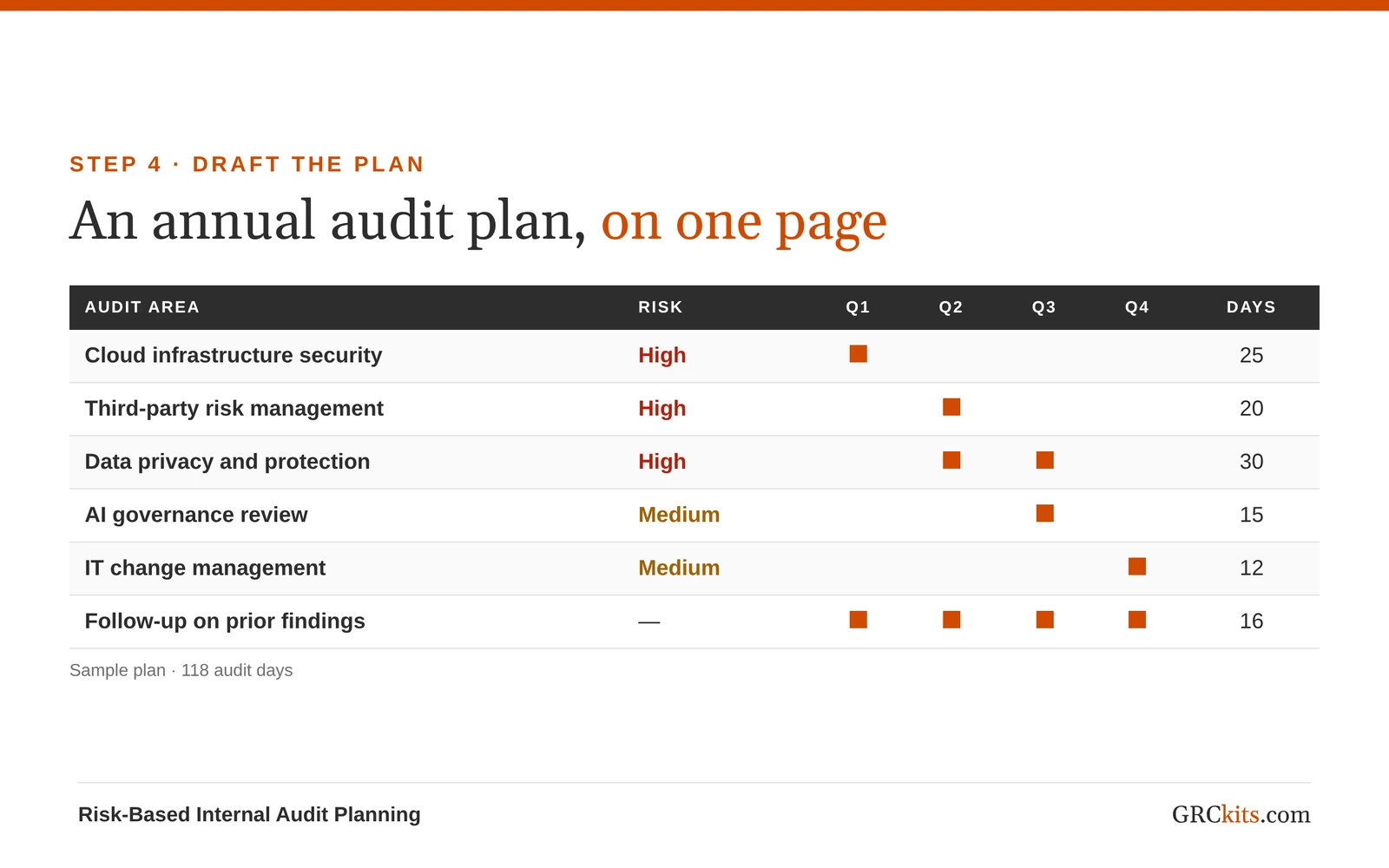
Audit area | Risk | Quarter | Audit days |
|---|---|---|---|
Cloud infrastructure security | High | Q1 | 25 |
Third-party risk management | High | Q2 | 20 |
Data privacy and protection | High | Q2–Q3 | 30 |
AI governance review | Medium | Q3 | 15 |
IT change management | Medium | Q4 | 12 |
Follow-up on prior findings | — | Q1–Q4 | 16 |
Total | 118 |
Sample plan for illustration.
Keep the plan to one page for the audit committee. Put the detail, such as engagement objectives, scope and key risks for each audit, in an appendix.
Step 5: Plan resources, skills and budget
Add up the days. In the sample plan above, six audits need 118 audit days. Compare that with the days your team actually has once you take out leave, training and administration. If the plan needs more than you have, you have three honest options: ask for more budget, co-source specialist skills, or cut lower-ranked audits and tell the committee which risks will go unaudited.
Check skills as well as headcount. A cloud security audit needs someone who understands IAM policies, network segmentation and logging in AWS, Azure or GCP. If nobody on the team does, plan for training or a co-source partner. Our IT audit career guide covers the ITGC, GRC and AI governance skills most teams are short of.
This is also the moment to review your tools. Spreadsheets work for small teams, but evidence tracking, findings follow-up and reporting get painful fast without a structured workbook or GRC platform.
From the field: When the plan needs more specialist time than the team has, I have co-sourced it: bringing in external specialists for areas such as cloud, cybersecurity or IT audits while the in-house team keeps ownership of the plan and the reporting. Agree the scope and the evidence standard up front, so co-sourced work reads the same as in-house work in the audit committee report.
Step 6: Add specialist reviews for today's risks
Four areas now appear on almost every audit committee's agenda, and they rarely fit neatly into a traditional process audit:
Cyber and operational resilience: can the organization prevent, detect and recover from a serious incident? Benchmark maturity with a framework such as the NIST CSF 2.0 cybersecurity maturity dashboard.
Third-party and supply chain risk: are critical suppliers assessed before onboarding and monitored afterwards?
AI governance and model risk: who approves AI use cases, how are models tested, and is there an inventory?
Data quality, privacy and compliance testing: is personal data mapped, minimized and protected as the law requires?
For cloud environments specifically, a structured questionnaire saves days of preparation. The Cloud Infrastructure Security Assessment covers 79 controls across 14 domains, with interview guidance and an evidence list for each control. For database-level risk, see our database security assessment tool guide.
Step 7: Document the baseline and get approval
Pull everything into a planning document: the audit universe, the risk assessment method and scores, the proposed plan, resource needs, and the areas you are not covering and why. Present it to the audit committee and ask for formal approval.
If the committee pushes back, that's the system working. Revise the plan, usually by changing scope or priorities in Step 4, and bring it back. Record the decision either way. When something goes wrong in an area you flagged but couldn't cover, that record matters.
From the field: The question I hear most often from audit committees on a draft plan is "why isn't area X in it?", usually about an area that was audited every year under the old cyclical approach, such as payroll. Have the answer ready: show its risk score next to the areas that made the plan, and record the committee's decision if it asks you to add the area back.
Step 8: Execute, monitor and move toward continuous assurance
An annual plan written in January is out of date by June. Review it at least quarterly and update it when risk changes: a breach, a new regulation, a major system go-live. Report progress against plan to every audit committee meeting.
Over time, shift the highest-risk, most data-rich areas from periodic audits to continuous monitoring, such as automated access reviews, exception reports and KRI dashboards. Tools like the ISO 27001 IT internal audit dashboard and the ISO 27001:2022 control implementation tracker make that status visible without a full audit each time.
From the field: What most often derails an annual plan, in my experience, is ad-hoc requests from management or regulators that take over planned audit days. Keep a small contingency in the plan for them, and when a request does displace a planned audit, take the trade-off back to the audit committee rather than absorbing it quietly.
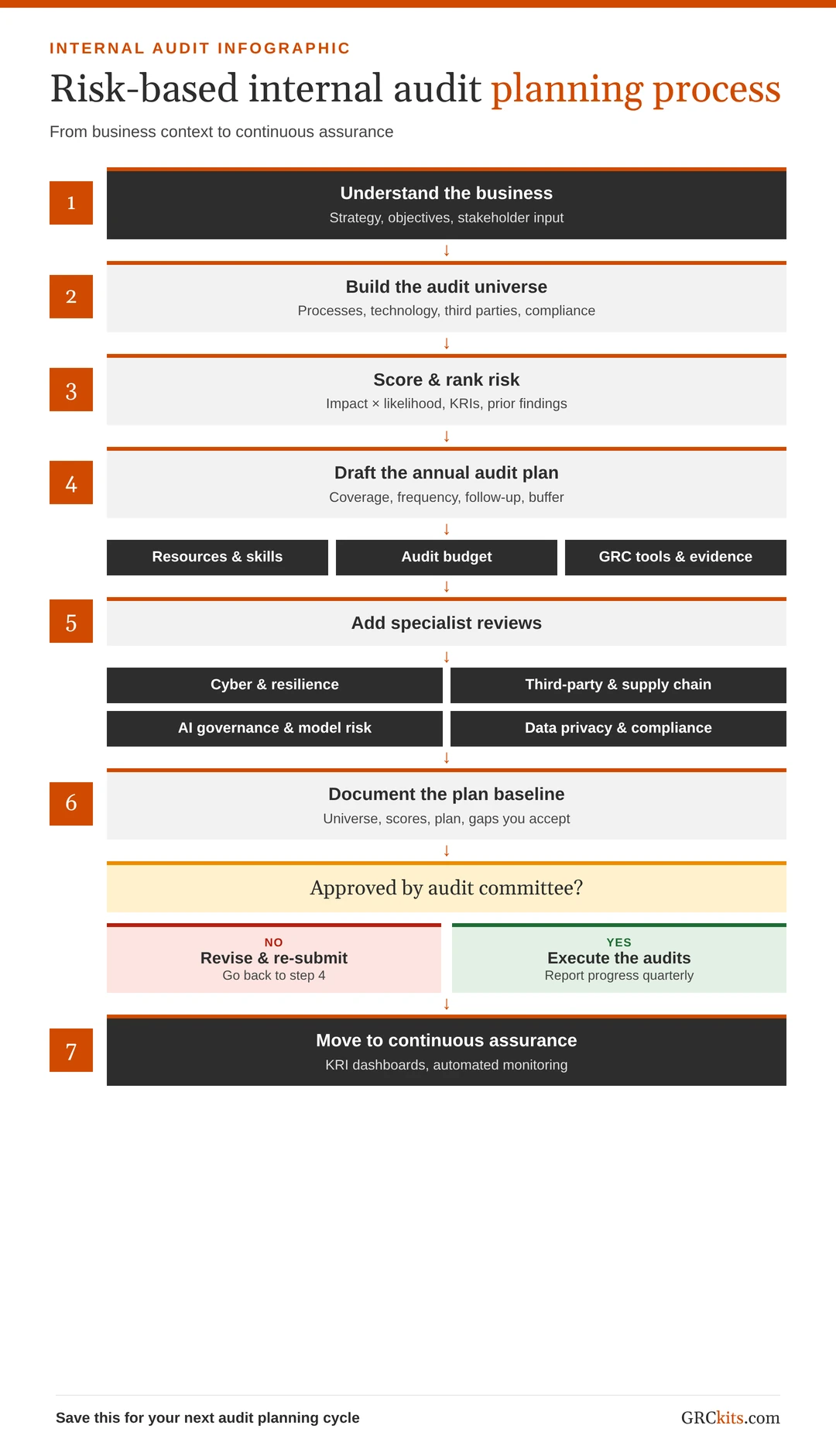
Internal audit plan checklist
Before you send the plan to the audit committee, check that you can answer yes to each of these:
Did you interview senior management and the audit committee chair, and record their input?
Does the audit universe cover processes, technology, third parties, compliance and emerging risks?
Is every entity scored with a consistent, documented method?
Do the high-risk areas all appear in this year's plan?
Is there time for follow-up and a contingency buffer?
Do planned days match available days, and are skill gaps addressed?
Are cyber, third-party, AI and data privacy risks considered explicitly?
Are uncovered risks listed for the committee to accept?
Is there a date to review and refresh the plan?
Common mistakes in risk-based audit planning
Copying last year's plan. If the plan barely changes year to year, it isn't risk-based.
Scoring by gut feel. Use KRIs and prior results to support likelihood scores, or the ranking won't survive challenge.
Ignoring other assurance providers. If an ISO 27001 certification audit or SOC 2 report already covers an area, take that into account. A SOC 2 Type 2 assessment dashboard helps you see what is already tested. If you prefer to make your own, here is how to build a SOC 2 audit dashboard in Excel.
Hiding the gaps. Telling the committee what you won't audit is as important as telling them what you will.
Treating approval as the finish line. The plan is a living document. Refresh it when risk moves.
Frequently asked questions
How often should the internal audit plan be updated?
Most functions prepare the plan annually and review it at least quarterly. Update it whenever a significant risk event or business change happens, and report changes to the audit committee.
What is the difference between the audit universe and the audit plan?
The audit universe is everything internal audit could audit. The audit plan is the prioritized subset it will actually audit in a given period, chosen by risk.
Who approves the internal audit plan?
The chief audit executive prepares it, senior management is consulted, and the board or audit committee approves it, as the IIA's Global Internal Audit Standards expect.
How many audits should be in an annual plan?
There is no fixed number. It depends on your risk profile and available audit days. Many small teams complete 6 to 12 engagements a year, plus follow-up work.
Can small organizations use risk-based audit planning?
Yes, and they benefit most, because small teams can't afford to spend scarce days on low-risk areas. A simple spreadsheet with a 5×5 scoring matrix is enough to start.
Conclusion
A good risk-based internal audit plan is short, defensible and honest. It shows the committee where the organization's biggest risks are, how internal audit will cover them, what that will cost and what is being left out. Build the audit universe, score it with real data, schedule by risk, resource it properly and keep it alive through the year.
Ready to put it into practice? Explore our GRC toolkits for audit-ready templates and dashboards, start with the ISO 27001 IT internal audit dashboard, or browse more guides in our risk management and IT audit categories.

Written by
Shahidul Shubo
Cybersecurity GRC Consultant
Shahidul Shubo is a Cybersecurity GRC Consultant with 10+ years of experience in information security governance, risk management, regulatory compliance and IT audit, and has audited more than 120 organisations. He is CISA and CISM certified, an ISO/IEC 27001 Lead Auditor and Lead Implementer, and a Lead Auditor for ISO/IEC 27701, ISO/IEC 42001, ISO 22301 and ISO 9001. His technical credentials include AWS Solutions Architect, AWS Security Specialty, Red Hat RHCA and RHCE, Fortinet NSE and CCEP. He works hands-on with ISO 27001, NIST CSF and NCA ECC, and builds the practical templates and assessment tools published on GRCkits.
Connect on LinkedInNeed hands-on help?
Information Security Management System (ISMS)
Design, implement and certify an ISO/IEC 27001 ISMS that protects the confidentiality, integrity and availability of your information.
Request a quote