An ISO 39001 audit is won or lost on evidence. You might run a safe fleet, train your drivers well, and inspect every vehicle. If you can't show the records, the auditor will still raise a nonconformity.
The hard part is knowing exactly which ISO 39001 records and evidence each clause requires. The standard doesn't come with a neat list. Requirements for documented information are spread across Clauses 4 to 10, and some evidence is implied rather than stated.
This guide fixes that. For every clause, you'll see:
the documented information you must have [Mandatory]
the evidence auditors usually expect [Recommended]
one common nonconformity to avoid
It is based on ISO 39001:2012, including Amendment 1:2024. Use it as a checklist before your Stage 1 or Stage 2 audit.
What "Documented Information" Means in ISO 39001
ISO 39001 uses the term documented information for both documents and records. The wording of each requirement tells you which one you need:
Maintain documented information = a document. It describes what you do, such as your RTS policy or a journey management procedure. It is kept up to date and version-controlled.
Retain documented information = a record. It proves something happened, such as a completed training session or an investigated crash. It is protected from changes.
Clause 7.6 covers two categories. The first is documented information the standard requires. The second is anything you decide is necessary for your RTS management system to work. The second category is where many organizations fall short. If your process depends on a pre-trip vehicle check, the checklist is part of your system, even though the standard never names it.
Format doesn't matter. Paper forms, telematics dashboards, a fleet management system, and a SharePoint library are all valid. What matters is that records are identifiable, retrievable, and protected.
This guide is based on ISO 39001:2012, which ISO last reviewed and confirmed in 2023, and its 2024 amendment. A second edition is at working-draft stage, so check for updates before your next certification cycle.
From the field: I have helped organizations implement ISO 39001. The auditor tips in this guide are the questions to be ready for at certification, clause by clause.
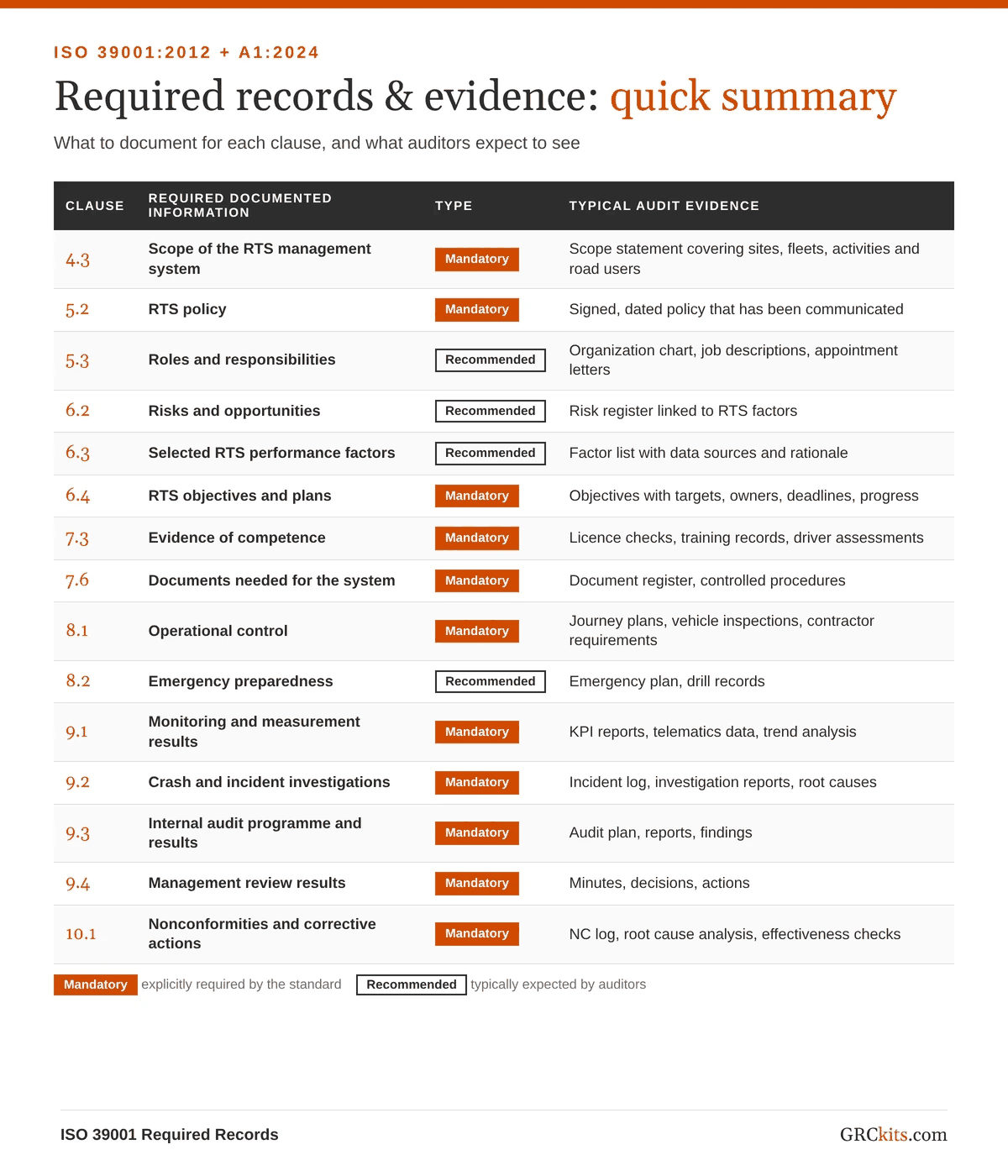
ISO 39001 Required Records and Evidence: Quick Summary Table
Clause | Required documented information | Type | Typical audit evidence |
|---|---|---|---|
4.3 | Scope of the RTS management system | Mandatory | Scope statement covering sites, fleets, activities, and road users |
5.2 | RTS policy | Mandatory | Signed, dated policy that has been communicated |
5.3 | Roles and responsibilities | Recommended | Organization chart, job descriptions, appointment letters |
6.2 | Risks and opportunities | Recommended | Risk register linked to RTS factors |
6.3 | Selected RTS performance factors | Recommended | Factor list with data sources and rationale |
6.4 | RTS objectives and plans | Mandatory | Objectives with targets, owners, deadlines, progress |
7.3 | Evidence of competence | Mandatory | Licence checks, training records, driver assessments |
7.6 | Documents needed for the system | Mandatory | Document register, controlled procedures |
8.1 | Operational control | Mandatory | Journey plans, vehicle inspections, contractor requirements |
8.2 | Emergency preparedness | Recommended | Emergency plan, drill records |
9.1 | Monitoring and measurement results | Mandatory | KPI reports, telematics data, trend analysis |
9.2 | Crash and incident investigations | Mandatory | Incident log, investigation reports, root causes |
9.3 | Internal audit programme and results | Mandatory | Audit plan, reports, findings |
9.4 | Management review results | Mandatory | Minutes, decisions, actions |
10.1 | Nonconformities and corrective actions | Mandatory | NC log, root cause analysis, effectiveness checks |
Clause 4: Context of the Organization – Records and Evidence
Clause 4 shows the auditor that you understand where road traffic risk comes from in your organization and what your system covers.
4.1 Understanding the organization and its context
[Recommended] Context analysis covering internal and external issues (e.g., PESTLE or SWOT) that mentions road safety.
[Recommended] Your role in the road traffic system: do you operate a fleet, send staff on the road, design roads, or ship goods?
[Recommended] Evidence that climate change was considered (required since Amendment 1:2024).
4.2 Needs and expectations of interested parties
[Recommended] Interested parties register: drivers, contractors, clients, regulators, insurers, the community, and other road users.
[Recommended] Legal and other requirements register: traffic laws, driving-hour rules, vehicle fitness regulations.
4.3 Scope
[Mandatory] Documented scope that states the locations, vehicle types, activities, and staff it covers, and whether contractors are included.
Auditor tip: A vague scope such as "all transport activities" is a common finding. Name the depots, fleet categories, and contracted haulage you include, and give reasons for any exclusions.
Clause 5: Leadership – Records and Evidence
Auditors use Clause 5 to test whether top management actually owns road safety, or whether it has been handed off to the HSE team.
5.1 Leadership and commitment
[Recommended] Management review minutes, budget approvals for safety equipment, and signed communications from senior leaders.
[Recommended] Evidence that RTS is part of business processes, such as safety criteria in procurement or route planning.
5.2 Policy
[Mandatory] RTS policy as documented information that is communicated inside the organization and available to interested parties.
[Recommended] Proof of communication: induction records, notice boards, intranet posts, contractor briefings.
5.3 Roles, responsibilities and authorities
[Recommended] Job descriptions or a RACI matrix naming who owns RTS performance, reporting, and driver management.
[Recommended] Appointment letter for the RTS management representative.
Auditor tip: Auditors often ask a driver or depot supervisor what the RTS policy means for them. A framed policy that nobody can explain counts as weak evidence of communication.
Clause 6: Planning – Records and Evidence
Clause 6 is where ISO 39001 differs most from other management system standards, because of the RTS performance factors in 6.3.
6.1–6.2 Actions to address risks and opportunities
[Recommended] Road safety risk assessment covering routes, vehicles, drivers, loads, schedules, and weather.
[Recommended] Risk treatment plans linked to the RTS objectives.
6.3 RTS performance factors
[Recommended, strongly expected] A documented list of the selected exposure, final outcome, and intermediate outcome factors, with the reason each one was chosen.
[Recommended] A baseline for each factor and its data source.
6.4 RTS objectives and planning to achieve them
[Mandatory] RTS objectives as documented information. They must be measurable and consistent with the policy.
[Mandatory, in practice] Action plans showing what will be done, the resources, who is responsible, the deadline, and how results will be evaluated.
Auditor tip: Objectives that are not linked to the selected performance factors are a frequent finding. If you selected "speed compliance" as a factor, an objective should target it.
Special Focus: RTS Performance Factors (6.3) Evidence
ISO 39001 groups RTS performance factors into three categories. Your records should cover each one.
1. Exposure factors. These measure how much road risk you are exposed to.
Kilometres driven per vehicle or per driver
Number of trips, driving hours, and vehicle types used
Records: telematics reports, fuel cards, trip logs
2. Final safety outcome factors. These measure the harm itself.
Deaths and serious injuries from road traffic crashes
Records: incident register, insurance claims, investigation reports
3. Intermediate safety outcome factors. These are leading indicators you can control.
Safe road design and use, and appropriate speed
Use of seatbelts, helmets, and child restraints
Driver fitness: fatigue, alcohol and drug checks, medical fitness
Vehicle safety: maintenance and pre-trip inspections
Safe journey planning and vehicle choice
Post-crash response and first aid
Records: speed violation reports, seatbelt audits, vehicle inspection checklists, driver fitness declarations, journey plans
A logistics company might track crashes per million kilometres (outcome), speeding events per 100 km (intermediate), and total fleet kilometres (exposure). This combination lets the auditor see that you are measuring risk, not just counting crashes.
Clause 7: Support – Records and Evidence
Clause 7 holds the most day-to-day records. It is also where auditors sample most heavily.
7.1–7.2 Coordination and resources
[Recommended] Evidence of coordination between functions such as fleet, HR, procurement, and HSE: meeting minutes or a road safety committee terms of reference.
[Recommended] Budget and resource allocation for vehicles, training, and technology.
7.3 Competence
[Mandatory] Retained evidence of competence for people whose work affects RTS performance.
[Recommended] Driver files: licence validity checks, defensive driving training, medical fitness, and on-road assessments.
[Recommended] Training needs analysis and effectiveness evaluation.
7.4–7.5 Awareness and communication
[Recommended] Toolbox talk records, safety campaign materials, and a communication plan for internal and external messages.
7.6 Documented information
[Mandatory] Documentation the standard requires, plus documentation the organization decides it needs.
[Recommended] Master document register showing version, owner, approval, and review date.
Auditor tip: Expired driving licences found in a sample of driver files are one of the most common major findings. Run licence checks on a schedule and keep proof.
Clause 8: Operation – Records and Evidence
Clause 8 proves that your planned controls actually happen on the road.
8.1 Operational planning and control
[Mandatory] Documented information to the extent needed to show that processes are carried out as planned.
[Recommended] Journey management plans for high-risk trips, including route, rest stops, and night-driving rules.
[Recommended] Pre-trip vehicle inspection checklists and preventive maintenance records.
[Recommended] Fatigue and driving-hours controls such as tachograph data or rosters.
[Recommended] Contractor and supplier road safety requirements, with records of evaluation.
8.2 Emergency preparedness and response
[Recommended] Road crash emergency response procedure: who to call, first aid, scene management.
[Recommended] Drill or test records and the lessons learned.
[Recommended] In-vehicle first aid kit and emergency contact checks.
Auditor tip: Contractor control is often missed. If subcontracted hauliers carry your goods, the auditor will expect evidence that you set and checked road safety requirements for them.
Clause 9: Performance Evaluation – Records and Evidence
Clause 9 records show that your system learns from data, from crashes, and from audits.
9.1 Monitoring, measurement, analysis and evaluation
[Mandatory] Retained evidence of monitoring and measurement results.
[Recommended] Monthly KPI dashboard covering the RTS performance factors, with trend analysis.
[Recommended] Compliance evaluation against legal requirements.
9.2 Road traffic crash and incident investigation
[Mandatory] Records of road traffic crashes and other incidents, and how they were investigated and analysed.
[Recommended] Investigation reports with root cause analysis, contributing factors, and actions.
[Recommended] Near-miss reporting log.
9.3 Internal audit
[Mandatory] Retained evidence of the audit programme and its results.
[Recommended] Audit plan, checklists, auditor competence records, and findings reports.
For how to plan and run these audits, see how internal audit works and how to build a risk-based internal audit plan.
9.4 Management review
[Mandatory] Retained evidence of management review results.
[Recommended] Minutes covering all required inputs, the decisions taken, and an action tracker.
From the field: In ISO 39001 implementations I have seen crash investigations that stop at "driver error". That label rarely leads to a useful corrective action. Look further, at scheduling pressure, route choice, vehicle condition or fatigue, and record what you changed as a result.
Clause 10: Improvement – Records and Evidence
10.1 Nonconformity and corrective action
[Mandatory] Retained evidence of the nature of each nonconformity, the actions taken, and the results.
[Recommended] Corrective action register with root cause, owner, due date, and an effectiveness check.
10.2 Continual improvement
[Recommended] Year-on-year performance trends, improvement projects, and updated objectives.
Auditor tip: Corrective actions closed without an effectiveness review are a frequent finding. Record the evidence that the fix worked, not just the date it was closed.
Amendment 1:2024 – Climate Action: What Changes in Documentation
In February 2024, ISO published Amendment 1 to ISO 39001 (ISO 39001:2012/Amd 1:2024, "Climate action changes"). Like other management system standards, it adds climate action to Clause 4. You must now decide whether climate change is a relevant issue for your RTS management system. You should also consider that interested parties may have requirements related to climate change.
No new mandatory document is created. In practice, update your context analysis and interested parties register to show that climate was considered. Examples include extreme weather affecting road conditions, or client demands for low-emission fleets.
ISO 39001 is also under revision, and a new edition is in draft. Until it is published, implement and certify against the current version.
Common Documentation Mistakes Before an ISO 39001 Audit
Copy-paste policies. An RTS policy taken from a template without your own commitments or context.
Factors without data. RTS performance factors are listed, but there is no baseline or monitoring.
Outdated driver files. Expired licences, missing medical checks, or no refresher training.
Ignoring contractors. No road safety requirements or evaluation for subcontracted transport.
Shallow investigations. Crash reports that name the driver but not the system causes.
No document control. Several versions of the same procedure in use at different depots.
FAQ
What documents are mandatory for ISO 39001?
At minimum, ISO 39001 expects a documented RTS management system scope, an RTS policy, RTS objectives, and the documented information the organization needs to run its processes. You must also retain records as evidence: competence, monitoring and measurement results, crash and incident investigations, internal audits, management reviews, and nonconformities with corrective actions.
How many records does ISO 39001 require?
ISO 39001 does not set a fixed number. It requires a core set of documented information and lets you add whatever your RTS management system needs to work. A small fleet operator might manage with 15 to 20 controlled documents and record types. A large logistics company with contractors usually needs more.
What evidence do auditors check in an ISO 39001 audit?
Auditors check that documents exist and that records prove the system is working. Typical evidence includes RTS performance factor data, objective tracking, driver competence files, vehicle inspection records, journey planning controls, crash investigation reports, internal audit reports, management review minutes, and closed corrective actions. They also interview drivers and managers.
How long should ISO 39001 records be retained?
ISO 39001 does not specify retention periods. You decide them, based on legal, contractual, and insurance requirements. A practical baseline is to keep records for at least one full certification cycle, which is three years. Crash investigation records often need to be kept longer for legal or insurance claims.
Conclusion: Build Your Evidence Before the Auditor Asks
Getting ISO 39001 required records and evidence in place for each clause is not about producing more paperwork. It is about proving that your road safety controls work: through the scope, the policy, the performance factors, and the investigations. It also shows that you improve when they don't.
Start with the mandatory items in the summary table. Then add the recommended evidence that matches your real operations. Finally, test your records with an internal audit before the certification body arrives.

Written by
Shahidul Shubo
Cybersecurity GRC Consultant
Shahidul Shubo is a Cybersecurity GRC Consultant with 10+ years of experience in information security governance, risk management, regulatory compliance and IT audit, and has audited more than 120 organisations. He is CISA and CISM certified, an ISO/IEC 27001 Lead Auditor and Lead Implementer, and a Lead Auditor for ISO/IEC 27701, ISO/IEC 42001, ISO 22301 and ISO 9001. His technical credentials include AWS Solutions Architect, AWS Security Specialty, Red Hat RHCA and RHCE, Fortinet NSE and CCEP. He works hands-on with ISO 27001, NIST CSF and NCA ECC, and builds the practical templates and assessment tools published on GRCkits.
Connect on LinkedInNeed hands-on help?
IS Audit
Independent information systems audits that strengthen IT governance and demonstrate compliance.
Request an audit