Ask a certification auditor which document they open first, and the Statement of Applicability will be near the top of the list. It is also, far too often, copied from somebody else. You can usually tell: every control says "applicable", every justification says "best practice", and nothing points back to a risk.
This guide explains what a Statement of Applicability (ISO 27001) really has to contain, how to write one in eight steps, and what good rows look like. You'll find a filled-in example, a template you can copy, and a way to test your own SoA before an auditor does. Everything refers to ISO/IEC 27001:2022 with Amendment 1:2024.
What is a Statement of Applicability? (Quick answer)
A Statement of Applicability (SoA) is the mandatory ISO/IEC 27001 document that lists the information security controls your organisation needs, explains why each one is included, states whether it is implemented, and justifies every Annex A control you leave out. It is required by Clause 6.1.3 d) and connects your risk assessment to the controls you operate.
Some people search for an "ISO statement of applicability" as if every ISO management standard had the same thing. They don't all work that way. ISO 9001, for example, has no SoA. In everyday GRC conversation the term means the ISO 27001 one, although related standards such as ISO/IEC 42001 for AI management use the same idea.
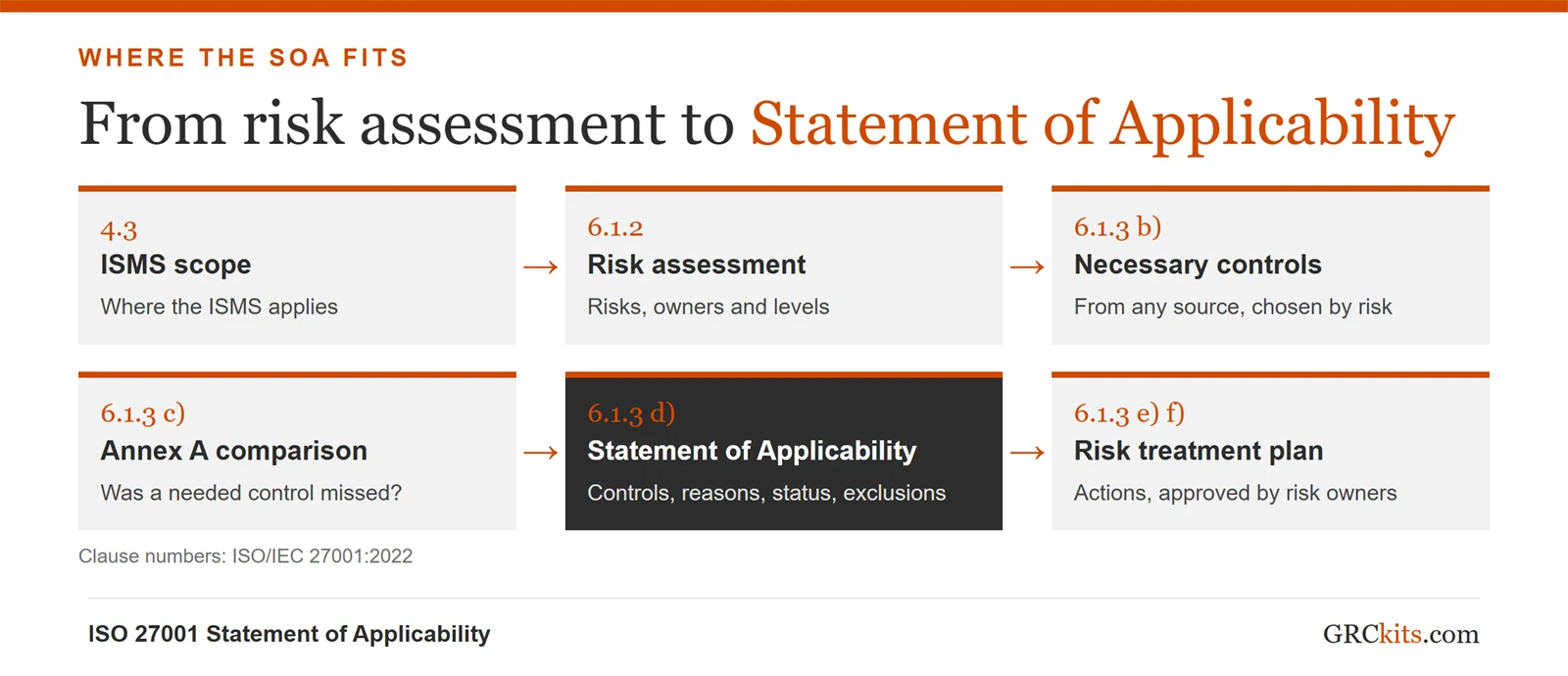
What Clause 6.1.3 d) requires, and what it doesn't
The requirement is short. Clause 6.1.3 d) tells you to produce a Statement of Applicability containing four things:
the controls you have determined are necessary;
the justification for including them;
whether those necessary controls are implemented or not;
the justification for excluding any Annex A control.
That is the whole list. No mandatory column set, no set file format, no fixed review cycle. A lot of what gets described online as "required" is ordinary good practice, and it helps to know which is which when an auditor and a project manager disagree.
Item in the SoA | Status | Where it comes from |
|---|---|---|
Necessary controls, inclusion reasons, implementation, exclusion reasons | Requirement | Clause 6.1.3 d) |
Comparison of your controls against Annex A | Requirement | Clause 6.1.3 c) |
Version, identification, review and approval of the document | Requirement | Clause 7.5 (documented information) |
Risk owner approval of the risk treatment plan and residual risk | Requirement, but for the plan rather than the SoA itself | Clause 6.1.3 f) |
Control owner, evidence link, risk ID on each row | Good practice | Makes the audit trail visible |
Yearly review | Good practice | The standard ties reassessment to planned intervals and significant change (Clause 8.2) |
"How it is implemented" narrative | Good practice, and very useful | ISO/IEC 27002:2022 can help you word it; it is guidance, not a requirement |
One more detail that trips people up: the SoA is not limited to Annex A. Your necessary controls can come from anywhere, including a regulator's rulebook or a control you designed yourself. Annex A is the cross-check that makes sure you didn't forget something.
SoA vs scope vs risk register vs risk treatment plan
These four documents answer different questions, and mixing them up causes a lot of confusion at Stage 1.
Document | Question it answers | Clause |
|---|---|---|
Where does the ISMS apply? | 4.3 | |
Risk assessment results (risk register) | What could go wrong, and how bad is it? | 6.1.2, 8.2 |
Statement of Applicability | Which controls do we need, why, and are they in place? | 6.1.3 d) |
Risk treatment plan | Who will do what, by when, to close the gaps? | 6.1.3 e), 8.3 |
The 93 Annex A controls your SoA has to address
Annex A of the 2022 edition contains 93 controls in four themes. Each one needs a decision in your SoA, even if the decision is "not applicable".
Theme | Controls | Count | How often exclusions make sense |
|---|---|---|---|
Organisational | 5.1–5.37 | 37 | Rarely. Policies, roles, suppliers and incidents exist almost everywhere |
People | 6.1–6.8 | 8 | Very rarely. If you employ people, these apply |
Physical | 7.1–7.14 | 14 | Sometimes, for remote-first or fully cloud-hosted scopes |
Technological | 8.1–8.34 | 34 | Sometimes, mostly the software development group (8.25–8.31) |
The last column is professional judgement, not a rule. Your scope and risk assessment decide.
If your current SoA shows 114 controls numbered A.5 to A.18, it was written for the 2013 edition. The transition period for those certificates ended on 31 October 2025, so the document needs rebuilding rather than a quick renumber: several old controls were merged and eleven are new. The publication of ISO/IEC 27000:2026 did not change Annex A; we covered that separately in what changed in ISO/IEC 27000:2026.
Statement of applicability ISO 27001 example (filled in)
Below is an illustrative extract for a made-up company: a 60-person B2B SaaS provider, hosted entirely on AWS, mostly remote, with one small office. The risk IDs, document numbers and dates are invented to show the level of detail that works.
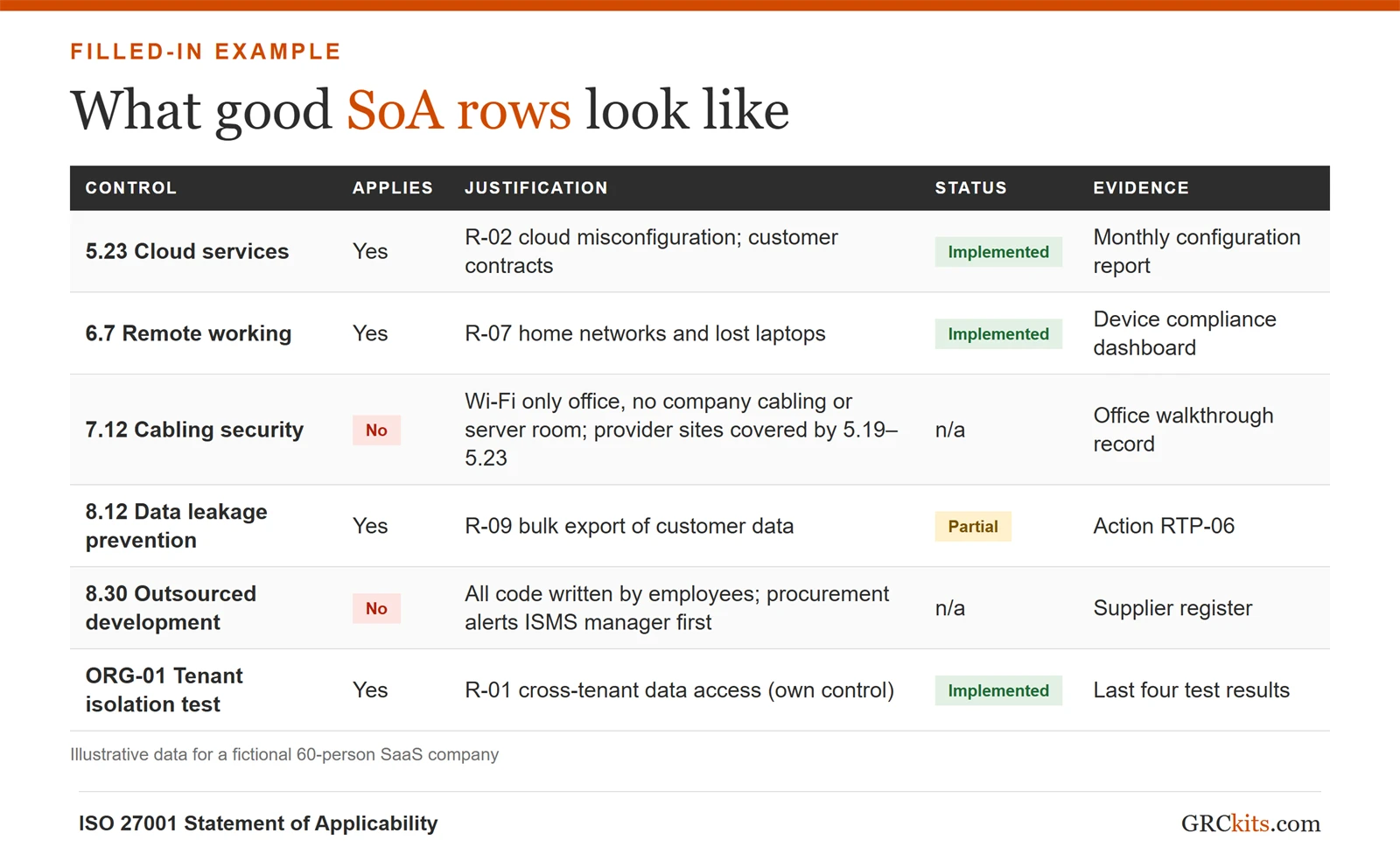
Control | Applicable? | Justification | Status | How it's done / evidence |
|---|---|---|---|---|
5.7 Threat intelligence | Yes | Risk R-04: exploitation of unpatched internet-facing components | Implemented | Weekly review of vendor advisories; log SEC-LOG-07 |
5.23 Use of cloud services | Yes | Risk R-02: cloud misconfiguration; also required by customer contracts | Implemented | Cloud security standard CSP-01; monthly configuration report |
6.1 Screening | Yes | Risk R-11: insider misuse of production access; two customer contracts | Implemented | HR procedure HR-02; sampled screening records |
6.7 Remote working | Yes | Risk R-07: data exposure on home networks and lost laptops | Implemented | Remote work policy; device compliance dashboard |
7.12 Cabling security | No | No company-managed cabling, server room or network cabinet in scope. The office is Wi-Fi only and holds no production systems. Hosting provider facilities are handled through 5.19–5.23. Revisit if an office network is installed. | n/a | Scope document section 5; office walkthrough record |
8.4 Access to source code | Yes | Risk R-03: unauthorised code change | Implemented | Repository permissions; quarterly access review |
8.12 Data leakage prevention | Yes | Risk R-09: bulk export of customer data by support staff | Partially implemented | Export alerts live; endpoint rules due under treatment action RTP-06, owner Head of IT |
8.24 Use of cryptography | Yes | Risk R-05; customer contracts; considered for GDPR Article 32 | Implemented | Cryptography standard; KMS key inventory |
8.30 Outsourced development | No | All product code is written and maintained by employees. Procurement must notify the ISMS manager before any development work is contracted out. | n/a | Supplier register, reviewed quarterly |
ORG-01 Tenant isolation test (not in Annex A) | Yes | Risk R-01: cross-tenant data access | Implemented | Automated test in release pipeline; last four results |
Three things to notice. The exclusions describe facts about the scope and name what would reverse the decision (for provider-run facilities there is a choice to make, covered further down). The partially implemented control isn't hidden; it points to an action with an owner. And the last row is a control that Annex A doesn't contain at all, which is perfectly acceptable and often a sign the organisation did its own thinking.
Want to see how large companies handle publication? Salesforce, for instance, lists its ISO Statement of Applicability on its compliance site, with the file itself available after login. That is a sensible model: acknowledge that it exists, control who reads it.
How to write an ISO 27001 Statement of Applicability in 8 steps
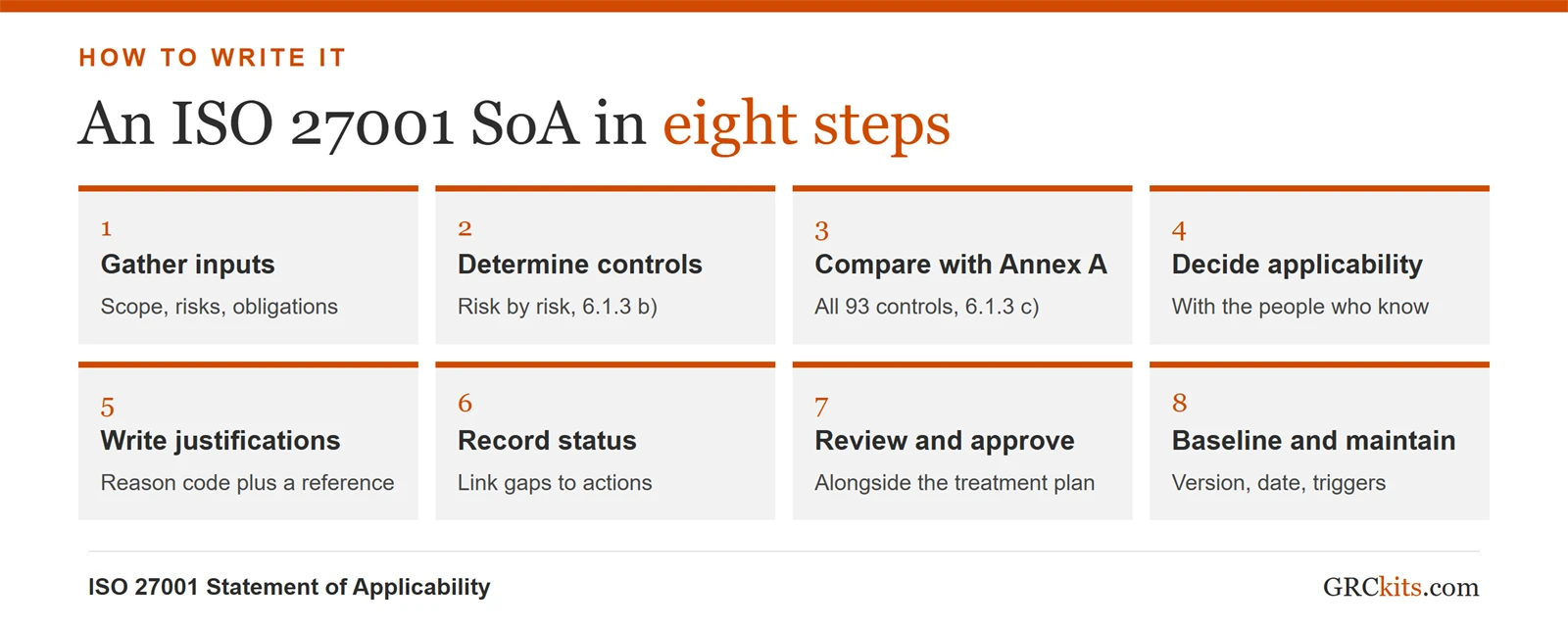
Step 1: Gather the inputs before you open a spreadsheet
You need an approved scope, a risk assessment method, completed risk results and a list of legal, regulatory and contractual security obligations. If the scope is still moving, stop and fix that first. A new office or product line can flip a dozen applicability decisions.
Output: scope document, risk register, obligations register.
Step 2: Determine the controls your risks need (6.1.3 b)
Go risk by risk. For every risk you plan to reduce, write down the controls that will do it, in your own words if necessary. ISO/IEC 27005:2022 offers guidance on treatment options if your method is thin here.
The order matters. Starting from Annex A and hunting for risks to match produces a checklist wearing a risk assessment's clothes. Starting from risks produces controls you can defend.
From the field: Shahidul Shubo
When I was brought in as a consultant at a mid-sized bank in the USA, its register held roughly 400 risks, most of them generic entries copied from a threat catalogue. With no link to a specific service or asset, and many with no owner, the register could not support risk treatment decisions or the Statement of Applicability. I describe that case in the ISO 27001 implementation guide.
Lesson: the SoA can only be as specific as the risks behind it. Fix the register first.
If your register needs that kind of rework, the ISO 27001 risk register dashboard gives you a structure with risk IDs, owners and treatment actions that you can reference directly from the SoA.
Step 3: Compare with Annex A (6.1.3 c)
Now walk through all 93 controls and ask one question of each: did we miss a control we need? Keep a short record of who took part and when. This comparison is its own requirement, and a dated workshop note is easy evidence.
Step 4: Decide applicability, control by control
Invite the people who know the answer. HR can settle most of section 6 in one short meeting; facilities knows the truth about section 7; a lead developer will tell you whether 8.25 to 8.31 apply. A security manager deciding all 93 alone will guess at some of them, and those guesses surface in Stage 2.
Step 5: Write justifications that stand up on their own
Use a small set of reason codes so the document stays readable, then add the specific reference. A common set:
RA: needed to treat an identified risk (give the risk ID)
LR: legal or regulatory obligation (name the law or rule)
CO: contractual obligation (name the contract or customer group)
BR: business requirement or group policy (name it)
The code alone isn't enough. "RA" tells a reader nothing; "RA: R-07, lost laptops" does. And if BR appears on half your rows, the risk assessment probably wasn't used.
Step 6: Record honest implementation status
The standard asks whether each necessary control is implemented or not. Most teams add a middle value for partial implementation, which is fine as long as every partial or planned row leads to a treatment action with an owner and a date. The ISO 27001:2022 control implementation tracker is built for this part: status, owner, target date and evidence reference for each control.
Step 7: Get it reviewed and approved
Clause 6.1.3 f) requires risk owners to approve the risk treatment plan and accept residual risk. The SoA should go through the same meeting, because approving one without the other makes little sense. The ISMS steering group or top management then signs the version off under your document control rules. If it isn't obvious who that should be, the layers of governance article explains how decision rights are usually split.
Step 8: Baseline it and keep it alive
Give the document a version number and date. Certification bodies commonly quote the SoA version or date on the certificate, so tell yours when you issue a new one and ask whether the certificate needs updating. Then list the events that trigger a review: scope change, new product, new supplier type, major incident, new regulation, internal audit finding, or the planned risk assessment cycle.
Justifications: weak vs strong wording
A justification is strong when someone outside your team could read it, check it and reach the same conclusion. Compare these.
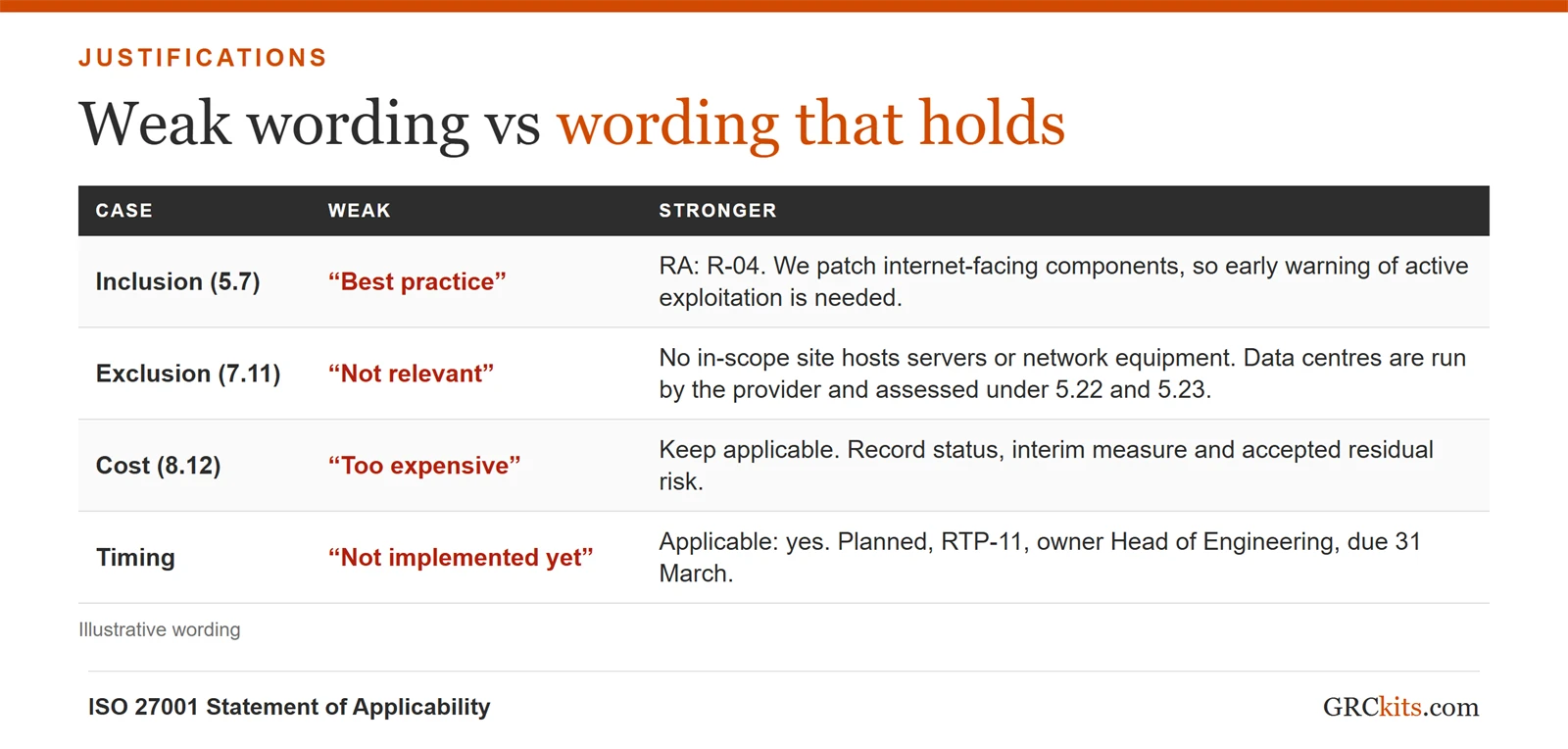
Weak | Why it gets challenged | Stronger |
|---|---|---|
"Best practice" | Applies to anything; no link to your risks | "RA: R-04. Internet-facing components are patched by us, so early warning of active exploitation is needed." |
"Not relevant" (7.11) | States a conclusion without a reason | "No in-scope site hosts servers or network equipment. Data centres are run by the hosting provider and assessed under 5.22 and 5.23." |
"Too expensive" (8.12) | Cost is a treatment decision, not evidence that the control isn't needed | Keep as applicable. Record the status, the interim measure and the accepted residual risk with the risk owner's approval. |
"Not implemented yet" | Confuses applicability with status | "Applicable: yes. Status: planned, RTP-11, owner Head of Engineering, due 31 March." |
Which controls can you exclude?
You can exclude an Annex A control when nothing in your scope needs it: no risk it would treat, and no legal, contractual or business obligation behind it. If any one of those exists, the control is applicable even if you haven't started on it.
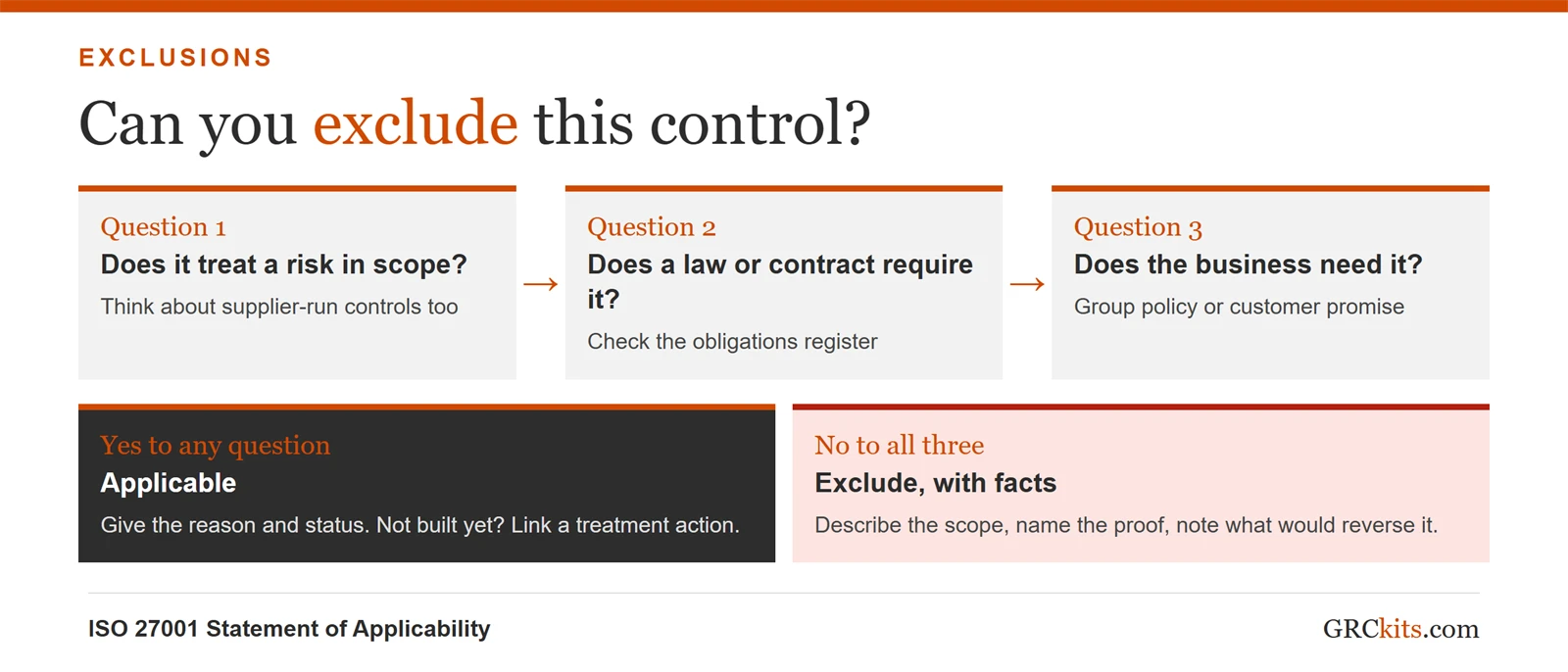
Outsourced doesn't mean excluded
This is the argument I'd settle first in any cloud-hosted scope. When a provider runs the data centre, the physical risk hasn't disappeared; somebody else operates the control and you depend on it. Both AWS and Microsoft publish shared responsibility models that put physical hosts and facilities on the provider's side, with data and access remaining yours in every service model.
So there are two defensible ways to record it. You can mark a control such as 7.1 as applicable and "implemented by supplier", with assurance through supplier controls 5.19 to 5.23. Or you can exclude it because your scope contains no such facility, and reference those supplier controls in the justification. The first option is usually easier to defend, in my opinion, because it shows the dependency. Whichever you pick, stay consistent across the whole section.
Exclusions that deserve a second look
8.25–8.28 (secure development) excluded because "we don't develop software". Check for in-house scripts, low-code apps, infrastructure as code and ERP customisation.
5.34 (privacy and PII) excluded because the product holds no personal data. Your HR files do.
All of section 7 excluded by remote-first companies. Laptops still get carried around (7.9), screens still get left unlocked (7.7), and old drives still need disposal (7.14).
8.30 (outsourced development) excluded while a freelancer still has repository access.
ISO 27001 Statement of Applicability template
A workable ISO 27001 statement of applicability template has a short cover section and one row per control. A spreadsheet is usually the best format because you'll filter it constantly.
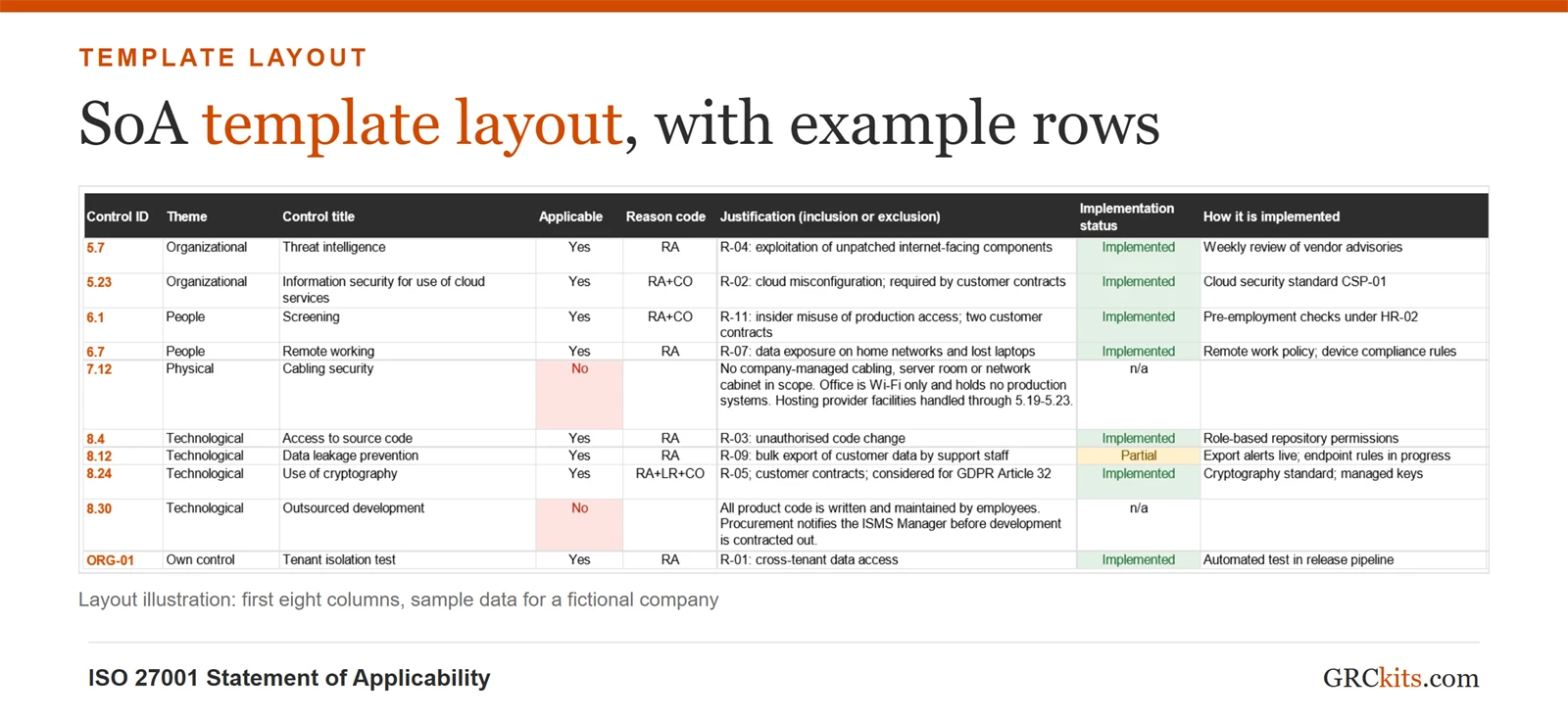
Cover section (copy and complete):
Statement of Applicability
Organisation: [legal name]
ISMS scope reference: [document ID and version]
Standard: ISO/IEC 27001:2022 (incl. Amd 1:2024), Annex A, 93 controls
Risk assessment reference: [register version and date]
Version / date: [x.x] / [date] Owner: [ISMS manager] Approved by: [name, role, date]
Classification: [e.g. Confidential] Next planned review: [date]
Columns:
Column | What to write | Needed for 6.1.3 d)? |
|---|---|---|
Control ID and title | 5.1 to 8.34, plus your own controls | Yes |
Applicable (Yes/No) | One decision, no "maybe" | Yes |
Reason code | RA, LR, CO, BR | Supports it |
Justification | Risk ID or obligation; or the facts behind an exclusion | Yes |
Implementation status | Implemented, partial, planned | Yes |
How it is implemented | One or two lines, naming the policy or tool | No, but worth it |
Control owner | A role, so it survives staff changes | No |
Evidence reference | Where the record is kept, not the record itself | No |
Review trigger | What would change this decision | No, but great for exclusions |
The layout above is yours to copy into a spreadsheet. Add a check column that flags any row with a missing reason, status or treatment action, and you will catch most gaps before anyone else does.
Prefer something ready-made? The ISO 27001 SoA Dashboard Tool is an Excel workbook with the 93 Annex A controls already set up, applicability and justification fields, implementation status tracking and a summary dashboard for management. Its layout differs from the illustration above.
Building the surrounding documents is the slower part. For the whole set, the ISO 27001 Full Assessment Toolkit includes the Annex A and SoA workbook along with the scope, risk, policy and internal audit documents it has to agree with. You still need to make the decisions yourself; a template can't know your risks.
Test your SoA like an auditor: the three-row check
Auditors sample. You can run the same exercise in one short session with a colleague who didn't write the document. Choose three rows at random:
One implemented control. Follow it back to a risk or obligation, then forward to evidence dated within the last few months. Speak to the owner. Do they know they own it?
One excluded control. Read the justification, then look for a counter-example in the asset inventory, supplier register or org chart.
One partial or planned control. Find its action in the risk treatment plan. Is the date still in the future?
If any of the three chains breaks, widen the sample. A break usually means the SoA and the register have drifted apart since the last update. Your formal internal audit should include this trace as a standard test, and the ISO 27001 internal audit dashboard can log the findings and corrective actions.
Common SoA ISO 27001 mistakes
Mistake | What to do instead |
|---|---|
Marking all 93 controls applicable "to be safe" | Every applicable control has to be demonstrated at audit. Include what you need, and justify the rest |
Borrowing another company's SoA | Reuse the layout, never the decisions. An ISACA Journal article written for the 2013 edition makes the same point: an SoA should be unique to the enterprise |
Leaving the 2013 numbering in policies while the SoA uses 2022 | Search all ISMS documents for old IDs such as A.9 or A.12 |
Status updated once, before certification | Review status with control owners on a set cycle and after changes |
SoA and risk treatment plan show different dates or owners | Keep one source for actions and reference it from the SoA |
Detailed firewall rules, IP ranges or names in the SoA | Point to evidence; customers and auditors may receive this document |
Can an SoA cover other frameworks too?
Yes, and it saves effort. Add mapping columns for NIST CSF 2.0, SOC 2 criteria, NCA ECC or a customer's control set, and one control can support several assessments. Treat the mapping as indicative. Frameworks overlap only in part, so a "yes" in your SoA never proves compliance elsewhere and a gap analysis is still needed.
Frequently asked questions
Is the Statement of Applicability mandatory for ISO 27001?
Yes. Clause 6.1.3 d) of ISO/IEC 27001:2022 requires it, and Clauses 4 to 10 cannot be excluded. Without an SoA you cannot be certified.
Does the SoA have to list all 93 Annex A controls?
In practice, yes. You must justify the exclusion of any Annex A control, so every one of the 93 needs to appear as included or excluded. Controls from other sources can be added.
Can a control be applicable but not yet implemented?
Yes. The clause asks whether necessary controls are implemented or not. An open control should be linked to a risk treatment action with an owner and date. Too many open controls at Stage 2 will raise questions about readiness.
Who should own and approve the SoA?
The standard doesn't name a person. Usually the ISMS manager owns it and top management or the security steering group approves it, alongside the risk owners' approval of the treatment plan.
How often should the SoA be updated?
Whenever scope, risks, controls or obligations change, and at each planned risk assessment. Many organisations set a yearly review as a minimum, which is good practice rather than a clause requirement.
Is the Statement of Applicability confidential?
That's your decision. Many organisations classify it as confidential and share it with customers under an NDA, or publish a summary. Buyers can check whether a certificate is listed through IAF CertSearch without seeing the SoA.
What is the difference between the SoA and ISO 27002?
The SoA is your own record of control decisions. ISO/IEC 27002:2022 is a published guidance standard explaining how the same 93 controls can be implemented. You can't be certified against ISO 27002.
Key takeaways
The SoA needs four things: necessary controls, reasons for inclusion, implementation, reasons for exclusion.
Work from risks to controls, then compare with Annex A.
Write exclusions as facts about your scope, and note what would reverse them.
Keep outsourced controls visible; a supplier operating a control doesn't remove the risk.
Run the three-row check before Stage 1 and again before each surveillance audit.
Your next step: pick three rows from your current SoA and trace them today. If the trail holds, carry on with the rest of the ISO 27001 implementation roadmap. If it doesn't, start with the risk register, or talk to us about ISMS implementation support.
This article is general guidance, not legal advice or a substitute for the text of the standard. Check wording against your licensed copy of ISO/IEC 27001:2022.

Written by
Shahidul Shubo
Cybersecurity GRC Consultant
Shahidul Shubo is a Cybersecurity GRC Consultant with 10+ years of experience in information security governance, risk management, regulatory compliance and IT audit, and has audited more than 120 organisations. He is CISA and CISM certified, an ISO/IEC 27001 Lead Auditor and Lead Implementer, and a Lead Auditor for ISO/IEC 27701, ISO/IEC 42001, ISO 22301 and ISO 9001. His technical credentials include AWS Solutions Architect, AWS Security Specialty, Red Hat RHCA and RHCE, Fortinet NSE and CCEP. He works hands-on with ISO 27001, NIST CSF and NCA ECC, and builds the practical templates and assessment tools published on GRCkits.
Connect on LinkedInNeed hands-on help?
Information Security Management System (ISMS)
Design, implement and certify an ISO/IEC 27001 ISMS that protects the confidentiality, integrity and availability of your information.
Request a quote