Most ISO 27001 projects that stall at Stage 1 run into the same problem: the scope statement is vague, copied from a different company, or doesn't match what the auditor sees on site. Clause 4.3 is only a few lines long, but every later decision depends on it, including the risk assessment, the Statement of Applicability, the audit plan and the wording on your certificate.
This guide gives you ISO 27001 scope statement examples for six common organisation types, examples of internal and external issues, a fill-in ISMS scope template and the mistakes auditors usually raise.
Quick answer: An ISO 27001 scope statement is a short piece of documented information, required by Clause 4.3 of ISO/IEC 27001:2022, that defines the boundaries of your ISMS: which organisation, services, locations, information, technology and people are covered. A good one names the activities, sites and key exclusions in one or two sentences, backed by a scope document that explains the issues, interested parties, interfaces and dependencies that shaped it.
What Clause 4.3 Actually Requires
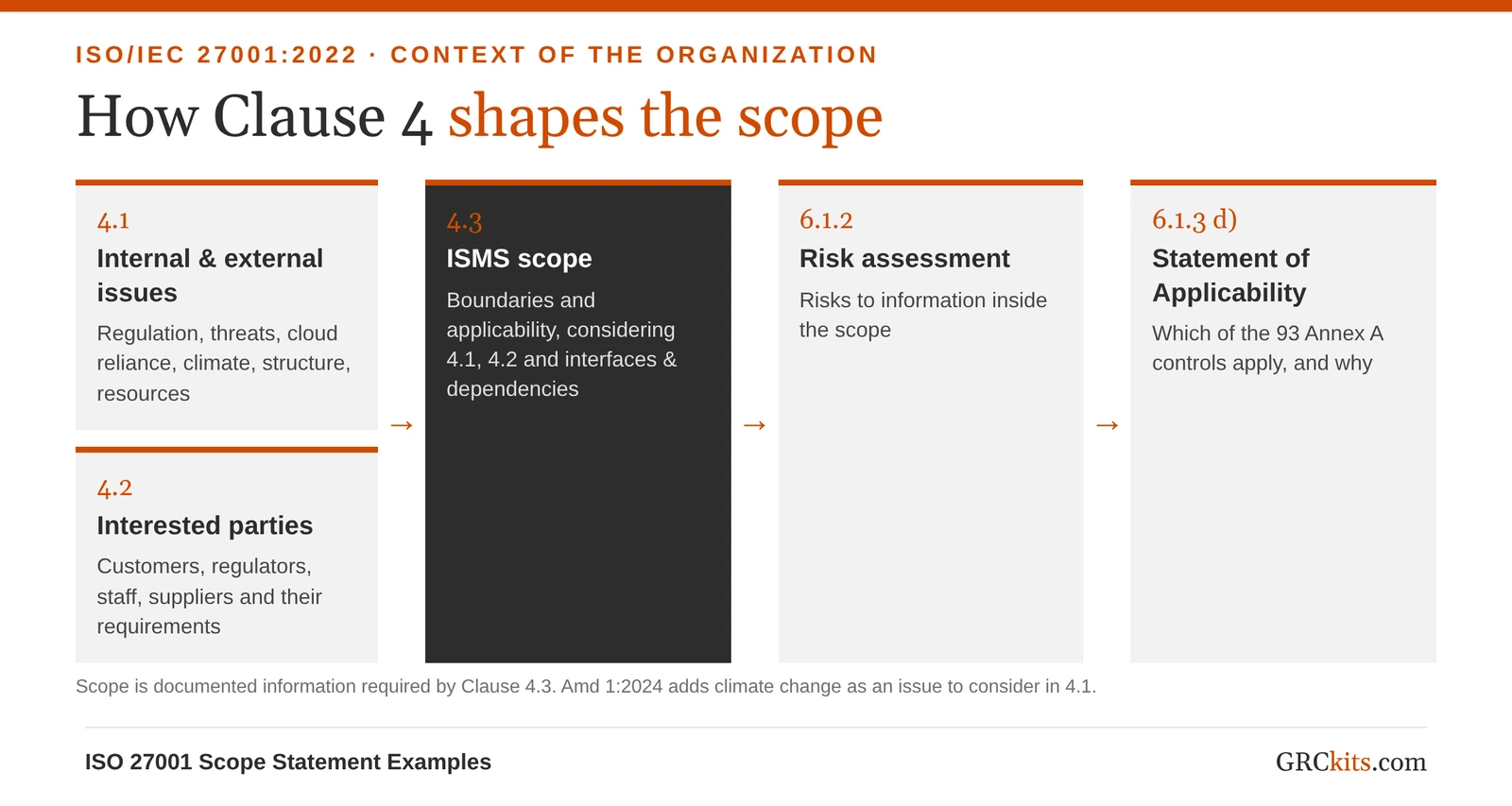
Under ISO/IEC 27001:2022 Clause 4.3, the organisation shall determine the boundaries and applicability of the ISMS. When doing so it shall consider:
- The external and internal issues identified under Clause 4.1
- The requirements of interested parties identified under Clause 4.2
- The interfaces and dependencies between activities performed by the organisation and those performed by other organisations
The scope shall be available as documented information.
That is the whole requirement. The standard does not prescribe a format, a length or a template. That freedom is why so many scope statements end up either too thin ("Information security for ABC Ltd") or too wide ("All activities of the group worldwide") to be auditable.
Three points that are easy to miss:
- Clauses 4.1, 4.2 and 4.3 are linked. An auditor will expect to see how your issues and interested parties led to your scope decision. Treat them as one chain rather than three separate documents.
- "Interfaces and dependencies" is where cloud and outsourcing belong. Most weak scopes fall down here. If your production runs on AWS, Azure or a managed SOC, the scope has to say where your responsibility ends.
- Amendment 1:2024 added a requirement in Clause 4.1 that the organisation determine whether climate change is a relevant issue, and a note in 4.2 that interested parties may have climate-related requirements. It doesn't change Clause 4.3 itself, but your issues list should now show that you considered it.
Scope vs Statement of Applicability vs certificate scope
These three get confused all the time:
| Document | What it defines | Required by |
|---|---|---|
| ISMS scope (Clause 4.3) | Where the ISMS applies: organisation, services, sites, assets | Clause 4.3 (mandatory documented information) |
| Statement of Applicability | Which of the 93 Annex A controls apply and why, and whether each is implemented | Clause 6.1.3 d) |
| Certificate scope wording | The short public sentence printed on the certificate | Agreed with your certification body based on your ISMS scope |
You cannot exclude Clauses 4–10 from your ISMS. Annex A controls can be excluded only through the Statement of Applicability, with a justification. Excluding a control is a different decision from excluding a business unit or a site from scope.
The Anatomy of a Good ISMS Scope
A complete scope document usually has two layers:
- The scope statement: one to three sentences, suitable for the certificate.
- The supporting scope document: the reasoning and boundaries behind it.
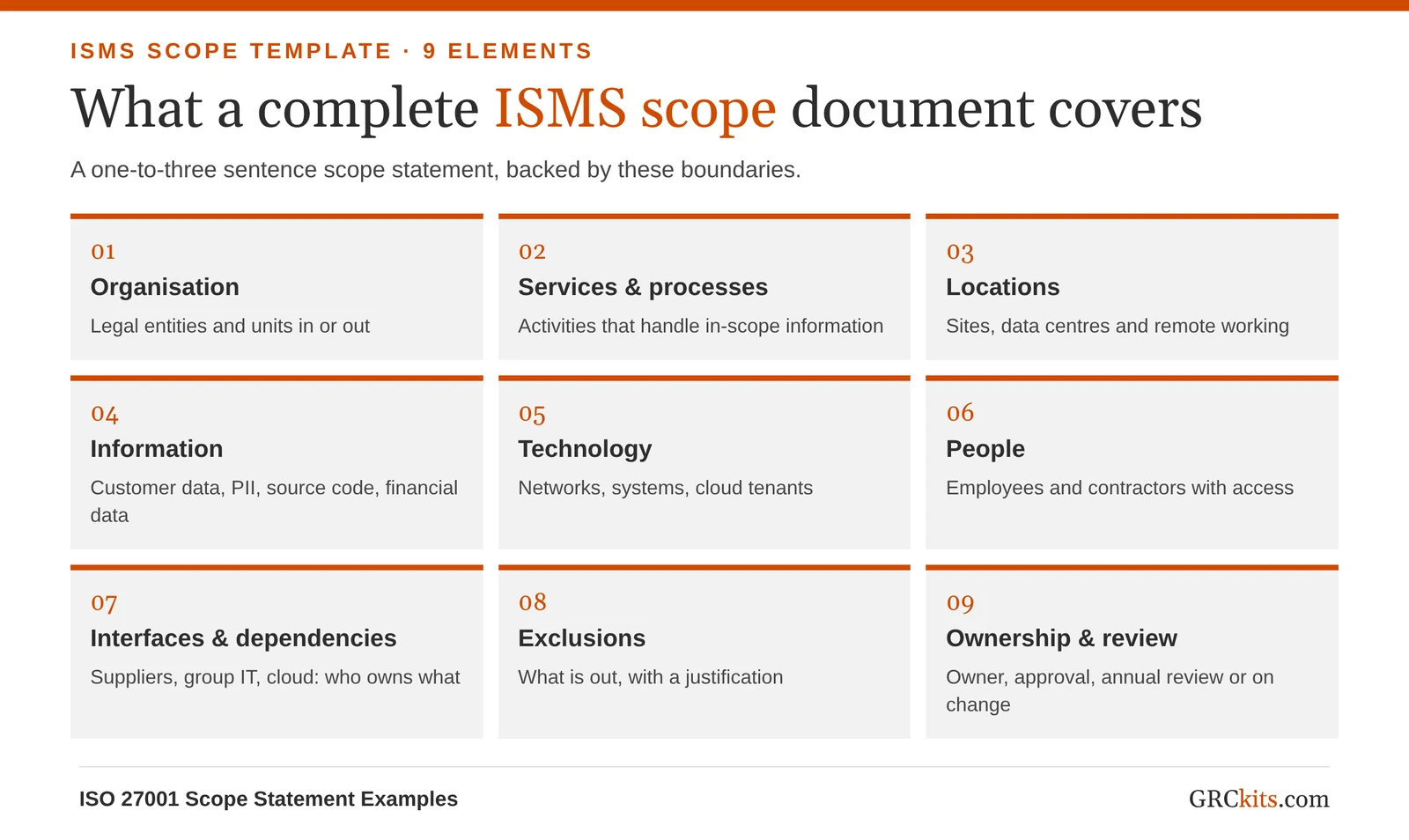
The supporting document typically covers:
| Element | What to write | Example |
|---|---|---|
| Organisation / legal entity | Legal name(s) and any business units in or out | "XYZ Pay Ltd (registered in UAE); excludes the parent group's retail division" |
| Products / services / processes | Activities that create, process or store in-scope information | "Development, operation and support of the XYZ Pay merchant platform" |
| Locations | Physical sites, including remote working | "Head office, Dubai; development centre, Dhaka; remote workers" |
| Information assets | Key information types | "Cardholder data, merchant KYC records, source code" |
| Technology | Networks, cloud tenants, key systems | "AWS production accounts (eu-west-1), corporate M365 tenant" |
| People / roles | Staff and contractor groups covered | "All employees and contractors with access to in-scope systems" |
| Interfaces & dependencies | Where you rely on others and who owns what | "AWS physical security is inherited; customer-managed IAM is in scope" |
| Exclusions & justification | What's out and why it doesn't undermine the ISMS | "Marketing website hosted by agency, holds no customer data" |
| Link to 4.1 / 4.2 | Reference to the issues and interested-parties registers | "See ISMS-DOC-02 and ISMS-DOC-03" |
| Ownership & review | Owner, approval, review cycle | "Owned by CISO, approved by CEO, reviewed annually or on major change" |
ISO 27001 Scope Statement Examples
The examples below are illustrative. They are built from common organisation types and are not real certificates. Adapt the wording to your own activities, sites and boundaries, and agree the final certificate wording with your certification body.
Example 1: SaaS company (cloud-hosted, partial scope)
"The information security management system covering the design, development, operation and customer support of the [Product] software-as-a-service platform, including supporting HR, IT and finance processes, delivered from the London office and by remote employees, in accordance with the Statement of Applicability version 1.3."
Why it works: It names the product customers are asking about, includes the support functions an auditor will want to sample (HR for screening, IT for access), and refers to the SoA version. Hosting providers are handled in the supporting document as dependencies.
Example 2: Managed IT services provider (MSP)
"The provision of managed IT infrastructure, service desk and security monitoring services to business customers, delivered from the Manchester operations centre and secondary site in Leeds, including the supporting corporate functions."
Boundary note for the scope document: Customer-owned infrastructure is outside scope. The MSP's privileged access to customer environments, its tooling and its staff are in scope.
Example 3: Bank or financial institution (department-level scope)
"The information security management system supporting the operation of digital banking channels (internet banking and mobile banking), including the related application management, infrastructure and security operations, at the head office and primary and disaster-recovery data centres."
Why partial scope is common here: A bank may begin with the channels that carry the most customer-facing risk or regulatory attention. The scope document must show how interfaces with out-of-scope core banking teams are controlled, for example through internal service agreements and access rules.
Example 4: Data centre / colocation provider
"The provision of colocation and physical hosting services, including physical security, environmental controls and facility operations, at the [City] Tier III data centre."
Boundary note: Customer equipment and data are excluded, because the provider has no logical access. This scope is mostly about Annex A theme 7 (physical controls), which is exactly what its customers rely on.
Example 5: Software development / outsourcing company
"The development, testing and maintenance of bespoke software for international clients, including secure handling of client source code and test data, at the Dhaka development centre and by approved remote staff."
Example 6: Whole-organisation scope (small business)
"All information processing activities of [Company Name] Ltd, including consulting, project delivery and corporate functions, performed at the head office in [City] and by remote workers."
When this fits: Small organisations (roughly under 100 people, one main site) often find a full scope easier to run than a carved-out one, because they don't need to control many internal interfaces.
Weak vs strong scope wording
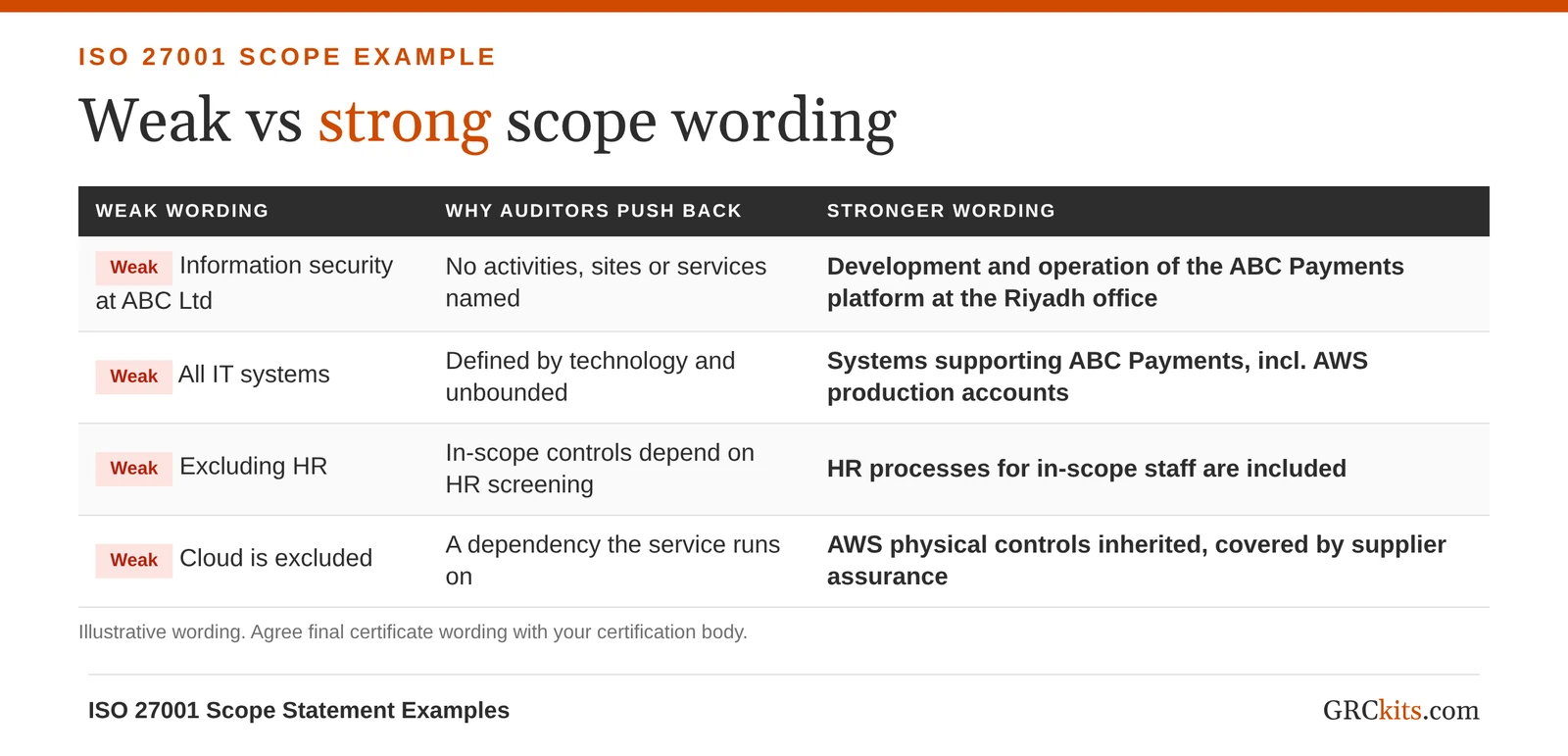
| Weak | Why auditors push back | Stronger |
|---|---|---|
| "Information security at ABC Ltd" | Doesn't say which activities, sites or services | "Development and operation of the ABC Payments platform at the Riyadh office" |
| "All IT systems" | Defined by technology, not business activity, and unbounded | "Systems supporting the ABC Payments platform, including AWS production accounts" |
| "Excluding HR" | HR handles screening, joiners and leavers, which in-scope controls depend on | Include HR processes related to in-scope staff |
| "Cloud is excluded" | You can't exclude a dependency your service runs on | "AWS-provided physical controls are inherited and covered by supplier assurance" |
Examples of Internal and External Issues for ISO 27001
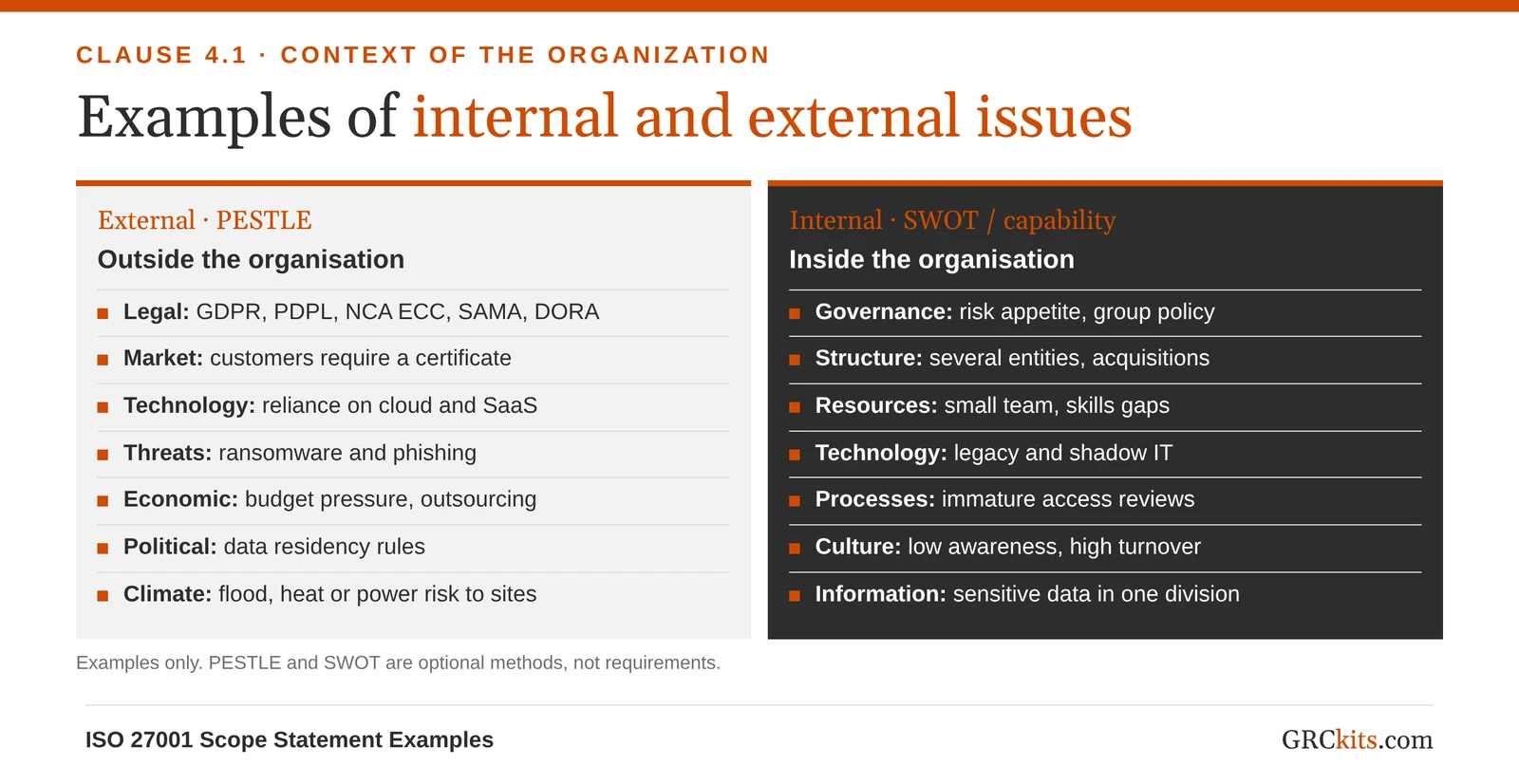
Clause 4.1 asks you to determine external and internal issues relevant to your purpose that affect your ability to achieve the intended outcomes of the ISMS. Many teams use PESTLE (Political, Economic, Social, Technological, Legal, Environmental) for external issues and SWOT or a capability review for internal ones. Neither method is mandatory; they are just practical ways to make sure nothing obvious is missed.
External issues: examples
| Category | Example issue | How it can shape the scope |
|---|---|---|
| Legal / regulatory | Data protection law (e.g. GDPR, Saudi PDPL), sector rules (e.g. SAMA, NCA ECC, DORA) | Regulated processes and data must be in scope |
| Contractual / market | Enterprise customers require ISO 27001 for a specific product | Scope built around that product |
| Technological | Reliance on public cloud and SaaS providers | Interfaces and dependencies section |
| Threat landscape | Ransomware and phishing aimed at your sector | Endpoint, email and backup processes in scope |
| Economic | Budget pressure, currency risk, outsourcing to cut cost | Outsourced activities as dependencies |
| Political | Data residency requirements, cross-border transfer limits | Hosting locations named in scope |
| Environmental / climate (Amd 1:2024) | Flooding or heat risk to a data centre, power instability | Physical sites and continuity arrangements |
| Social | Remote and hybrid working expectations | Remote workers named in the location boundary |
Internal issues: examples
| Category | Example issue | How it can shape the scope |
|---|---|---|
| Governance | Board's risk appetite, group security policy | Whole vs partial scope decision |
| Structure | Multiple legal entities or a recent acquisition | Which entities are in or out |
| Resources | Small security team, skills gaps | Phased scope, starting narrow |
| Technology | Legacy systems, shadow IT, mixed on-prem and cloud | Asset boundaries |
| Processes | Immature change management or access reviews | Influences risk treatment rather than scope |
| Culture | Low security awareness, high staff turnover | People section and awareness programme |
| Information | Highly sensitive customer data in one division | That division prioritised for scope |
Tip: Every issue on your list should lead somewhere: a scope decision, a risk, an objective or a control. An issue nobody acts on is just a list to auditors.
Interested Parties: The Other Input to Scope
Clause 4.2 requires you to determine the interested parties relevant to the ISMS, their relevant requirements, and (new in the 2022 edition) which of those requirements will be addressed through the ISMS.
| Interested party | Typical requirement | Addressed through ISMS? |
|---|---|---|
| Customers | Confidentiality of data, ISO 27001 certificate, breach notification | Yes |
| Regulators | Compliance with data protection or sector cyber rules | Yes (partly via legal register) |
| Employees | Protection of personal data, clear security rules | Yes |
| Shareholders / board | Protection of reputation and revenue | Partly (via risk reporting) |
| Suppliers / cloud providers | Clear contract terms, access rules | Yes (supplier security) |
| Insurers | Minimum controls for cyber cover | Yes |
ISO 27001 ISMS Scope Template (Copy and Adapt)
Use this structure as your ISO 27001 scope document sample. Replace the bracketed text.
ISMS SCOPE DOCUMENT
Document ID: ISMS-DOC-01 | Version: [1.0] | Owner: [CISO / ISMS Manager]
Approved by: [CEO / Top management] | Date: [dd/mm/yyyy] | Classification: Internal

1. Purpose
   This document defines the boundaries and applicability of the [Company]
   ISMS in accordance with ISO/IEC 27001:2022 Clause 4.3.

2. Scope statement
   "[The ISMS covering ... (activities/services) ... delivered from ...
   (locations) ..., in accordance with the Statement of Applicability v[x]]."

3. Organisational boundaries
   In scope:  [legal entities, departments, functions]
   Out of scope: [units] — Justification: [reason]

4. Products, services and processes in scope
   - [Service 1]  - [Supporting process: HR, IT, procurement, finance]

5. Physical boundaries (locations)
   - [Site / address / type]  - Remote working: [Yes/No, conditions]

6. Information and technology boundaries
   - Information types: [customer data, PII, source code, financial data]
   - Systems / networks / cloud tenants: [list or reference to asset inventory]

7. Interfaces and dependencies
   | Party / function | Service provided | In/Out | How the interface is controlled |
   | [Cloud provider] | [IaaS hosting]   | Out (inherited) | [Contract, assurance reports, shared-responsibility matrix] |
   | [Group IT]       | [Network]        | Out     | [Internal SLA, access rules]  |

8. Inputs considered
   - Internal and external issues: see [ISMS-DOC-02]
   - Interested parties and requirements: see [ISMS-DOC-03]

9. Exclusions and justification
   [Item] — [Why excluding it does not affect the organisation's ability to
   ensure information security within the scope]

10. Review
   Reviewed at least annually, and when there is a significant change
   (new site, product, acquisition, major outsourcing).
Writing this from scratch takes time. The ISO 27001 Full Assessment Toolkit includes the Clause 4 documents (scope statement, internal and external issues, and interested parties with their requirements) pre-written, so you only need to add your organisation's details.
How to Write Your Scope in 7 Steps
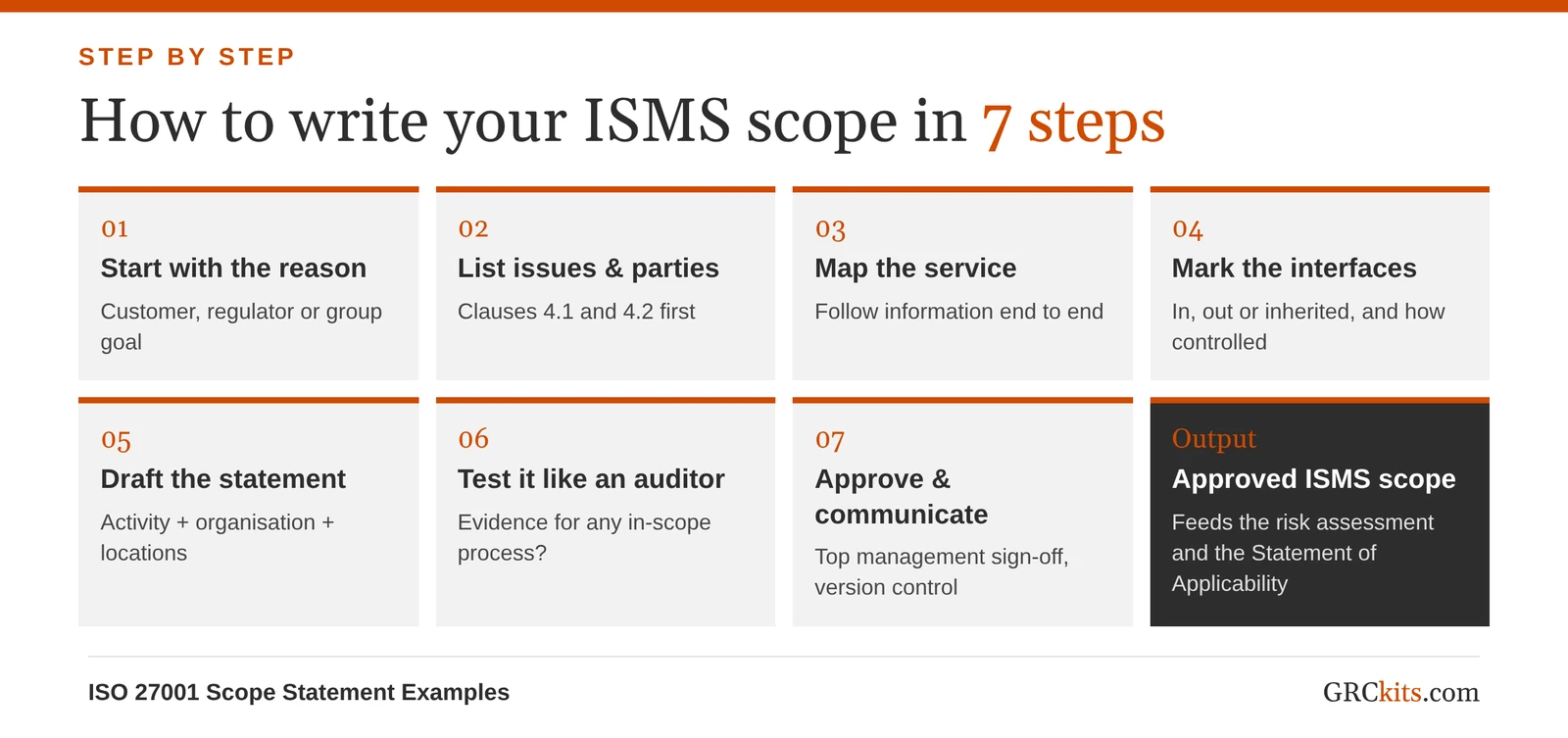
- Start with the reason for certification. Is it a customer demand for one product, a regulator, or a group-wide goal? That decides whether you go narrow or wide.
- List issues (4.1) and interested parties (4.2) first. The scope should follow from them rather than come before them.
- Map the service end to end. Follow the information from creation to deletion: people, systems, sites and suppliers.
- Mark the interfaces. At each handoff to another team or supplier, decide whether it's in scope, out of scope, or an inherited control, and how you'll control it.
- Draft the one-sentence statement. Activity + organisation + location(s). Add "in accordance with the SoA version x" if your certification body prefers that.
- Test it against an audit. Ask: "If an auditor picks any in-scope process, can we show evidence of risk assessment, controls and records?" If not, narrow the scope or fix the gaps. An ISO 27001 internal audit dashboard helps you run that test properly.
- Approve and communicate. Get top management sign-off (it supports Clause 5 leadership evidence, alongside your information security policy) and keep the document under version control.
Common Scope Mistakes Auditors Raise
- Scope too narrow to be credible. For example, certifying only the server room while customers think the whole service is covered. Certification bodies can challenge scopes that would mislead customers.
- Excluding functions the ISMS depends on. HR, IT support and procurement usually need to be in, at least in part.
- Ignoring cloud and outsourced dependencies. "We use AWS, so it's out of scope" isn't a boundary. Say what's inherited and how you get assurance.
- Scope document and SoA out of sync. If a site was added to scope, the risk assessment and SoA should show it. A control implementation tracker makes that easier to keep in step.
- No review after change. Acquisitions, new products and office moves often happen without anyone updating the scope.
- Copy-pasted examples. Auditors recognise generic templates that mention services the company doesn't offer.
Frequently Asked Questions
Is the ISO 27001 scope statement mandatory?
Yes. Clause 4.3 of ISO/IEC 27001:2022 requires the scope to be available as documented information. The format is up to you.
Can we certify only part of the organisation?
Yes. A partial scope (a product, site or department) is allowed if the boundaries and interfaces are clearly defined and the scope isn't misleading. Many organisations start narrow and extend scope at later surveillance or recertification audits.
What is the difference between ISMS scope and the Statement of Applicability?
The scope defines where the ISMS applies. The SoA lists which Annex A controls apply within that scope, with justifications for inclusion and exclusion.
Can we exclude Annex A controls from scope?
Controls aren't excluded in the scope statement. They are justified as not applicable in the SoA, based on your risk assessment. Clauses 4–10 cannot be excluded at all.
How many internal and external issues should we list?
There is no required number. A focused list of roughly 10–25 issues that actually influence decisions is usually more useful to auditors than a long generic list. This is a practical guideline, not a requirement.
Do we need to mention climate change?
Since Amendment 1:2024, Clause 4.1 requires you to determine whether climate change is a relevant issue. Record your conclusion either way, even if it is "not relevant", along with the reasoning.
How often should the scope be reviewed?
At least during each management review, and whenever there's a significant change such as a new site, product, acquisition or outsourcing arrangement.
Key Takeaways
- The scope statement is short. The reasoning behind it (issues, interested parties, interfaces) is what auditors test.
- Write the scope around business activities and services, then add locations, information and technology.
- Make cloud and outsourced dependencies explicit instead of simply excluding them.
- Keep scope, risk assessment and SoA aligned, and review them after every major change.
Next step: Draft your issues and interested parties list this week, then use the template above to write your scope. For the full set of mandatory documents in one place, see the ISO 27001 Full Assessment Toolkit, and for the overall roadmap read our ISO 27001 implementation guide.

Written by
Shahidul Shubo
Cybersecurity GRC Consultant
Shahidul Shubo is a Cybersecurity GRC Consultant with 10+ years of experience in information security governance, risk management, regulatory compliance and IT audit, and has audited more than 120 organisations. He is CISA and CISM certified, an ISO/IEC 27001 Lead Auditor and Lead Implementer, and a Lead Auditor for ISO/IEC 27701, ISO/IEC 42001, ISO 22301 and ISO 9001. His technical credentials include AWS Solutions Architect, AWS Security Specialty, Red Hat RHCA and RHCE, Fortinet NSE and CCEP. He works hands-on with ISO 27001, NIST CSF and NCA ECC, and builds the practical templates and assessment tools published on GRCkits.
Connect on LinkedInNeed hands-on help?
Information Security Management System (ISMS)
Design, implement and certify an ISO/IEC 27001 ISMS that protects the confidentiality, integrity and availability of your information.
Request a quote